




Food Delivery Robots - Benefits, Challenges, Use Cases, Cost, and More
Dec 2025





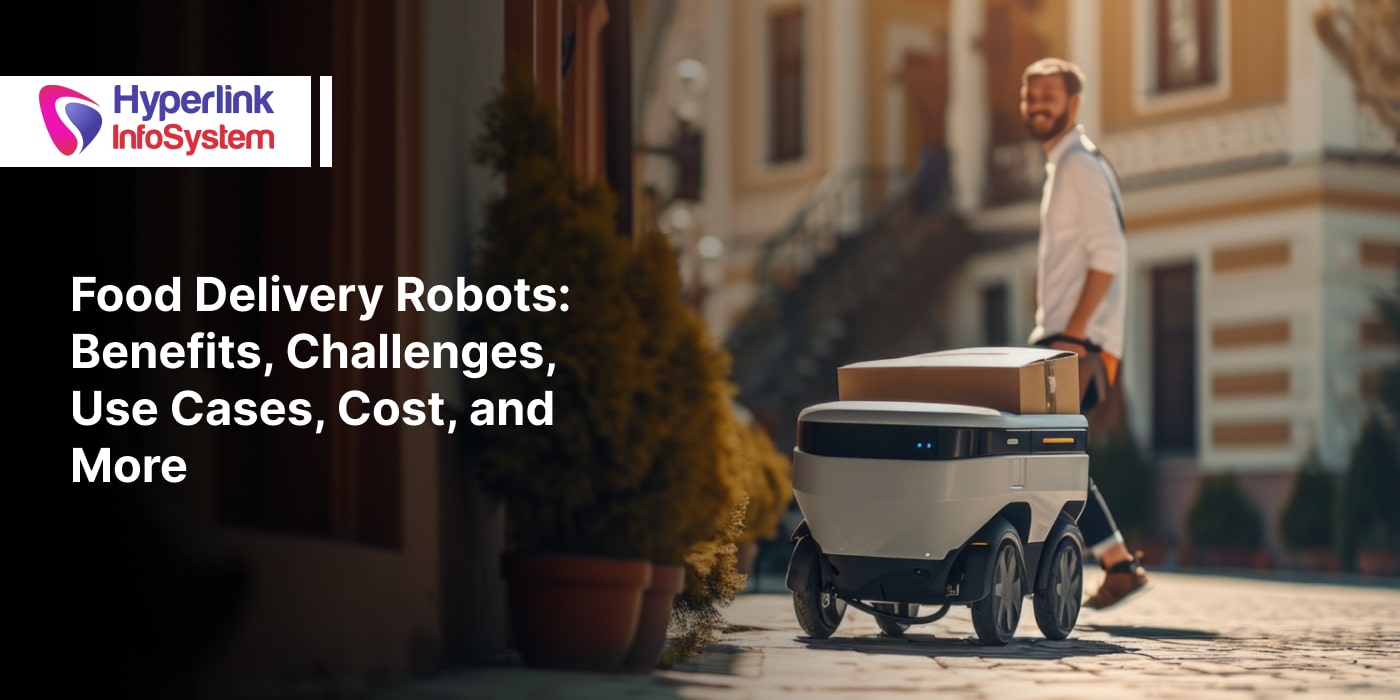

The food industry has changed drastically in the past 10 years. Since the pandemic, customer order patterns have changed, and food businesses have been forced to adapt. No business can make customers wait for 30 minutes to an hour for their orders. Thank God those days are over. Autonomous food delivery robots are becoming the hot favorites to deliver food orders. The online food delivery market’s revenue is expected to increase from $1.40tn trillion in 2025 to reach $2.02 trillion by 2030. Managing huge food volumes manually is not possible. Autonomous food delivery robots are the solution.
The global autonomous delivery market is expected to grow from $795.6 million in 2025 to $3.236.5 million in 2030. Every business can benefit greatly from implementing food delivery robots in its operations. These businesses include restaurants, cafes, takeaways, hotels, and ghost kitchens. Fuel prices are rising, and so are labor costs. Does this mean companies can refuse deliveries in far or hard-to-reach areas? If they do, it will negatively affect their reputation. Autonomous food delivery robots will reduce costs and ensure timely last-minute deliveries while ensuring sustainability.
Yes, autonomous food delivery robots have plenty of advantages, but they have their share of challenges. The trick lies in identifying business needs, learning how to use food delivery robots, and implementing them correctly in business operations. This blog will touch on multiple aspects related to autonomous food delivery robots. This includes challenges, benefits, costs, and more. Let’s get started.
How Do Autonomous Food Delivery Robots Work?
Let’s begin by understanding what food delivery robots are. There are autonomous and semi-autonomous food delivery robots. Autonomous food delivery robots can work without human intervention. On the other hand, semi-autonomous food delivery robots work independently but can be monitored by humans when required.
Businesses use autonomous food delivery robots to deliver food and groceries to customers’ addresses. How do they work? They use a combination of AI, sensors, cameras, GPS, and machine learning. This helps the robots move safely and identify obstacles in their path. No route is without obstacles. Sidewalks, vehicles, trees, animals, and houses may force robots to adopt a different route. Smart robots can effectively overcome these obstacles and deliver customer orders safely and on time.
Below is a brief explanation of how automated food delivery robots work.
1) AI and Sensors
Food delivery robots don’t use just one or two technologies. They use multiple technologies to deliver customer orders. Let’s delve deeper into what these technologies are.
- Cameras - Cameras capture visuals of everything from humans, animals, vehicles, and houses.
- LIDAR - LIDAR reflects light off surfaces to create a 3D map of the location and its surroundings.
- GPS - Tells the robot about the exact location of the customer and the route it should take to reach there.
- AI Algorithms - Intelligent algorithms process vast volumes of data in real time. This enables the autonomous robot to make the right decisions.
2) Navigation and Mapping
Autonomous food delivery robots are trained on vast data sets, including the city’s digital maps. From sidewalks, slopes, streets, to signals, the robots map every single corner of the city. Whenever the delivery robot is assigned a delivery, it does the following:
- Calculates and determines the best route from the delivery center to the customer’s location.
- Sensors analyze the route and check for any changes/hurdles. Accordingly, the robot adjusts its path.
- While attempting deliveries on the sidewalk, the robot’s cameras and sensors check for obstacles. In case it faces animals or humans, the robot moves away from them.
Autonomous food delivery robots use a process called SLAM (Simultaneous Localization and Mapping). This process enables the robot to know its location while being in motion.
3) Control Systems
Control systems within the food delivery robots ensure their smooth functioning. What does the control system do? It helps accomplish the following goals:
- Safety - The autonomous robot has in-built features to avoid hitting objects and people
- Efficiency - Determines the best route to reach the customer’s address.
- Stability - Handles obstacles easily without bumping into them.
Sometimes, the autonomous delivery robot may face obstacles or unexpected situations. It may experience traffic jams, road repairs, or customer work. These activities may cause delivery robots to deviate from their assigned path. In such cases, it sends the data to a human operator. The operator will provide further assistance (for rerouting and other tasks).
4) Communication and Delivery
With 4G/5G or even Wi-Fi, the food delivery robot connects with the cloud. Connecting to the cloud helps the robot coordinate with external food delivery apps like Swiggy and Uber Eats.
- Customers can track orders minute by minute on their smartphones.
- The food delivery robot sends a notification after arriving at the customer’s location.
- Customers will have to enter the code they receive on their smartphone. Entering the code will unlock the lid and allow them to collect the food parcel.
After the food delivery robot completes the delivery, it returns to its base. Otherwise, it proceeds to the next delivery/pickup point.
5) Power and Maintenance
The vast majority of autonomous food delivery robots rely on rechargeable lithium batteries for power. On average, each charge lasts for almost 8 to 12 hours. When the robot's battery starts to run out of power, it makes its way to the charging station. Technicians and maintenance personnel perform regular maintenance.
Regular maintenance keeps the food delivery robot ready for deliveries. It also reduces the chances of breakdowns and performance issues. Maintenance tasks include the following:
- Hardware Upkeep - Clearing and lubrication, sensor/hardware inspections, battery management, and replacing components if required.
- Software Management - System diagnostics, refining AI and ML models, software updates, plus mapping and navigation updates.
- Fleet Management - Includes predictive maintenance, remote assistance, performance monitoring, and issue tracking.
Interested in implementing food delivery robots in your organization? Consider partnering with a top AI development company.
8 Benefits of Implementing Food Delivery Robots
Below are some benefits of implementing food delivery robots in business operations.
1) Reduced Delivery Costs
- Robots reduce labor and fuel costs. This makes deliveries cost-effective for food businesses.
- Automation enables businesses to be profitable even with increased operational costs.
2) Faster and Consistent Deliveries
- Robots don’t experience fatigue. Robots don’t take breaks and work 24/7.
- This ensures accurate and timely deliveries. Customers remain satisfied.
3) Environment Friendly
- Most food delivery robots run on electricity. This ensures almost zero direct emissions.
- This ensures that food businesses achieve their sustainability goals. It also reduces the company’s carbon footprint.
4) Improved Safety and Hygiene
- Robots ensure contactless deliveries. No human interaction required.
- Zero-contact deliveries are ideal during pandemic-like situations or outbreaks.
5) Enhanced Customer Experience
- Allows customers to track deliveries in real-time. Customers can also unlock robots using secure apps.
- Deliveries via robots grab people’s attention. It cements the brand’s reputation as tech-savvy and modern.
6) Operational Efficiency
- Food delivery robots can handle several short-distance orders at the same time.
- Food businesses can serve more customers without hiring additional staff.
7) Data-Driven Insights
- Food delivery apps gather real-time data related to deliveries and routes.
- Data-driven insights optimize delivery times and energy use.
- Robust data insights also help companies identify their target audience.
8) Scalability and Reliability
- Once a company deploys a robot fleet, it can expand as per business needs. It can accomplish this without incurring additional costs.
- Thanks to this fleet of food delivery robots, the company can ensure optimal productivity and performance at all times. Busy hours and manpower shortages won’t impact operations much.
Thinking about deploying food delivery robots for your business? Consider partnering with an artificial intelligence development company to build custom delivery robots.
6 Types of Food Delivery Robots
There are many types of food delivery robots available in the market. Depending on the design, mobility, and delivery environment, there are 6 main types of food delivery robots. They are as follows.
1) Sidewalk Delivery Robots
These are food delivery robots with small wheels. Such robots usually operate on sidewalks or spaces reserved for pedestrians. Most sidewalk delivery robots are deployed to deliver parcels nearby. Examples include restaurants, cafes, and customers in the vicinity.
2) Autonomous Delivery Vehicles
Autonomous delivery vehicles are large food robots that drive on the roads. They are ideal for medium-distance deliveries or locations in the city.
3) Aerial Drones
Aerial food delivery drones travel in the air and make deliveries possible. These aerial drones ensure faster deliveries as they don’t have to face traffic. Moreover, they also deliver in remote or hard-to-reach areas.
4) Indoor Food Delivery Robots
Indoor food delivery robots are perfect for deliveries in large multi-storey buildings or vast campuses. Examples of such establishments include hotels, hospitals, and corporate offices. Using these robots, organizations can ensure effective room service or delivery within internal departments.
5) Campus Robots
Campus or closed-environment robots typically operate in controlled environments. Examples of controlled environments include university campuses or tech parks. When a food business has to attempt multiple deliveries within a stipulated time, these campus robots are useful.
6) Smart Lockers/Autonomous Pickup Stations
Smart lockers are stationary robotic units. Food businesses store multiple orders that are ready for pickup. Smaller bots arrive and take away these food parcels for delivery.
Which type of food delivery robot do you want to build for your business? Hire AI developers for your custom food delivery robot development.
9 Use Cases of Autonomous Robots in the Food Delivery Industry
Below are the 10 most important use cases of autonomous robots in the food delivery industry.
1) Last-Mile Deliveries
Autonomous ground robots attempt last-mile deliveries. In simple language, it means these robots deliver meals directly to the customer’s doorstep. They offer several advantages, including reduced delivery costs by 30 to 50 percent.
No matter the time of day, the business can ensure smooth and continuous operations. With these robots, companies can ensure greater delivery accuracy and within the estimated time.
2) Campus and Corporate Deliveries
Food businesses can leverage small robots to deliver parcels in educational institutions such as university campuses or tech parks. Students and corporate employees can get food easily and on time. Most importantly, these food delivery robots can avoid traffic to get to their destinations faster while reducing carbon emissions.
3) In-Restaurant Automation
Restaurants are busy for the most part, especially on weekends. Often, the wait staff may not be able to handle the increased workload. Autonomous robots can pick up food from the kitchen and deliver it straight to the customer’s table.
Besides reducing waiter workload, these robots ensure faster service. In a post-pandemic world, these robots ensure optimal hygiene. All of these factors ensure top-notch customer service while introducing an element of uniqueness.
4) Back of House Logistics
Restaurant backend operations involve a lot of repetitive tasks. These tasks include moving objects such as dishes, fetching ingredients, and disposing of waste. Not only do these robots optimize kitchen workflows, but they also cut down on labor costs. Lastly, they also prevent untoward incidents such as trips, falls, and other accidents.
5) Parking Lot Delivery
Autonomous food delivery robots collect orders from restaurants and other food businesses. They then deliver the orders to customers waiting in their vehicles in public spaces such as parking zones. In this way, these robots ensure streamlined takeout operations while reducing customer wait time (especially during busy hours).
6) Urban Micro-Delivery Hubs
Many times, food from small kitchen hubs, aka dark kitchens, must reach other delivery spots. Since the delivery area is small, robots can ensure faster and more efficient deliveries. Additionally, robots minimize the need for drivers. Robots can handle deliveries for short trips.
7) Drone-Based Food Deliveries
Drone robots can deliver food to remote places or areas that are hard to navigate for humans. These drones don’t have to wait endless hours in traffic. Also, companies can use it to deliver supplies in areas affected by earthquakes, floods, fires, and other disasters.
8) Data-Powered Analytics
Autonomous robots equipped with AI and IoT sensors can identify the best delivery routes. This minimizes energy use while ensuring the safety of food parcels. Not to mention reduced carbon footprint.
Moreover, food companies can leverage real-time data to optimize delivery operations. They can avoid crowded/slower routes. On top of that, the robots provide insights into locations where customers may place a higher number of orders. Delivery companies can route robots to such locations.
9) Smarter Collaboration
Robots integrate seamlessly with systems that use advanced technologies such as AI and digital twins. With these systems, food businesses can predict the time and location of future orders. Accordingly, they can assign robots to manage these tasks.
Such efficient collaboration results in efficient operations. Labor and robots are used properly to maximize performance and productivity. As the business grows, companies can add more robots to the fleet without any confusion.
Do you want to implement food delivery automation with AI for your organization? Consult a reputed AI development company to know more.
8 Challenges Faced When Implementing Food Delivery Robots
In the above sections, we discussed the various benefits and use cases of food delivery robots. There is no denying the significance and benefits of food delivery robots in the food industry. However, implementing robots in food delivery operations has its share of challenges. Below are some of the challenges.
- Navigating Complex Environments
Food companies can use advanced AI mapping techniques and real-time obstacle detection systems to help robots navigate complex environments.
- Handling Weather Conditions
Delivery robots can fail in bad weather. Water and heat can take a toll on them. Hence, companies should use heat-resistant and waterproof robots to complete deliveries. Additionally, the robots must be equipped with smart systems that help them adapt to changing weather conditions.
- Battery Life Limitations
Many times, robots cannot work for long because their batteries die out. Engineers can solve this problem to make the robot work more efficiently. Options such as quick charging or having spare batteries can ensure smooth and continuous operations.
- High Deployment Costs
Deploying food delivery robots demands high infrastructure and implementation costs. Food businesses can solve this problem by deploying a high number of robots. Along with scaling the number of robots, shared infrastructure can also reduce the per-unit cost (ultimately reducing overall costs).
- Public Safety and Liability Concerns
Robots must follow rules to ensure the safety of people around them. They must stop at signals and when getting close to people. At the same time, these robots must ensure regulatory compliance.
- Limited Delivery Range
The solution to this problem lies in efficient planning of delivery routes. Also, robots must be designed with modular capabilities. This will allow it to add/remove compartments based on order size.
- Data Privacy Issues
Protect data with strong encryption. This will ensure that only authorized employees can view and edit the details while ensuring privacy.
- Sustainability Concerns
Food businesses must ensure sustainability by investing in renewable energy sources. Using recyclable materials in daily operations will also benefit the environment. Ultimately, these measures will also earn customer trust.
Are you facing challenges related to food delivery robot implementation? Partner with a professional food delivery robot automation consultant for the best results.
Cost of Implementing Food Delivery Robots in Business Operations
In broad terms, the cost of implementing food delivery robots depends on the model. Below are the three most common models.
- Custom Configuration Model - $2,500 - $12.500
- Lease/Monthly Configuration Model - $700 - $1,200/month per robot
- Third Party Robot Delivery Service Model - $0.50 - $3.00 per delivery range
The cost of food delivery robot implementation mentioned above is just to give our readers a brief idea. It is advisable to consult a reputed AI development company for better clarity.
Final Thoughts
In the above sections, we discussed the benefits, challenges, use cases, and costs of implementing food delivery robots. With that being said, choosing a food delivery robot requires careful thought and consideration. Depending on the target audience, business needs, delivery distance, and budget, companies must choose the right food delivery robot. Trying to do everything single-handedly is unwise. It is better to entrust the responsibility to an AI development company.
Besides the above, companies must also take into account regulatory requirements, maintenance, and support, along with the customer interface. That is not all. Just because a competitor is using a food delivery robot does not mean others should blindly jump on the bandwagon. Conducting a detailed ROI analysis before investing in food delivery robots is a must. This detailed analysis will ensure that companies make the right decision. Also, it will help convince stakeholders about these major investments and what to expect after implementation.
Finally, it is crucial that companies test the food delivery robot before deployment. Create a pilot area and instruct the robot to perform real tasks. Human intervention is a must, and so is data collection. Gather feedback and adapt. This is the game plan companies can follow to implement food delivery robots. Is your business interested in leveraging food delivery automation with AI? Schedule a consultation now.

Frequently Asked Questions
AI voice ordering for restaurants refers to a system that uses AI to take customer orders. Customers do not have to type in information. All they need to do is use their voice to convey their needs over the phone/kiosks. The order will go through without the need for human staff.
The cost of AI development services depends on project complexity, scope, duration, location, and other factors. Below is the cost of AI development services in India and other locations.
- India - $15 - $20/hour
- USA - $60 - $150/hour
- Europe - $70 - $150/hour
- Latin America - $40 - $80/hour
Self-driving food delivery robots are autonomous vehicles. These vehicles use a combination of technologies, including sensors, cameras, and AI. This helps the robots navigate routes effectively and deliver food parcels to customers. The best part is that deliveries do not require human intervention.
An intelligent AI model gathers data and learns over time. Also, it can learn, reason, and make informed decisions. All these decisions are based on data, making them accurate.
The future of AI in food delivery robots looks bright. Below are some food delivery robot trends to look forward to.
- AI and smart system integration
- Improved hardware and industry-specific features
- Wider deployment
- Business model changes
- Regulatory adaptation
Measuring the ROI of delivery robots is quite complex. To put it in simple terms, companies can measure the ROI of autonomous food delivery robots by comparing the benefits with the costs. For example, a company must first determine how much money it has saved or earned after deploying food delivery robots. Now, compare the benefits/savings against the costs of buying the robots plus operational, maintenance, and other costs. The difference between the two is the ROI.
Harnil Oza is the CEO & Founder of Hyperlink InfoSystem. With a passion for technology and an immaculate drive for entrepreneurship, Harnil has propelled Hyperlink InfoSystem to become a global pioneer in the world of innovative IT solutions. His exceptional leadership has inspired a multiverse of tech enthusiasts and also enabled thriving business expansion. His vision has helped the company achieve widespread respect for its remarkable track record of delivering beautifully constructed mobile apps, websites, and other products using every emerging technology. Outside his duties at Hyperlink InfoSystem, Harnil has earned a reputation for his conceptual leadership and initiatives in the tech industry. He is driven to impart expertise and insights to the forthcoming cohort of tech innovators. Harnil continues to champion growth, quality, and client satisfaction by fostering innovation and collaboration.
Latest Blogs

Is BlockChain Technology Worth The H ...
Unfolds The Revolutionary & Versatility Of Blockchain Technology ...

IoT Technology - A Future In Making ...
Everything You Need To Know About IoT Technology ...
Feel Free to Contact Us!
We would be happy to hear from you, please fill in the form below or mail us your requirements on info@hyperlinkinfosystem.com
Hyperlink InfoSystem Bring Transformation For Global Businesses
Starting from listening to your business problems to delivering accurate solutions; we make sure to follow industry-specific standards and combine them with our technical knowledge, development expertise, and extensive research.

4500+
Apps Developed

1200+
Developers

2200+
Websites Designed

140+
Games Developed

120+
AI & IoT Solutions

2700+
Happy Clients

120+
Salesforce Solutions

40+
Data Science

