




Why Does Every Business Needs A CRM Software?
Jan 2026




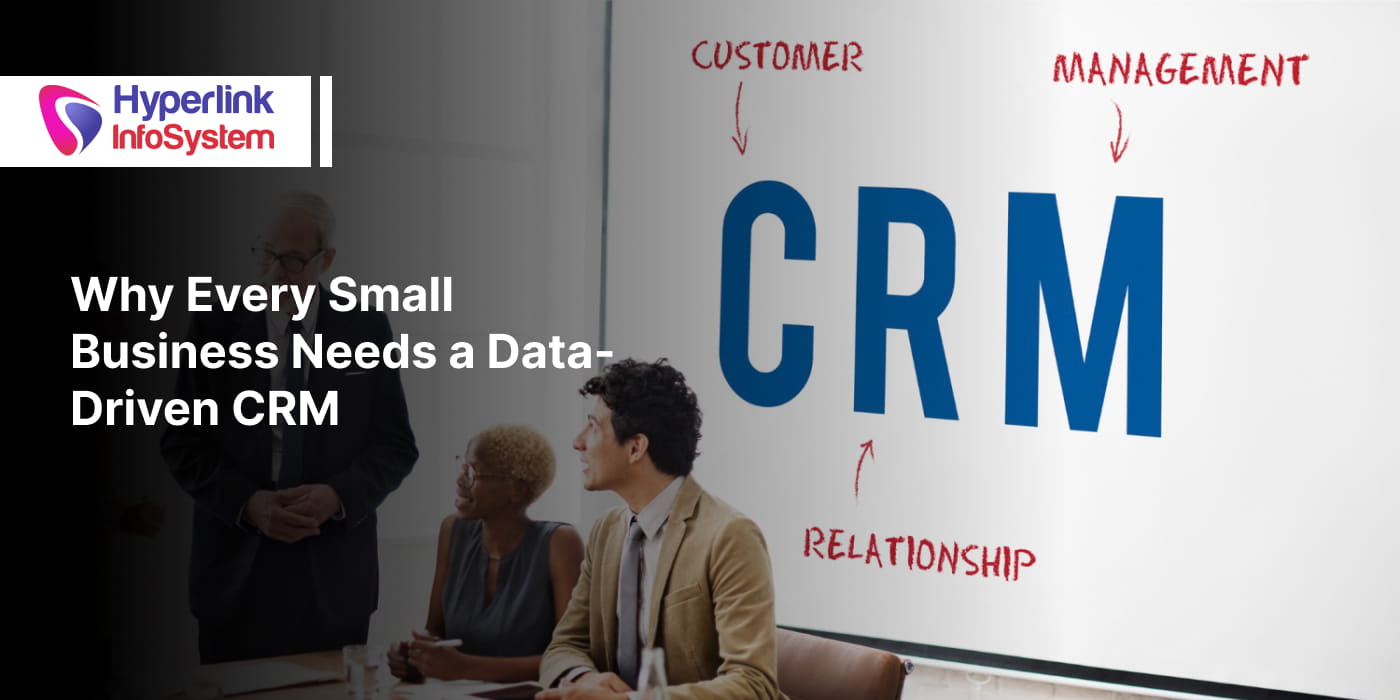
Most business owners believe that only large businesses need a CRM due to the complexity of their operations. However, that is a huge misconception. Large companies and corporations need CRMs to manage complex business operations and scale effectively. But why do small businesses need CRMs? Even small businesses have to endure cut-throat competition. They aim to expand and streamline their operations.
The CRM market is expected to grow from $98.84 billion in 2025 to $145.37 billion in 2030. These figures are proof that companies are willing to invest in CRM software to understand customers and improve marketing efficiency. 91% of companies with 10 or more employees use CRM software. Also, many companies have begun to realize that cookie-cutter solutions will not solve business problems. Hence, they partner with a CRM development company for custom solutions.
A custom CRM solution does not compel companies to adjust their workflows as per its features. The features are built to align with the company’s workflows. Scalability, integration, and having total control over data turn out to be cost-effective without compromising efficiency. This blog will discuss the benefits of a small business CRM, ideal features, reasons to invest in a CRM, and more. Let’s get into the nitty-gritty.
What is a small business CRM?
A small business CRM is custom-built to meet the specific needs of small businesses. Most small businesses don’t make the best use of data. All customer and operations-related data lies scattered across multiple systems, spreadsheets, and paper records. Departments work in silos, and everyone has different versions of the data.
A CRM system built with small businesses in mind enables companies to manage customer relationships effectively. At the same time, the CRM provides access to accurate and real-time data. Using these real-time insights, small businesses can identify their target audience, understand their needs, and determine how they interact with the business. Below is what real-time data can do for companies.
- Target them with personalized offers and promotions.
- Track prospects and follow up with them.
- Provide faster and personalized support.
How does a CRM for a small business work?
A CRM for small businesses should be easy to use with only the necessary features. Other than its lightweight nature, such a CRM stores all the company data, including customer interactions, leads, follow-ups, and more. Even though the CRM holds vast amounts of data, it doesn’t confuse users because they only see features and data that are relevant to their job roles.
A small business CRM usually has a simple and intuitive design. Details on the CRM are displayed in a timeline view that includes only the necessary information. These details include follow-ups, reminders, deadlines, and others. Furthermore, simple search and filter options make it easy to find information.
Unlike enterprise CRMs, a CRM for small businesses does not have complex customization options such as multiple configuration options or heavy infrastructure/technical setup.. Nor does it boast advanced analytics. A small business CRM is built to naturally blend into the company’s style of working rather than the other way around.
Even non-technical people can adopt it with minimal training. This eliminates the need for companies to hire a full-time developers. While the CRM works in the background, employees can perform their tasks easily without sacrificing productivity or efficiency.
How Do CRMs for Small Businesses Differ from Large Enterprise CRMs?
As stated above, a CRM for small businesses has fewer complex features, but that is just an oversimplification. Below are some ways in which small business CRMs differ from their enterprise-level counterparts.
- Simplicity Over Complexity - Small business CRMs are simple and easy to use because of the small scale of operations. On the other hand, enterprise CRMs need customization options to handle multiple features and modules while offering scalability.
- Pricing - Small businesses cannot afford to spend hundreds to millions of dollars on CRM solutions. A small business CRM is a blessing because it's relatively affordable with monthly pricing. In contrast, enterprise CRM systems demand significant upfront costs, including licensing and contracts.
- Simple Integrations Vs. IT Setup - While small business CRMs are easy to integrate using the plug-and-play option, enterprise integration is not that simple. It requires an extensive IT setup and continuous maintenance.
- Simple Data Fields and Workflows - CRMs for small businesses have only the basic fields such as name, address, phone number, email, and an odd additional details section. This keeps it simple and clutter-free. The same goes for reporting. Whereas in enterprise CRMs, there is scope for customization. Creating extra fields, data categories, and pipelines is possible.
- Reporting - For small businesses, CRM systems remain simple, and the basic features are enough to streamline operations. However, for enterprises, developers tweak the CRM to ensure it meets the specific needs of every business. Examples of complex features in enterprise CRMs include advanced analytics and forecasting models.
Want to know which is the right CRM for your small business, or build a custom CRM for your organization? Partner with a leading CRM development company to get the best results.
8 Must-Have Features in a CRM for Small Businesses
CRMs for small businesses have basic features, but they should enable the business to achieve its bespoke goals. Simplicity is great, but it should not come at the expense of efficiency. Below are the 8 must-have features in a CRM for small businesses.
- Content and Lead Management
Central repository to store customer data, history, and past interactions. The CRM should help companies divide customers into various segments, such as prospects, active, and loyal customers etc.
- Sales Pipeline and Deal Tracking
A visual pipeline to help employees manage sales prospects with a drag-and-drop board. Depending on the journey, the prospects should move through different stages for better tracking.
- Task and Activity Management
Provides reminders for calls, follow-ups, and meetings to help companies stay on top. Automated scheduling integrates appointments into customer records to facilitate efficient tracking.
- Email Integration and Tracking
Syncs emails between CRM and email accounts. It also tracks whether recipients read, clicked, opened, or replied to emails.
- Mobile App Access
Sales reps and other employees can manage customers on their smartphones. Offline mode allows field teams to access and update data without access to the internet.
- Automation
Automatically sends emails after certain actions and assigns leads to the right department based on rules.
- Communication Tools
Ensures seamless communication across multiple channels, including calls, messages, and social media channels. Stores all details in a single repository.
- Analytics and Reporting
Analytics provide detailed information about sales performance. Detailed reports shed light on top customers, loyal customers, and churn risks.
- Integration with Existing Tools
Integrates with existing tools such as QuickBooks, MailChimp, and e-commerce ports such as WooCommerce.
- Scalability and Customization
Must be flexible enough to allow the addition of new users, fields, or workflows as the business expands. Must include customizable dashboards, pipelines, and reports.
10 Reasons why small businesses need a Data-Driven CRM
What do CRM solutions bring to the table? Everyone is aware of the benefits, but many businesses want to know how a bespoke CRM benefits them. Below are some reasons why small businesses need a data-driven CRM.
- 360-Degree Customer View
Tracks customer interactions across multiple touchpoints, including calls, emails, social media, and more. This eliminates silos to enable data collection for informed decision-making.
- Smarter Forecasting
Analyzes historical data and uses predictive analytics to predict sales figures and cash flow with greater accuracy.
- Personalized Customer Journeys
Ends the bulk messaging and email approach. Tailors messaging to suit customer behavior and preferences.
- Early Churn Detection
Identifies key changes in customer behavior, such as reduced engagement or fewer purchases. Based on the data, customers can take the right steps to retain customers.
- Optimal Resource Allocation
Highlights the products, advertising campaigns, or customer segments that generate the highest ROI for the company. Depending on these insights, the company allocates the right budgets to each department.
- Scalable Growth
Helps a business stay organized by leveraging automation. This facilitates smooth and easy scaling as the business expands.
- Enhanced Collaboration
Allows teams to access customer data. This ensures that all teams, including sales, customer support, marketing, and others, are on the same page.
- Compliance
Since all the data lies in a single location, it becomes possible for customers to furnish all of it when required. This makes regulatory reporting and auditing simple and stress-free.
- Operational Visibility
If numbers indicate negative signs for business, such as inefficiencies or bottlenecks, companies can address them quickly to prevent escalations.
- Competitive Edge
With a data-driven CRM, small and emerging businesses can compete with industry bigwigs without incurring significant costs.
Do you want a tailored CRM for small businesses to experience the above benefits? Consider partnering with the top software development company in your location.
Parting Thoughts
Small businesses are at a very early stage of business where one mistake can mean the end. There is no room for mistakes. This is why a CRM is necessary for small businesses. Don’t think of them as just a repository to hold customer data. It provides the necessary tools for company owners to track key metrics and ensure the business is on the right track.
That said, choosing the right CRM for your small business may be complicated. The main reason for this is the abundance of CRM options, making it hard for business owners to choose the best option. Ease of use, integration capabilities, customization, scalability, and data security are some points that business owners must consider when choosing a CRM solution. Hiring dedicated software developers may be the right strategy if the company has the necessary funds.
If hiring dedicated developers and other professionals is not cost-effective, companies can consider teaming up with a software development company. However, such a company must have prior experience in designing custom CRM solutions. Speak with multiple providers, see what they have to offer, and choose the option that suits your business needs.

Harnil Oza is the CEO & Founder of Hyperlink InfoSystem. With a passion for technology and an immaculate drive for entrepreneurship, Harnil has propelled Hyperlink InfoSystem to become a global pioneer in the world of innovative IT solutions. His exceptional leadership has inspired a multiverse of tech enthusiasts and also enabled thriving business expansion. His vision has helped the company achieve widespread respect for its remarkable track record of delivering beautifully constructed mobile apps, websites, and other products using every emerging technology. Outside his duties at Hyperlink InfoSystem, Harnil has earned a reputation for his conceptual leadership and initiatives in the tech industry. He is driven to impart expertise and insights to the forthcoming cohort of tech innovators. Harnil continues to champion growth, quality, and client satisfaction by fostering innovation and collaboration.
Latest Blogs


Is BlockChain Technology Worth The H ...
Unfolds The Revolutionary & Versatility Of Blockchain Technology ...


IoT Technology - A Future In Making ...
Everything You Need To Know About IoT Technology ...
Feel Free to Contact Us!
We would be happy to hear from you, please fill in the form below or mail us your requirements on info@hyperlinkinfosystem.com
Hyperlink InfoSystem Bring Transformation For Global Businesses
Starting from listening to your business problems to delivering accurate solutions; we make sure to follow industry-specific standards and combine them with our technical knowledge, development expertise, and extensive research.

4500+
Apps Developed

1200+
Developers

2200+
Websites Designed

140+
Games Developed

120+
AI & IoT Solutions

2700+
Happy Clients

120+
Salesforce Solutions

40+
Data Science

