




Walk into any enterprise technology conversation right now and someone will mention AI Agents or AI Copilots within the first five minutes. Usually both, often interchangeably. That's a problem - because these two things are genuinely not the same, and deploying one when you needed the other is an expensive way to learn the difference.
Here's where most companies are: they know AI matters, they've seen the demos, maybe they've run a pilot or two. What they haven't done is get clear on which kind of AI fits which problem. That's what this article is for.
Quick background: enterprises spent years building automation on rule-based systems and RPA. Those tools worked - until the process changed, and then you were basically starting over. Every exception needed a human. Every edge case was a ticket.
What AI brought to the table was adaptability. These systems don't just follow a script; they interpret, infer, and in some cases, act independently. But "AI" is doing a lot of heavy lifting as a word. A Copilot that helps someone write a better email and an Agent that autonomously processes thousands of invoices are operating on entirely different principles, with entirely different risk profiles. Today, businesses are increasingly turning to a custom AI development company to build solutions tailored to their specific workflows — rather than forcing generic tools to fit.
Both use large language models. Both connect to enterprise data. That's roughly where the similarities end.
Getting this wrong doesn't just slow down your AI program - it erodes internal trust, creates governance headaches, and burns budget that could've delivered real results. So let's actually sort it out.
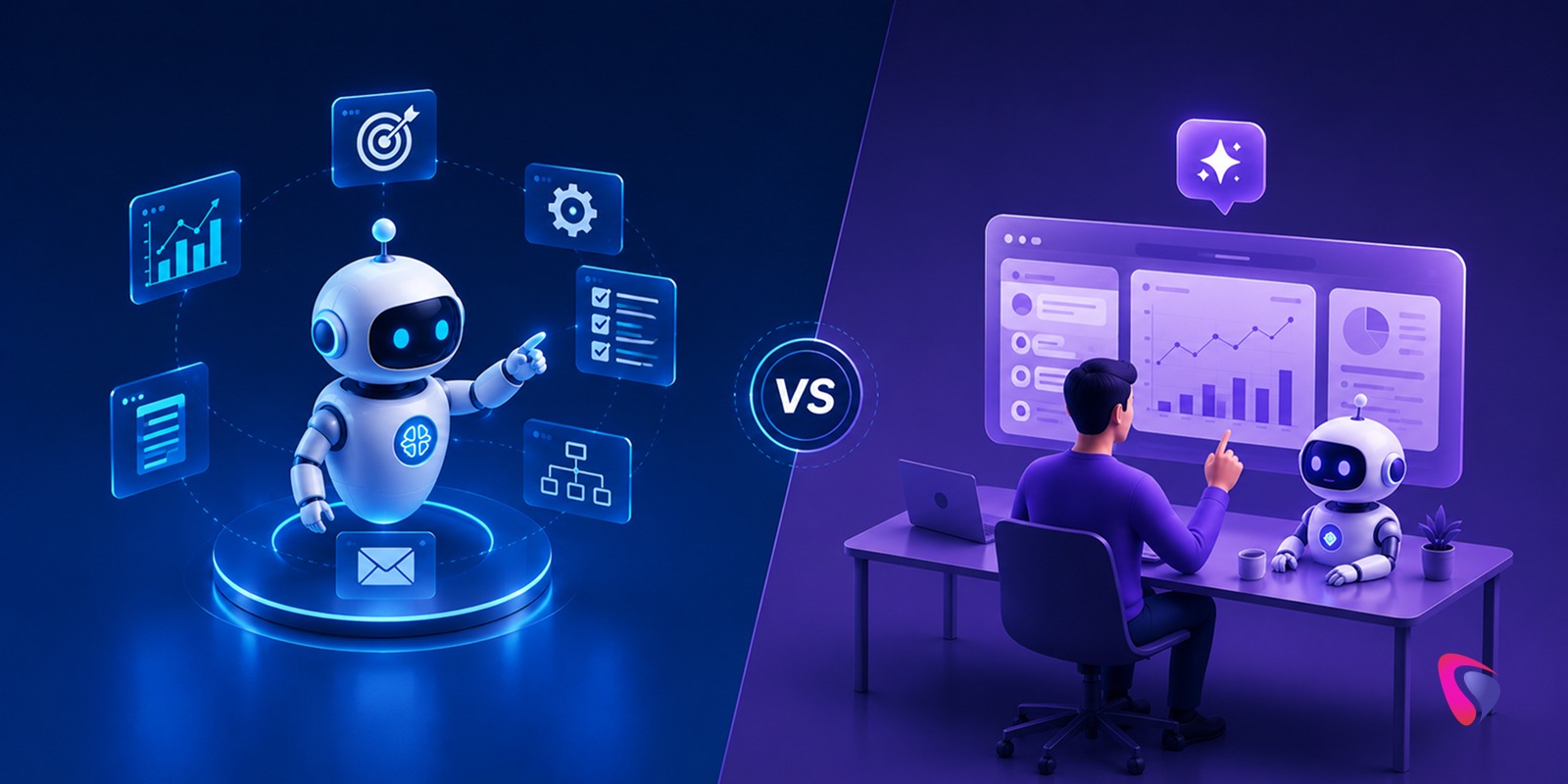
AI Agents vs AI Copilots: Core Differences
| Factor | AI Copilots | AI Agents |
|---|---|---|
| Primary Purpose | Assist users with tasks | Execute tasks autonomously |
| User Dependency | High | Low |
| Decision-Making | Human-led | AI-led |
| Autonomy Level | Limited | High |
| Workflow Execution | Assists execution | Performs execution |
| Human Oversight | Continuous | Periodic |
| Context Awareness | Session-based | Persistent and adaptive |
| Productivity Impact | Individual efficiency | Process automation |
| Enterprise Role | Digital assistant | Digital workforce |
| Business Outcome | Faster work completion | End-to-end automation |
One word separates these two: autonomy.
Copilots are built around a human making the final call. The AI drafts, suggests, summarizes, generates - and then you decide what to do with it. It's collaborative. The human is never out of the loop because that's the design, not a limitation.
Agents work on a fundamentally different premise. You give them an objective. They figure out the steps, interact with your systems, watch what happens, course-correct. There's no approval gate at each action. That's not a bug - it's literally why you'd choose an Agent over a Copilot.
So the "which is better" question is a bit of a trap. Better for what?
- AI Copilots help employees work smarter.
- AI Agents help businesses operate smarter.
Those sound similar. They're not. One is about lifting individual performance. The other is about redesigning how operations run. Both have enormous value - just in different places.
Risks Associated with AI Copilots
Overreliance on AI Recommendations
It starts subtly. The AI keeps giving reasonable outputs, employees stop reviewing as carefully, and gradually the human check becomes more of a rubber stamp than an actual review. Nobody decides to stop paying attention - it just happens.
And then something slips through:
- A report with wrong figures that got presented to leadership because it looked right
- A compliance issue that nobody caught because the review had become perfunctory
- A customer email that reflected what the model assumed rather than what the company actually intended
This is probably the most common Copilot failure we've seen. It's not dramatic. It's slow drift.
Hallucinated Outputs
AI models can generate answers that are specific, confident, well-structured - and completely wrong. Not uncertain. Not hedged. Just incorrect, presented with full conviction.
The hallucination isn't the disaster on its own. The disaster is when it goes up the chain unchallenged, because everyone assumed the AI had already verified it.
Data Privacy Concerns
Every enterprise deploying AI tools needs honest answers to some fairly uncomfortable questions before go-live: What data is the model touching? What gets retained? Where does it go? Who can see it? In healthcare, financial services, legal - anywhere data regulation is serious - this can't be a checkbox. It needs to be a real architectural decision.
Risks Associated with AI Agents
Autonomous Decision Errors
With a Copilot, a bad output is still just a draft. A human sees it before anything happens. With an Agent, by the time anyone notices something went wrong, the system has already acted - possibly many times.
Real examples of what this looks like:
- Incorrect financial transactions processed at scale before the error surfaced
- Workflow logic that ran exactly as configured but violated an undocumented business rule
- System actions the Agent inferred were appropriate, even though no one ever explicitly authorized them
- Autonomy amplifies mistakes the same way it amplifies efficiency. Higher speed in both directions.
Governance Complexity
Autonomous systems demand infrastructure that most organizations genuinely aren't set up for yet: proper monitoring, full audit trails, clear accountability chains, compliance coverage across every workflow the Agent can touch. The organizations that treat this as foundational, rather than something to figure out later, are the ones that end up with systems they can actually trust and defend.
Expanded Security Attack Surface
An Agent plugged into your CRM, ERP, ticketing platform, communication tools, and databases simultaneously is also a single point that - if compromised or misconfigured - can affect all of those things at once. Every integration is an exposure. The security review before a production Agent deployment needs to be substantive, not a formality someone signs off on to hit a launch date.
Scalability Analysis: Enterprise Impact at Scale
Scaling AI Copilots
Copilots are genuinely low-friction to deploy. They augment existing workflows rather than replacing them, which means less organizational disruption, faster rollout, and lower downside if something underperforms.
They land well across customer support, sales, software development, marketing, and HR - basically any role where people spend significant chunks of their day drafting, researching, or summarizing.
What works in their favor:
- Faster time to visible value than almost any other enterprise technology category
- Risk stays manageable, especially in early rollout phases
- Adoption tends to be organic - people use things that make their job easier
Where the ceiling shows up:
- Productivity gains are permanently tied to human availability
- You're helping the human go faster, but there's still a human in every loop - the bottleneck shifts, it doesn't disappear
Scaling AI Agents
This is where the bigger structural changes become possible. Agents don't have shift schedules. They don't get tired or context-switch inefficiently. They can run customer service queues, process invoices, manage inventory logic, and monitor infrastructure — around the clock, consistently, at whatever volume the business requires. Organizations serious about this level of automation often work with an AI agent development company to build and deploy these systems properly.
The real advantages:
- Significant cost reduction in high-volume operational areas
- Decisions that happen at system speed rather than waiting for human availability
- Continuous operation without the overhead of shift management or capacity planning
The honest tradeoffs:
- Implementation is substantially more complex than a Copilot deployment
- Governance requirements are heavier and need to be built in from the start
- Integrating across enterprise systems is real work - it takes time and expertise to do properly
For organizations that want genuine operational transformation rather than productivity experiments, Agents tend to deliver more durable ROI. But they're not a faster path. They require more upfront investment to implement in a way that actually holds up.
Technical Debt and Maintenance Considerations
Maintaining AI Copilot Environments
By comparison, Copilots are manageable. You're looking at ongoing prompt tuning, model updates, knowledge base maintenance, and user adoption work. None of that is trivial, but the technical debt stays bounded if the initial design was reasonable.
Maintaining AI Agent Ecosystems
Agents are a different level of ongoing commitment. Orchestration logic, workflow dependencies, integration health, security configurations, performance monitoring, decision frameworks - all of these need continuous attention, and all of them can drift as the business changes underneath them.
The pattern we've seen repeatedly: organizations that didn't build governance infrastructure from day one end up with automation ecosystems that become progressively harder and more expensive to maintain. Systems that nobody fully understands anymore. Workflows that can't be safely changed because the dependencies are opaque. That's a hard place to be when the business needs to move.
Enterprise Use Cases
Top AI Copilot Use Cases
Copilots land well across customer support, sales, software development, marketing, and HR - basically any role where people spend significant chunks of their day drafting, researching, or summarizing. Many enterprises accelerate this by working with a specialized AI copilot development company or choosing to hire AI developers who can tailor these tools to their existing processes.
Software Development Assistance
Code generation, documentation, test coverage. Developer Copilot adoption has moved faster and stuck more durably than almost any other AI deployment we've seen.
Customer Support Enhancement
Getting support agents to the right answer faster, and helping them phrase it better. Handle time drops, consistency improves.
Sales Productivity
Faster drafting, more personalized outreach, follow-up communications that actually get sent rather than falling off the to-do list.
Knowledge Management
Surfacing institutional knowledge that used to require knowing exactly which person to ask. Summarizing documents. Answering the internal questions that eat up half the day.
Business Reporting
Turning raw data into executive-ready summaries - work that used to take analysts days getting done in minutes.
Top AI Agent Use Cases
Autonomous Customer Service
End-to-end resolution for well-defined issue categories, no human routing required. Already production-viable today for a meaningful slice of common queries.
IT Operations Automation
Monitoring, anomaly detection, automated remediation. The 2am incident that used to require waking someone up gets handled before anyone's phone buzzes.
Supply Chain Optimization
Dynamic inventory management, automated procurement triggers, logistics coordination that responds to real-time conditions rather than running on a weekly batch schedule.
Financial Process Automation
Invoice processing, reconciliation, routine reporting - exactly the kind of high-volume, detail-heavy work where human error accumulates and nobody particularly enjoys doing it anyway.
Enterprise Workflow Orchestration
The cross-functional coordination work that perpetually falls between systems and teams. Agents can own those handoffs in ways that no individual person or department realistically can.
Hybrid Approach: Why Leading Enterprises Use Both
The most mature organizations have stopped treating this as a choice. They use both — deliberately, with clear thinking about which one does what. This is also where generative AI proves its full value: powering the Copilot's ability to draft and recommend, while driving the Agent's ability to interpret context and act across complex workflows.
A real automation strategy tends to look like this in practice:
Step 1: AI Copilot Assists Employees
- Surfaces the information that matters in the moment
- Handles drafting, summarization, recommendations
- Puts better options in front of the human making the decision
Step 2: AI Agent Executes Actions
- Takes what gets decided and runs the downstream work
- Updates connected systems without anyone having to log into five different tools
- Monitors outcomes, flags exceptions, refines over time
Concrete version: a sales rep uses a Copilot to write a message that actually sounds like it was written for that specific prospect. An Agent handles every step after that - scheduling, CRM updates, follow-up sequences, next-step triggers. The rep never has to track any of it.
Human judgment where judgment matters. Autonomous execution everywhere else. That's the model, and it's not hypothetical - it's what high-performing teams are running right now.
Decision Framework: Which Is Better for Enterprise Automation?
Choose AI Copilots If:
- Making employees more effective in their current roles is the near-term objective
- Human review is non-negotiable - regulatory, legal, or just organizational reality
- You need to demonstrate ROI quickly and build internal confidence before going further
- Your AI program is still in its early stages
- Workflows are human-managed and expected to stay that way for the foreseeable future
Choose AI Agents If:
- End-to-end process automation - not just speed improvement - is the actual goal
- Reducing operational costs at scale is a real business priority, not just a talking point
- You have high-volume workflows that humans can't execute at the required pace or consistency
- The business needs systems that run around the clock, across time zones
- You're committed to operational transformation, not running another pilot
Choose a Hybrid Model If:
- You need both things: augmented humans and autonomous execution
- Multiple business functions are on the transformation roadmap
- You're thinking in multi-year terms, not just the next quarter
- Some steps in your workflows genuinely need judgment; others just need reliable execution
- You want the AI investment to compound in value over time rather than solve one narrow problem
Conclusion
AI Copilots and AI Agents are both genuinely valuable. They're also genuinely different, and organizations that blur that distinction tend to underinvest in one while misapplying the other.
Copilots are the right tool when the goal is helping people do better work. Lower risk, faster deployment, real value in any knowledge-work context.
Agents are the right tool when the goal is changing how the business runs - taking high-volume, time-sensitive, or repetitive processes off human plates and running them more reliably, at scale, without the overhead.
For most enterprises, both end up being part of the picture eventually. Copilots build the internal muscle and confidence. Agents unlock the structural transformation. Together, they build something competitors can't replicate overnight.
The question was never really which one is better. It's which one is right for where you are - and which one gets you where you're going.
FAQ’s
Q1: What is the difference between an AI Agent and an AI Copilot?
A Copilot assists humans by drafting, suggesting, and summarizing - but a human always makes the final call. An Agent works autonomously, executing tasks and interacting with systems on its own without needing approval at each step.
Q2: Which one should my company use first?
Start with a Copilot if you want quick wins and need humans to stay in control. Choose an Agent if your goal is full process automation at scale. Most enterprises start with Copilots and add Agents once they're ready for deeper transformation.
Q3: What are the biggest risks of AI Agents?
Three main risks: errors that propagate at scale before anyone notices, governance gaps (no proper audit trails or accountability), and a larger security attack surface since Agents are connected to multiple systems at once.
Q4: Can Agents and Copilots work together?
Yes. A common setup: a Copilot helps an employee make a decision, and an Agent handles all the downstream execution - updating systems, sending follow-ups, triggering next steps - automatically.
Q5: What are the top use cases for each?
Copilot: coding assistance, customer support, sales drafting, knowledge management, business reporting.
Agent: invoice processing, IT operations, supply chain management, autonomous customer service, cross-functional workflow automation.