




AI in Stock Trading Market: Benefits, Trends and Future of AI Trading
May 2026





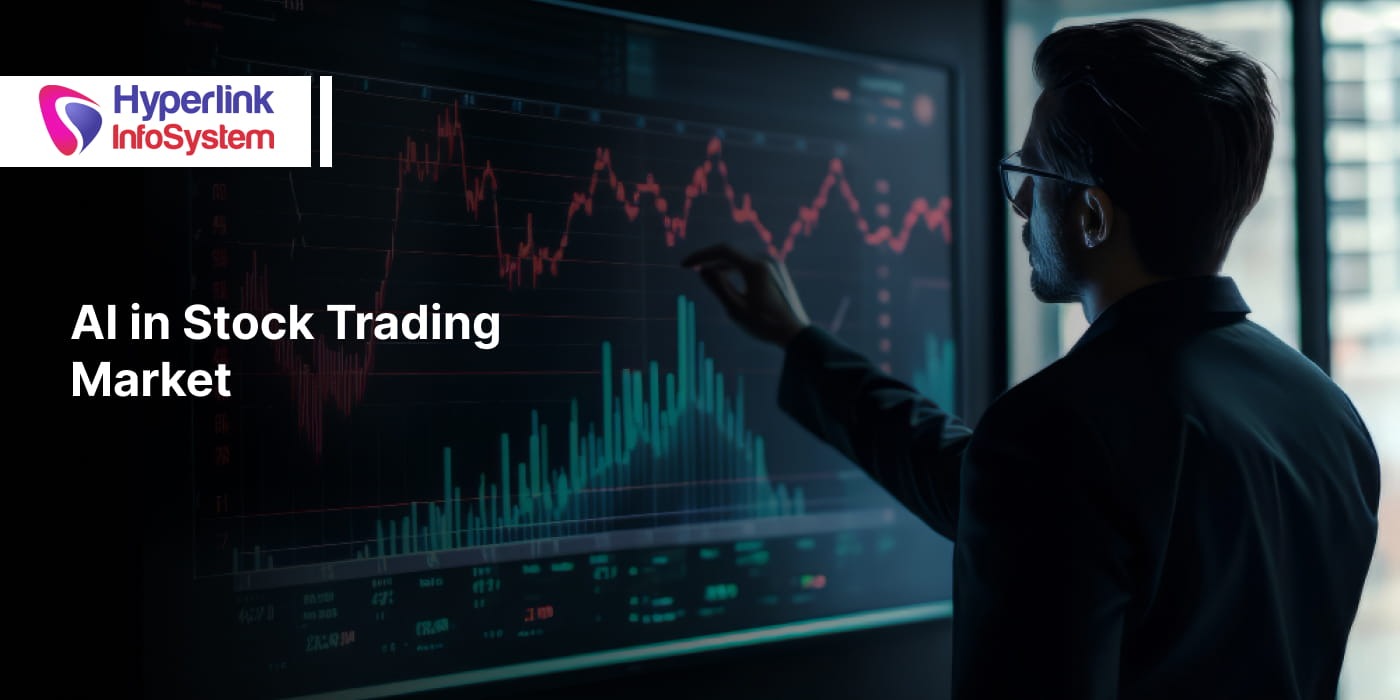

Artificial Intelligence is transforming the global financial ecosystem at an incredible pace. The modern stock market is no longer driven only by human intuition and traditional market analysis. Today, technologies powered by AI in Stock Market operations are helping traders, investors, and financial institutions make faster and more accurate decisions using real-time data and predictive intelligence.
The adoption of Artificial Intelligence in Stock Market platforms has increased significantly in recent years because of the growing demand for automation, risk reduction, and smarter investment strategies. AI systems can analyze millions of market signals within seconds, identify trading opportunities, track investor sentiment, and execute trades automatically with minimal human intervention.
From hedge funds and investment banks to retail investors using stock trading apps, AI is becoming an essential part of modern trading strategies. Financial organizations are increasingly partnering with a top AI development company to create intelligent trading solutions that improve efficiency and profitability.
AI technologies such as machine learning, predictive analytics, deep learning, and natural language processing (NLP) are reshaping how financial markets operate. These technologies help traders analyze massive volumes of structured and unstructured data from stock exchanges, economic reports, financial news, and social media platforms.
At the same time, the rise of AI stock trading also brings new challenges. Concerns around transparency, market volatility, data dependency, and compliance are becoming increasingly important as automated systems gain greater control over financial transactions.
Understanding how AI works in trading markets can help investors and businesses make informed decisions while preparing for the future of intelligent finance.
What is AI in Stock Market Trading?
AI in Stock Market trading refers to the use of artificial intelligence technologies to analyze financial data, predict market movements, and automate investment decisions. These AI-powered systems can process large datasets much faster than humans and identify patterns that may indicate profitable trading opportunities.
Traditional stock trading often depends on manual research, technical analysis, and emotional decision-making. In contrast, AI stock trading systems use machine learning algorithms to continuously learn from market behavior and improve their performance over time.
Artificial Intelligence in Stock Market platforms can evaluate historical stock prices, company earnings, trading volumes, investor sentiment, global economic indicators, and breaking news simultaneously. This allows AI systems to make data-driven predictions and recommendations with greater speed and efficiency.
Many businesses are now investing in AI for stock trading companies to create advanced trading software and automated investment platforms. These systems can execute trades instantly based on predefined conditions, helping traders take advantage of even the smallest market fluctuations.
How AI Works in the Stock Trading Market
AI-powered trading systems operate through a combination of data collection, machine learning, predictive analysis, and automation. The entire process is designed to improve trading accuracy while reducing human effort.
Data Collection and Market Analysis
AI systems collect data from multiple sources, including stock exchanges, financial reports, economic indicators, and news platforms. They also analyze social media discussions and investor opinions using natural language processing (NLP).
This allows AI to understand not only numerical market trends but also emotional and behavioral market signals. AI can detect whether public sentiment around a company is positive or negative and use this information for trading predictions.
Machine Learning and Predictive Analytics
Machine learning models study historical market patterns and compare them with current trading conditions. Over time, these systems learn which patterns are likely to lead to profitable outcomes.
For example, if certain stock movements repeatedly occur before price increases, AI models may recognize these signals and suggest potential buy opportunities.
Many businesses that build intelligent trading platforms work with a top AI development company to create custom machine learning algorithms for financial analysis.
Automated Trade Execution
Once AI identifies a trading opportunity, automated systems can execute buy or sell orders immediately. This process is known as algorithmic trading.
AI stock trading systems can perform transactions within milliseconds, which is significantly faster than manual trading. This speed helps traders capitalize on market opportunities before prices change.
Risk Assessment and Portfolio Optimization
AI systems also evaluate risk factors such as volatility, liquidity, and market exposure. These systems can automatically rebalance investment portfolios and adjust trading strategies based on changing market conditions.
This functionality is especially useful for investors using stock trading apps powered by artificial intelligence.
Role of Natural Language Processing in AI Trading
Natural language processing (NLP) plays a major role in modern AI-driven trading systems. NLP allows computers to understand, interpret, and analyze human language from various sources.
Financial markets are heavily influenced by news events, earnings announcements, government policies, and investor sentiment. NLP helps AI systems process this information quickly and determine its impact on stock prices.
For example, if a company releases strong quarterly earnings or announces a major partnership, NLP algorithms can identify positive sentiment and generate bullish trading signals.
Similarly, negative headlines related to economic slowdowns, legal issues, or management controversies can trigger cautionary alerts.
AI for stock trading companies increasingly depends on NLP technologies to improve market prediction accuracy and sentiment analysis capabilities.
Applications of AI in Stock Trading
AI is transforming several areas of the financial and investment industry. Its applications continue to expand as trading platforms become more intelligent and data-driven.
- Algorithmic Trading
Algorithmic trading is one of the most common applications of AI in Stock Market activities. These systems execute trades automatically based on predefined rules and market conditions.
AI algorithms can monitor multiple stocks, identify opportunities, and execute transactions within milliseconds. High-frequency trading firms rely heavily on AI to process large trading volumes efficiently.
- Smart Portfolio Management
AI-powered investment platforms can create and manage personalized portfolios based on investor preferences, financial goals, and risk tolerance.
Robo-advisors use AI to recommend investment strategies, monitor market changes, and automatically rebalance portfolios. This technology makes investment management more accessible and affordable.
- Fraud Detection and Security
AI systems can identify suspicious trading activities and detect fraud by analyzing unusual patterns and behaviors. Financial institutions use AI to monitor insider trading, cyber threats, and market manipulation attempts.
- Market Forecasting
AI helps traders forecast market trends by analyzing historical data, investor sentiment, and economic indicators. These predictions support better decision-making for both short-term and long-term investments.
- Personalized Trading Experiences
Modern stock trading apps use AI to deliver customized investment suggestions, trading alerts, and market insights. AI enhances user experiences by tailoring recommendations according to trading habits and preferences.
Benefits of AI in Stock Market Trading
The growing popularity of Artificial Intelligence in Stock Market operations is driven by several significant advantages.
1) Faster Data Processing
AI systems can process massive volumes of financial data in real time. This allows traders to react quickly to changing market conditions and identify profitable opportunities faster than human analysts.
2) Reduced Emotional Decision-Making
Human traders often make decisions influenced by fear, greed, or panic. AI eliminates emotional bias by relying entirely on data-driven analysis and predefined trading strategies.
This creates more disciplined and consistent investment behavior.
3) Improved Accuracy and Predictions
AI models continuously learn from historical data and market behavior. As a result, prediction accuracy improves over time.
Businesses looking to build an AI model for trading often focus on improving forecasting precision and reducing investment risks.
4) Better Risk Management
AI systems monitor market volatility, liquidity, and exposure continuously. Automated risk management features help minimize losses and optimize portfolio performance.
5) 24/7 Market Monitoring
Unlike humans, AI systems can monitor financial markets continuously without interruptions. This is especially useful in global trading environments where market activity occurs across multiple time zones.
Multimodal AI Development in Stock Trading
The future of trading technology is increasingly connected to multimodal AI development. Multimodal AI combines multiple forms of data such as text, audio, video, charts, and numerical datasets into a single intelligent system.
In stock trading, multimodal AI development can improve market predictions by analyzing financial reports, video interviews, earnings calls, stock charts, and social media content simultaneously.
For example, AI can analyze the tone of a CEO during an earnings presentation while also studying financial performance data and investor sentiment online. This provides a more comprehensive understanding of market behavior.
Many organizations are now investing heavily in multimodal AI development to create next-generation trading platforms with advanced analytical capabilities.
Challenges of AI in Stock Trading
Despite its advantages, AI stock trading also presents several challenges and limitations.
- Dependence on Historical Data
AI systems rely heavily on historical market information to make predictions. However, financial markets are unpredictable and influenced by sudden geopolitical events, economic crises, and unexpected news.
When markets behave differently from past trends, AI predictions may become less accurate.
- Lack of Transparency
Some AI trading systems operate like black boxes, making it difficult to understand how specific decisions are made. This creates concerns related to trust, compliance, and accountability.
- Technical Risks
AI-powered trading platforms depend on stable infrastructure, accurate data, and secure systems. Technical failures, software bugs, or cyberattacks can lead to financial losses.
- Regulatory Challenges
Governments and financial regulators are still adapting to the rapid growth of AI-driven trading systems. Regulatory frameworks must evolve to address concerns related to automated trading and market manipulation.
Importance of Hiring AI Experts for Trading Platforms
Developing advanced AI trading solutions requires deep expertise in machine learning, data science, financial analysis, and automation technologies.
Businesses looking to create intelligent trading systems often Hire AI developers with experience in financial technology and predictive analytics. Skilled AI engineers can help organizations design secure, scalable, and efficient trading platforms tailored to market requirements.
Partnering with a top AI development company can also accelerate innovation by providing access to experienced developers, AI researchers, and financial technology specialists.
These experts can help businesses build an AI model capable of analyzing market behavior, predicting trends, and automating investment strategies effectively.
Future of AI in Stock Trading
The future of AI in Stock Market trading looks highly promising. As artificial intelligence technologies continue to evolve, trading platforms are expected to become even smarter, faster, and more accurate.
Advanced technologies such as deep learning, reinforcement learning, and multimodal AI development will likely play a major role in future trading systems.
Retail investors are also expected to benefit significantly from AI-powered stock trading apps that provide personalized investment insights and automated trading capabilities.
Financial institutions will continue investing heavily in AI for stock trading companies to gain competitive advantages in global markets.
Although AI will continue automating many trading processes, human expertise will still remain important. Traders and analysts will be needed to supervise AI systems, validate predictions, and manage complex market situations.
Conclusion
AI is revolutionizing the financial industry by transforming how traders analyze markets, manage investments, and execute transactions. The adoption of AI in Stock Market platforms has introduced faster decision-making, predictive intelligence, automated trading, and advanced risk management capabilities.
Artificial Intelligence in Stock Market operations is helping financial institutions and investors process enormous amounts of data efficiently while reducing emotional trading behavior. Technologies such as machine learning, natural language processing (NLP), and multimodal AI development are creating smarter and more adaptive trading systems.
From algorithmic trading and fraud detection to portfolio optimization and stock trading apps, AI is reshaping every aspect of the investment ecosystem.
However, AI stock trading also comes with challenges related to transparency, data dependency, technical reliability, and regulatory compliance. Businesses and investors must understand both the opportunities and risks before adopting AI-driven financial technologies.
As innovation continues, companies that Hire AI developers and collaborate with a top AI development company will be better positioned to build advanced trading platforms and gain a competitive edge in the evolving financial market.

Frequently Asked Questions
AI in Stock Market trading refers to the use of artificial intelligence technologies such as machine learning and predictive analytics to analyze market data and automate trading decisions.
AI stock trading systems analyze historical and real-time market data, identify patterns, predict price movements, and execute trades automatically using intelligent algorithms.
Natural language processing (NLP) helps AI systems analyze news articles, financial reports, and social media content to understand investor sentiment and market trends.
Artificial Intelligence in Stock Market platforms improves trading speed, reduces emotional decision-making, enhances prediction accuracy, and supports better risk management.
Businesses Hire AI developers to build intelligent trading systems, create predictive analytics models, automate investment processes, and improve trading efficiency.
Multimodal AI development combines multiple data types such as text, charts, videos, and financial reports to improve market analysis and trading predictions.
Harnil Oza is the CEO & Founder of Hyperlink InfoSystem. With a passion for technology and an immaculate drive for entrepreneurship, Harnil has propelled Hyperlink InfoSystem to become a global pioneer in the world of innovative IT solutions. His exceptional leadership has inspired a multiverse of tech enthusiasts and also enabled thriving business expansion. His vision has helped the company achieve widespread respect for its remarkable track record of delivering beautifully constructed mobile apps, websites, and other products using every emerging technology. Outside his duties at Hyperlink InfoSystem, Harnil has earned a reputation for his conceptual leadership and initiatives in the tech industry. He is driven to impart expertise and insights to the forthcoming cohort of tech innovators. Harnil continues to champion growth, quality, and client satisfaction by fostering innovation and collaboration.
Latest Blogs




Is BlockChain Technology Worth The H ...
Unfolds The Revolutionary & Versatility Of Blockchain Technology ...


IoT Technology - A Future In Making ...
Everything You Need To Know About IoT Technology ...
Feel Free to Contact Us!
We would be happy to hear from you, please fill in the form below or mail us your requirements on info@hyperlinkinfosystem.com
Hyperlink InfoSystem Bring Transformation For Global Businesses
Starting from listening to your business problems to delivering accurate solutions; we make sure to follow industry-specific standards and combine them with our technical knowledge, development expertise, and extensive research.

4500+
Apps Developed

1200+
Developers

2200+
Websites Designed

140+
Games Developed

120+
AI & IoT Solutions

2700+
Happy Clients

120+
Salesforce Solutions

40+
Data Science

