




Three months. That's how long a product manager I know spent building the internal case for a generative AI investment - slide decks, ROI models, stakeholder meetings, the whole process. Her leadership team eventually said yes. The rollout happened. Writers turned drafts around faster, the support queue shrank a bit, developers stopped complaining quite as loudly about documentation.
Nobody called it a failure. But six months in, she described it to me as "the most expensive way we've ever saved people thirty minutes a day."
What finally shifted her perspective wasn't a new vendor pitch. It was something she saw at a competitor - their sales team was running outreach campaigns where follow-ups got scheduled automatically, warm leads got flagged before any human noticed them, and CRM records updated themselves while her team was still manually copying AI-drafted emails from one window into another.
Same underlying technology. Completely different outcome.
That's the gap this article is actually about. Not AI versus no AI. The gap between AI that makes your work faster and AI that does the work - between a system that waits for instructions and one that figures out what needs to happen next.
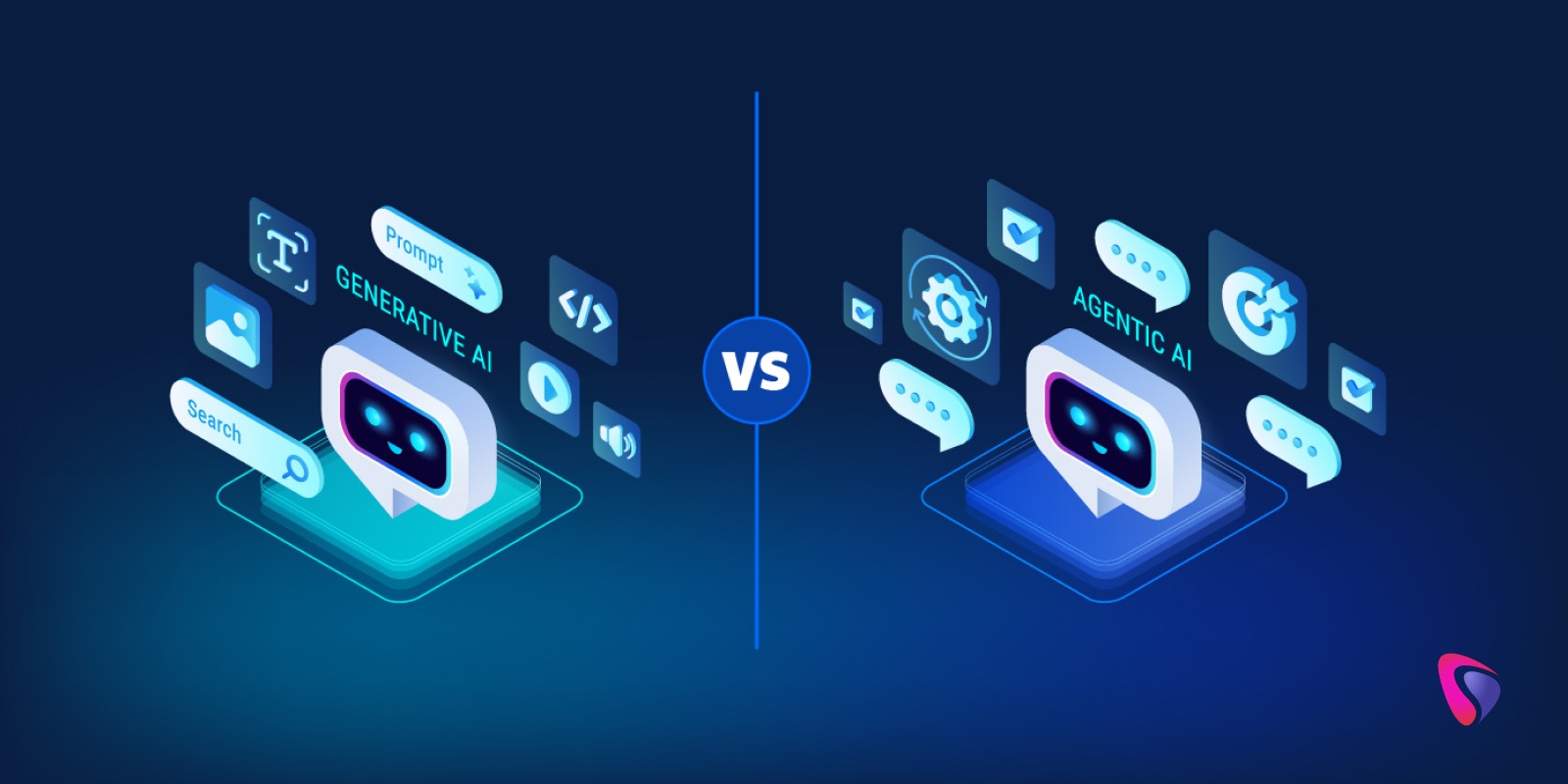
Generative AI and Agentic AI are both built on the same foundation of large language models and machine learning. But they're designed for fundamentally different jobs. Getting that distinction wrong - deploying one when you needed the other - is how organizations end up with technology investments that technically succeed and operationally disappoint.
Here's what each actually does, where each one runs into trouble, and how the businesses getting real results have figured out when to use which.
Key Takeaways
- Generative AI creates - text, images, code, reports. It responds to what you ask it.
- Agentic AI acts - it plans, decides, and executes toward a goal you've defined.
- One is reactive. The other is proactive. That distinction has real operational consequences.
- Agentic AI can run end-to-end workflows across systems without someone coordinating each step.
- Generative AI raises productivity. Agentic AI can restructure how work gets done entirely.
- Most enterprises doing this well aren't choosing between the two - they're running both.
- Agentic AI isn't the logical next step after Generative AI. It's a different category of tool.
Agentic AI vs Generative AI: Core Differences
| Factor | Generative AI | Agentic AI |
|---|---|---|
| Primary Purpose | Generate content | Achieve goals autonomously |
| User Interaction | Prompt-driven | Goal-driven |
| Decision Making | Limited | Advanced |
| Autonomy | Low | High |
| Workflow Execution | No | Yes |
| Context Awareness | Session-based | Persistent and adaptive |
| Human Intervention | Frequent | Minimal |
| Learning Capability | Content generation focused | Continuous task optimization |
| Business Impact | Productivity enhancement | Process transformation |
| Enterprise Value | Content creation and assistance | Autonomous operations |
Forget the technical specs for a second. The real difference is simpler than most explanations make it.
Generative AI sits there until you need it. You come to it with a question or a task, it gives you something back, and then you take that output and do something with it. You're still the one moving the work forward. The AI just made your part of it easier - faster writing, better first drafts, code that doesn't start from zero. Useful. Genuinely useful. But the workflow still runs on human initiative at every step.
Agentic AI operates on its own initiative within whatever boundaries you've set. You tell it what you're trying to achieve. It figures out the path, runs the steps, makes the calls it's authorized to make, touches the systems it needs to touch, and surfaces things to you when it hits something outside its scope. The workflow runs. You handle exceptions.
That's not a minor distinction. It's the difference between a very smart assistant and something closer to a capable team member.
Plain version: Generative AI answers your questions. Agentic AI works on your problems.
Picking the wrong one - especially when demo environments make both look equally autonomous - is exactly how you end up where that product manager ended up.
Agentic AI vs Generative AI Across the AI Lifecycle
| Stage | Generative AI | Agentic AI |
|---|---|---|
| Input | User prompt | Goal or objective |
| Planning | Minimal | Autonomous planning |
| Execution | Generates output | Executes actions |
| Decision Making | User-driven | AI-driven |
| Monitoring | Not continuous | Continuous |
| Adaptation | Limited | Dynamic |
| Learning | Contextual | Contextual + task-oriented |
| Outcome | Content creation | Task completion |
The lifecycle comparison makes the operational difference visible in a concrete way.
Generative AI is excellent at the generation stage. Everything before it - figuring out what to generate, how it fits into the broader workflow, what happens after - that's still human work. Everything after - reviewing the output, deciding what to do with it, moving it forward - also human work. The AI handles one stage of a process that still needs people at every other stage.
Agentic AI spans the whole thing. Input comes in as a goal, not a prompt. Planning happens autonomously. Execution happens across systems. Monitoring is continuous, not periodic. When conditions change, it adapts rather than waiting to be re-prompted.
I've heard people describe the difference as "AI that helps versus AI that does." That's close. The more precise version is that Generative AI improves how long individual steps take, while Agentic AI changes how many steps require a human at all.
Challenges of Generative AI
Hallucinations and Inaccurate Outputs
This is the one that keeps coming up in enterprise AI conversations, and for good reason - it's genuinely tricky. Not because it happens constantly, but because of how it happens. The output looks right. It reads confidently. The structure is correct, the tone is appropriate, and somewhere inside it is a fact that's simply wrong, presented with the same conviction as everything else around it.
That's manageable in low-stakes contexts. In regulated or high-consequence ones, it becomes a real problem:
- A clinical summary that gets one detail wrong and influences a care decision
- A legal brief that cites a case that doesn't exist, discovered during review - or not discovered at all
- A financial report with a calculation error that propagates into an executive presentation
- A compliance document that confidently omits a requirement nobody caught until the audit
The answer is human verification - building review into the workflow before AI outputs become decisions or deliverables. Teams that resist that step because it slows things down are the ones that learn the hard way why it exists.
Data Privacy Concerns
Getting value from Generative AI usually means feeding it information - which means the data governance question has to be answered, not deferred. The risks that don't get enough attention early:
- Customer records flowing into external model APIs that weren't designed for that data
- Proprietary information embedded in prompts that ends up in training data
- Regulatory requirements around data residency or handling that AI workflows silently violate
None of these are showstoppers. They're architecture decisions. The time to make them is before deployment, not after the first audit question arrives.
Limited Context Retention
Generative AI generally operates within a session. What it knew last Tuesday isn't automatically available this Tuesday. For tasks that require ongoing context - a customer relationship, a long-running project, an evolving regulatory situation - that limitation creates real gaps in output quality and consistency. Not a fatal flaw. Worth designing around.
Challenges of Agentic AI
Autonomous Decision Risks
Here's the thing about systems that make decisions without waiting for human approval: the quality of those decisions depends entirely on the quality of the guardrails around them. Insufficient constraints produce agents that:
- Complete a workflow perfectly according to their instructions while producing an outcome nobody actually wanted
- Take actions that were locally reasonable and globally problematic
- Keep operating outside expected boundaries without any obvious signal that something has gone sideways
The governance model has to be designed before deployment. Organizations that treat it as something to figure out later tend to find out why that's a mistake at a moment they'd rather not be discovering it.
Governance Complexity
Autonomous systems create an accountability question that doesn't go away: when something goes wrong, can you explain what the system did, why it did it, and what authorized it to do that? Without audit trails, monitoring infrastructure, approval mechanisms, and clear escalation paths, the answer is no - and that becomes a serious problem in any regulated context or any organization where humans are ultimately accountable for outcomes.
The organizations that handle this well build governance as a first-class design requirement. The ones that struggle treat it as documentation to write after the system is running.
Security Vulnerabilities
Agentic systems have a larger attack surface than Generative AI, almost by definition. They touch more systems, hold more permissions, and take more actions - which means there are more ways to compromise them and more damage that compromise can do.
The specific risks worth planning for:
- Prompt injection - crafted inputs that redirect agent behavior in ways that weren't intended
- Credential misuse - agents with broad system access being exploited to act outside their authorized scope
- API exploitation through automated agent actions at scale
- Data manipulation that occurs several steps deep in a workflow, well past any obvious monitoring point
These aren't hypothetical concerns. They're the category of attack that Agentic AI specifically enables, and they require security design that goes beyond what Generative AI deployments typically need.
Scalability Analysis: Business Impact at Enterprise Scale
Generative AI Scalability
Generative AI scales without much drama. Deploying AI assistants across departments, functions, and geographies is operationally straightforward - the main requirements are access management and thoughtful data governance, neither of which is particularly exotic.
The fit areas are well-established: content at volume, first-line customer support, development assistance, knowledge retrieval. Teams get productive quickly, the implementation risk is manageable, and the changes feel evolutionary rather than disruptive.
Where it works well: Fast deployment, low operational risk, productivity gains that show up quickly and clearly.
Where it hits a ceiling: The AI doesn't move work forward on its own. It makes the human's steps faster, but humans still have to take every step. At some point, that's the constraint.
Agentic AI Scalability
Agentic AI at enterprise scale is a different proposition entirely. The value isn't faster steps - it's fewer steps requiring human involvement. CRM, ERP, customer service tooling, supply chain systems, business intelligence platforms - an Agentic AI infrastructure can coordinate across all of them simultaneously, without a human orchestrating each handoff.
For organizations where the real bottleneck is coordination - where things slow down not because any individual step is slow but because things sit waiting for the next person to pick them up - Agentic AI can eliminate that category of delay rather than just reducing it.
Where it delivers: Lower operational costs, faster end-to-end execution, automation that becomes more valuable as more workflows are added to it.
What it actually requires: This is not plug-and-play. The implementation complexity is higher, governance requirements are real, and security infrastructure needs to be more robust. For large enterprises with the right foundation, the return justifies the investment. For teams expecting quick wins with minimal setup, the gap between expectation and reality is significant.
Technical Complexity and Maintenance
Maintaining Generative AI Systems
Honest answer: not that hard. Keeping models current, tuning prompts as use cases evolve, connecting to knowledge bases, validating output quality - these are things engineering teams with existing capacity can handle. Specialized AI operations expertise isn't usually required at the Generative AI tier.
The main ongoing work: prompt optimization, model updates, knowledge base integration, output validation.
Maintaining Agentic AI Systems
Meaningfully harder, and underestimated in most implementation plans. When organizations decide to hire AI developer talent for Agentic systems specifically, the skill requirements are different from general engineering - these systems are executing workflows, managing state across sessions, and making decisions with downstream consequences.
Agentic systems aren't producing text - they're executing workflows, managing state across sessions, integrating with live systems, and making decisions that have downstream consequences. When something goes wrong, you're not reviewing a bad paragraph. You're debugging a process that may have touched six systems and taken twenty actions before producing an unexpected outcome.
The ongoing maintenance surface includes: agent orchestration logic, workflow integrity as integrated systems change, access controls and security posture as APIs and permissions evolve, behavioral monitoring for unexpected patterns, and performance management as workloads grow.
None of this is insurmountable. It does require appropriate staffing and realistic expectations - neither of which shows up clearly in vendor demos.
Use Cases
Top Generative AI Use Cases
- Content Creation - Marketing copy, blog posts, reports, emails, product descriptions. Volume without proportional headcount increases.
- Software Development - Code generation, debugging assistance, documentation that doesn't require a separate sprint to write.
- Customer Support - Medium-complexity queries that needed human routing before because the old bot couldn't follow the thread. Now they don't.
- Design and Creativity - Image generation and creative asset production for teams without dedicated design capacity.
- Knowledge Management - Surfacing institutional knowledge that exists somewhere in a document repository but is practically inaccessible. Making it findable and usable.
Top Agentic AI Use Cases
- Autonomous Customer Service - Not chatbots. Actual resolution, without handoff, for defined problem categories.
- Sales Process Automation - The full sequence: identify, reach out, follow up, schedule, update the CRM. Running without someone managing each step.
- Supply Chain Optimization - Continuous monitoring and coordinated response to inventory signals, demand shifts, and logistics conditions in real time.
- Financial Operations - Invoice processing, reconciliation, reporting. End-to-end, without manual touchpoints between systems.
- IT Operations - Incident detection and resolution for defined issue categories. Not alerts sent to humans - resolution handled, humans notified.
Hybrid Approach: Why Businesses Are Combining Both
The organizations running the most capable AI systems right now didn't choose between Generative and Agentic. Many partnered with a Generative AI development company to architect both layers deliberately — and the combination produces something neither technology delivers alone.
A hybrid workflow that holds up in production:
- Generative AI produces content, analysis, or recommendations from available data
- Agentic AI evaluates those outputs against current conditions and objectives
- Agentic AI takes action across the relevant systems
- Humans maintain oversight of governance, handle genuine exceptions, and set strategic direction
The sales example is worth making concrete because it shows up in real deployments: Generative AI drafts personalized outreach for a prospect based on their profile and recent signals. Agentic AI sends it, watches what happens, schedules follow-up based on engagement patterns, updates the CRM, and routes the lead to a human rep when the timing is right. No one managed any individual step. The human closed the deal.
That's not a theoretical workflow. It's what the competitor's sales team was running while the product manager's team was copying emails from one window to another.
Decision Framework: Choosing Between Agentic AI and Generative AI
Choose Generative AI If:
- Better output is the goal - faster, higher quality, more consistent
- Human review and coordination at each step is fine
- You want value quickly without a complex implementation program
- Your workflows are manual and you're looking to accelerate specific steps within them
- Autonomous decision-making isn't something your organization is ready for yet
Choose Agentic AI If:
- You need workflows to move without human coordination at every stage
- Operational efficiency - changing how work gets done, not just how fast - is the objective
- You want AI that acts on information, not just generates it
- Process structure change is the goal, not process speed improvement
- Your governance infrastructure is ready for systems that make decisions
Choose a Hybrid Approach If:
For organizations ready to go this route, working with an experienced AI agents development company makes the difference between a system that compounds in value and one that stalls at the pilot stage.
- You want intelligence and execution working together
- Complex multi-system workflows are where your operational drag lives
- AI transformation is a strategic program, not a departmental experiment
- You're prepared to invest in both the technology and the governance alongside it
- You want the value to compound over time rather than plateau once teams adapt
Conclusion
The product manager's story is more common than most AI vendors would like to acknowledge. Real productivity gains. Real value. And a persistent, nagging feeling that the technology is doing something different from what was promised - faster steps, not fewer steps, not a different kind of work entirely.
That feeling is usually accurate. And it usually traces back to the same root: deploying Generative AI when Agentic AI was what the use case actually needed, or expecting Agentic outcomes from a Generative deployment because the demo made them look similar.
They're not similar. Generative AI makes people more capable at their existing jobs. Agentic AI can change what the job requires humans to do at all. Both are worth having. Neither substitutes for the other. The organizations that understand the distinction - and build deliberately for both where both are warranted - are building something that compounds.
The ones still treating them as versions of the same thing are still measuring success in minutes saved per person per day.
That's not nothing. It's just not transformation.
FAQ’s
Q1: What's the simplest way to explain the difference between Generative AI and Agentic AI?
Generative AI answers your questions. Agentic AI works on your problems. One responds when prompted; the other plans, acts, and executes toward a goal on its own.
Q2: Is Agentic AI just the next upgrade after Generative AI?
No. It's a different category of tool entirely. Generative AI makes individual steps faster. Agentic AI reduces how many steps need a human at all.
Q3: What's the biggest risk with Agentic AI specifically?
Autonomous decisions without proper guardrails. An agent can complete a workflow perfectly per its instructions while producing an outcome nobody wanted - and without strong governance, you may not even know it happened.
Q4: Is Agentic AI harder to maintain than Generative AI?
Significantly. Generative AI maintenance is mostly prompt tuning and output validation. Agentic AI means debugging workflows that touched multiple systems and took dozens of actions - a different level of operational complexity.
Q5: Should businesses choose one or use both?
Most organizations getting real results use both together - Generative AI creates content and recommendations, Agentic AI evaluates and acts on them across systems, with humans handling exceptions and strategy.