
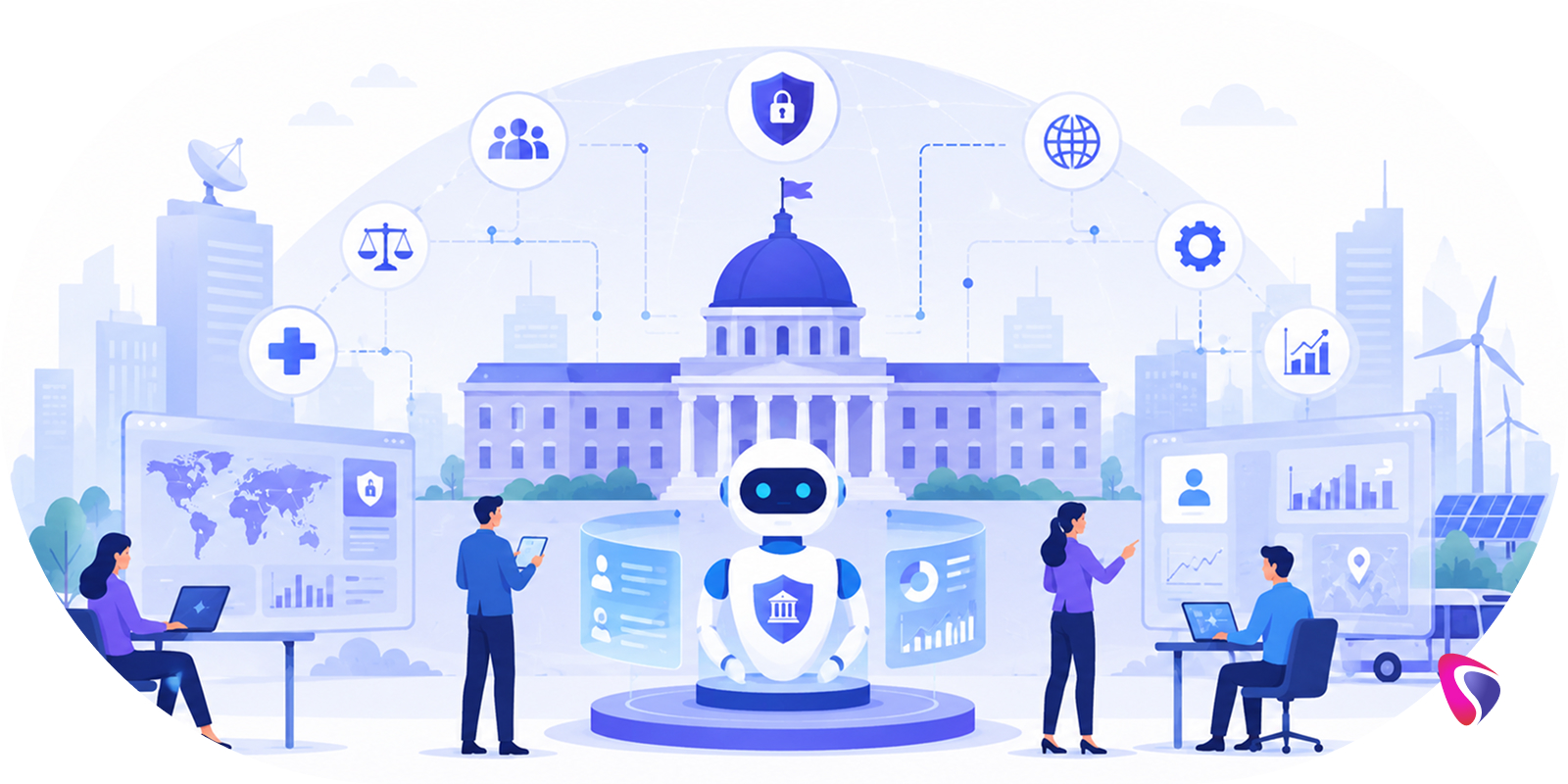




Government agencies are not typically where you look for early technology adoption. The incentive structures push toward caution - the cost of a high-profile failure in public services is political, not just operational, and the constituencies affected by government decisions are broad enough that edge cases matter in ways they don't in commercial software. When a bank's chatbot fails, the customer finds another channel. When a welfare eligibility system produces incorrect determinations at scale, the consequences are measured in food insecurity and housing instability.
This is what makes the scale of AI adoption currently underway in public sectors worldwide genuinely noteworthy. It's not that governments have suddenly become risk-tolerant. It's that the operational pressures - aging infrastructure, workforce shortages, rising citizen expectations, budget constraints that don't match service demand - have become acute enough that the calculus on AI investment has shifted substantially.
The governments that moved early and carefully are demonstrating real operational improvements. Those results are influencing peers. And the conversation has moved from "should governments use AI" to something more interesting and more complicated: what does responsible, effective AI adoption in public service actually require, and what separates governments getting meaningful value from ones producing expensive demonstrations?
Why the Current AI Revolution Is Different from Past Government Technology Initiatives
Public sector technology adoption has a complicated history. Ambitious modernization programs have repeatedly underdelivered - sometimes spectacularly - on promises made during procurement and planning. Legacy system migrations that took twice as long and cost three times as much as projected. Digital transformation initiatives that produced new interfaces on top of unchanged processes. Enterprise software rollouts that never fully replaced the spreadsheets and manual workarounds they were meant to eliminate.
Healthy skepticism about AI in government is warranted. But there are structural differences between the current wave of AI adoption and previous modernization efforts that explain why outcomes have been more consistently positive in the cases where implementation has been thoughtful.
AI, particularly generative AI and machine learning applications, doesn't require ripping and replacing existing systems to deliver value. It can layer over legacy infrastructure, process documents produced by outdated workflows, and provide intelligent interfaces to systems that were never designed for them. For governments where wholesale system replacement is politically and practically impossible, this is a material difference from previous technology waves.
The other meaningful difference is that the capability-to-deployment timeline has compressed dramatically. Government IT procurement cycles are long. The time between identifying a need, procuring a solution, implementing it, and getting it into production has historically been measured in years. Modern AI deployment models - particularly cloud-based API integrations and configurable platforms - have made it possible to go from problem identification to working system in months in some contexts. That's not universally true, and the governance requirements around sensitive government data add complexity, but the capability exists in a way it didn't for previous generations of enterprise software.
Key Government Applications of Artificial Intelligence in 2026
1) Citizen Services: The First and Most Visible Application
The most widespread government AI deployment is in citizen-facing services - the interfaces through which most people actually interact with their government. Benefits inquiries, permit applications, tax questions, licensing processes. These interactions are high-volume, largely routine, and have historically required either significant call center staffing or citizens navigating complex online systems designed around government internal processes rather than citizen needs.
AI-powered virtual assistants and document processing systems are handling significant portions of this volume at a growing number of agencies. The value isn't just operational cost reduction, though that's real. It's availability - a citizen who needs to understand their benefit eligibility at 10pm on a Saturday can get an accurate, contextually relevant answer rather than a link to a PDF and a callback number.
The implementations that are working consistently share a few properties: they're connected to accurate, current data rather than operating from static knowledge bases, they're transparent about being AI-powered systems rather than human agents, and they have clear escalation paths to human staff for situations that exceed their capability. The shift from AI as a tool that assists human decision-making to AI agents that can execute multi-step workflows with limited human involvement per transaction is happening faster in some government domains than others. Much of this momentum traces back to a handful of agencies that brought in a leading AI development company early, building internal expertise alongside external delivery rather than treating the engagement as a one-off project."
2) Healthcare and Public Health Intelligence
Public health agencies have been among the more sophisticated early adopters of AI in government, partly because the data science tradition in epidemiology gave them a head start on the analytical foundations and partly because COVID-19 created urgent demand for surveillance and modeling capabilities that traditional approaches couldn't satisfy at the required speed.
Disease surveillance applications - monitoring patterns in syndromic data, pharmacy sales, social media signals, and diagnostic coding to detect emerging outbreaks before they're identified through traditional reporting - are now operational at multiple national and regional public health agencies. The speed advantage over traditional surveillance is measured in days to weeks, which in an infectious disease context is the difference between containment and widespread transmission.
Hospital resource allocation modeling, diagnostic support tools, and healthcare demand forecasting are all in various stages of deployment. The healthcare AI applications that have generated the most controversy involve clinical decision support - situations where the AI's recommendation influences patient care decisions - and those applications are quite rightly held to higher validation standards than administrative automation.
Also read : AI in Healthcare Industry
3) Smart Cities and Urban Infrastructure
Urban AI applications are where the data volume and complexity arguments for AI are most compelling. Traffic management systems that optimize signal timing based on real-time flow data, public transit scheduling that responds to demand patterns, energy grid management that balances supply and demand across distributed renewable sources - these are optimization problems at a scale and speed that traditional management approaches genuinely can't handle.
Singapore, Seoul, Amsterdam, and a handful of other cities have moved from pilot programs to operational infrastructure for various urban AI applications. The results on traffic congestion and energy efficiency have been measurable. The governance questions - who has access to the data collected, what it's used for beyond the stated purpose, how long it's retained - are questions these cities are still working through, with varying degrees of public transparency.
4) Tax Administration and Financial Compliance
Tax authorities are among the most data-rich government agencies, and they've been using statistical modeling to identify audit candidates and detect fraud patterns for longer than the current AI conversation suggests. What's changed is the sophistication of the models and the volume and variety of data they can process.
AI-enhanced compliance systems can identify patterns of potential evasion that would be invisible to human reviewers working through returns manually - cross-referencing transaction data with corporate filings, beneficial ownership records, and international reporting to surface inconsistencies that warrant investigation. The UK's HMRC, the US IRS, and several European tax authorities have deployed or are deploying ML-enhanced compliance tools with documented improvements in audit targeting efficiency.
The civil liberties dimensions of AI in tax enforcement deserve honest treatment. More capable AI fraud detection means more scrutiny of more taxpayers, and the burden of false positives - incorrect flags that trigger audits of compliant taxpayers - falls unevenly. Bias in training data can translate into disparate audit rates across demographic groups. These aren't reasons not to use AI in tax administration, but they are reasons to build bias monitoring and error rate tracking into the governance framework from the start.
5) Social Services: High Stakes, Complex Data
Social service applications of AI carry the highest stakes of any government domain because the populations they serve are often among the most vulnerable, and errors in eligibility determination or benefit administration have immediate material consequences for people with limited capacity to absorb them.
The applications generating the most value are on the administrative efficiency side - processing documentation, identifying eligibility based on structured criteria, flagging cases that need human review because the situation is complex or unusual. The applications generating the most concern are ones that use predictive models to determine risk levels or resource allocation in ways that affect individual case decisions. Those applications require particularly rigorous bias testing, audit capability, and human oversight to be deployed responsibly.
How AI Agents Are Reshaping Public Sector Operations
The shift from AI as a tool that assists human decision-making to AI agents that can execute multi-step workflows with limited human involvement per transaction is happening faster in some government domains than others.
Document processing and records management are the clearest current examples. AI agents that can receive a submitted application, extract relevant information, verify it against existing records, check eligibility criteria, generate a determination, and route for human review or direct approval are operational in several jurisdictions - typically built by agencies working with specialized AI Agent Development services rather than retrofitting legacy automation tools. These aren't simple chatbots. They're systems executing consequential administrative processes end-to-end.
Gartner's projection that 80% of governments will have AI agents handling routine decision-making by 2028 is ambitious but not implausible given current trajectory. What the projection doesn't capture is the enormous variation in what "routine decision-making" means and the governance infrastructure required to deploy AI agents responsibly in different contexts.
An AI agent that processes a permit application for a residential deck addition is a different governance question from an AI agent that makes an initial determination on a disability benefits claim. Both might be described as "routine decision-making." The appropriate level of human oversight, the explainability requirements, the audit trail needed, and the appeal mechanisms required are very different.
Global Approaches to Government AI Adoption
The United Kingdom: Balancing Innovation with Public Sector Productivity
The UK's approach to government AI has emphasized practical deployment alongside governance. The AI Opportunities Action Plan, published in early 2025, identified specific high-value use cases across public services and created frameworks for cross-agency AI adoption. The focus on measurable productivity improvements - reducing caseworker time on administrative tasks, accelerating planning decision timelines - reflects a pragmatic orientation toward demonstrable outcomes.
The European Union: Prioritizing Regulation, Transparency, and Accountability
The EU's approach is more cautious in the best sense of that word. The AI Act's risk-based classification system explicitly addresses government AI applications, requiring higher levels of transparency, human oversight, and documentation for AI used in consequential decisions about individuals. This creates real compliance overhead for government AI deployment but also creates accountability structures that protect citizens from the most problematic failure modes.
India: Advancing Sovereign AI for National Development
India's National AI Mission and subsequent investments in sovereign AI capability reflect a different strategic priority - building domestic AI capacity rather than relying on foreign technology platforms. The Earth observation AI systems being deployed for agriculture monitoring, infrastructure assessment, and disaster response represent the intersection of AI capability and national development priorities in a way that's distinctive to India's context.
Middle East Governments: Accelerating AI Deployment at Scale
The Middle East, particularly the UAE and Saudi Arabia, is deploying AI in government at a pace that outstrips most of the rest of the world. The governance context is different - less democratic accountability, less press scrutiny of government programs - which creates conditions for fast deployment but also for less public visibility into how these systems actually perform.
Building Public Trust in Government AI Systems
Trust in government AI isn't primarily a communications challenge, though it has a communications dimension. It's an operational challenge - building systems that merit trust through how they work, not just through how they're described.
The elements that actually build trust are less glamorous than the technology: explainability mechanisms that let citizens understand why an AI system made a particular determination about their case. Human review rights for consequential decisions. Independent audit capability for bias, accuracy, and disparate impact. Clear complaint mechanisms that are actually staffed and responsive. Data governance frameworks that specify what data is used, how it's retained, who has access, and what prevents its use for purposes beyond the stated application.
None of these are primarily technical problems. They're organizational and political commitments that require sustained investment and genuine accountability rather than policy statements.
The trust deficit that exists in many populations toward government AI is not irrational. Governments have historically used data collected for one purpose in service of another. Algorithmic decision-making systems in social services and criminal justice have produced documented disparate impacts. The caution is earned. Building it back requires demonstrated performance, not reassurance.
The Biggest Challenges Facing Government AI Adoption
1) Legacy Systems and Infrastructure Barriers
Legacy infrastructure is genuinely limiting in ways that are easy to understate. It's not just that old systems are slower or more expensive to maintain. It's that they weren't designed to expose their data in ways that modern AI applications can consume. Agencies tackling this integration work often find it faster to hire dedicated AI developer talent with public-sector data experience than to rely solely on internal IT teams already stretched across legacy maintenance. Integration work between AI applications and legacy databases is frequently the most expensive and time-consuming part of government AI deployments - not the AI itself.
2) Workforce Transformation and Skills Development
Workforce concerns deserve more nuance than they typically receive in government AI discussions. The legitimate concern is not that AI will eliminate government jobs - the employment protections in most civil service systems make rapid headcount reduction difficult regardless of technology - but that it will change what government jobs involve in ways that require new skills and create transitions that are managed well or badly depending on how intentionally organizations approach them. The "AI will free workers for higher-value tasks" framing is true enough but incomplete without honest engagement with what retraining those workers requires and who's responsible for providing it.
3) Data Quality and Governance Challenges
Data quality problems are frequently the binding constraint on AI deployment. AI systems learn from data. Government data quality is uneven in ways that reflect decades of fragmented systems, inconsistent data entry practices, and limited investment in data infrastructure. An AI system trained on incomplete or systematically biased historical data will reproduce and potentially amplify those problems. Data quality investment frequently needs to precede or accompany AI investment, and the business case for data quality work alone is difficult to make - it only becomes clear when poor data quality limits what AI can do with it.
The Future of Government AI: What to Expect by 2030
Prediction is difficult, particularly for government technology adoption where the timeline between decision and deployment is long and political context can shift quickly. But a few trends have enough momentum to project with reasonable confidence.
AI Agents Will Automate Routine Government Processes
Agentic systems will handle a larger fraction of routine government administrative processes than they do today. The question isn't whether AI agents will be processing applications, verifying eligibility, and generating determinations - they already are in some jurisdictions - but how much of the routine administrative workload they handle and what governance infrastructure ensures they do it responsibly.
From Reactive Services to Predictive Citizen Support
Predictive service delivery - proactively identifying citizens who need services and initiating contact rather than waiting for applications - is technically feasible and politically complicated. The privacy implications of governments using their data to model which citizens are likely to need healthcare, housing assistance, or child protective services raise questions that don't have easy answers. The potential to help people who don't know about or access services they're entitled to is real. So is the potential for intrusion and misuse.
Case study : Healthcare Automation with AI
The Growing Importance of Sovereign AI Infrastructure
Sovereign AI - national investments in AI models and infrastructure that operate on domestically controlled systems - will expand as data sovereignty concerns intensify and as the geopolitical dimensions of AI capability become clearer. This has implications for the AI supply chain that are still working themselves out.
Conclusion
The governments getting real value from AI in 2026 share more than advanced technology. They share operational clarity about what they're trying to improve, governance structures that build accountability into the deployment rather than appending it afterward, and an honest approach to the limitations and risks of the systems they're deploying.
The technology is no longer the limiting factor for most government AI applications. The limiting factors are organizational - data infrastructure, workforce capability, governance design, and the sustained political commitment to hold AI-powered systems accountable for their performance rather than just their promise.
That's actually a more optimistic picture than it might appear. Technology limitations are hard to solve without major research advances. Organizational limitations are solvable with sustained, deliberate effort and genuine leadership commitment. The governments investing in that organizational infrastructure alongside the technology will be substantially better positioned to serve their citizens over the next decade than the ones treating AI adoption as primarily a technology procurement decision.
The public sector's track record with technology transformation is mixed. The stakes for getting AI right in government are high enough that the mixed record deserves to be part of the conversation, not footnoted. Learning from what has failed matters as much as emulating what has succeeded.
Contact us today to learn how AI can help modernize public services, improve operational efficiency, and deliver better outcomes for citizens.
FAQ’s
Q1. How are governments using AI in 2026?
Governments are using AI for citizen services, healthcare analytics, tax compliance, urban planning, document processing, and public service automation.
Q2. What are the benefits of AI in government services?
AI helps improve efficiency, reduce administrative costs, accelerate decision-making, enhance service accessibility, and provide 24/7 citizen support.
Q3. What risks are associated with government AI adoption?
Key risks include data privacy concerns, algorithmic bias, lack of transparency, inaccurate decisions, and cybersecurity vulnerabilities.
Q4. Are AI systems replacing government employees?
In most cases, AI automates routine administrative tasks, allowing employees to focus on complex cases, oversight, and citizen engagement.
Q5. What makes AI adoption successful in the public sector?
Successful AI adoption requires strong governance, high-quality data, human oversight, transparency, accountability, and clear operational objectives.