

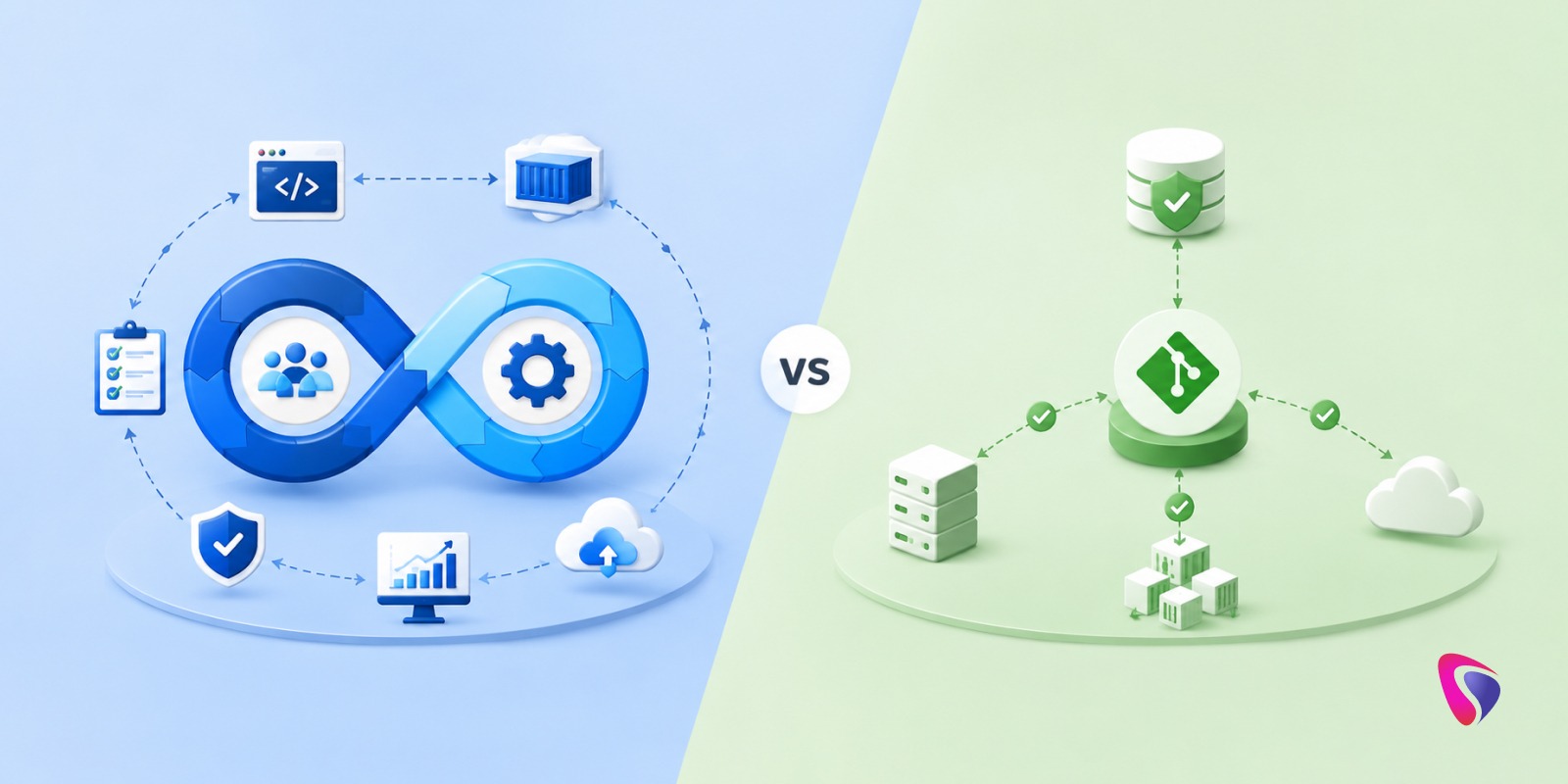




DevOps is a philosophy about how software organizations work - how development and operations share accountability, how they build feedback loops, how they automate the path from code to production. GitOps is more specific: it's a methodology for managing infrastructure and deployments using Git as the definitive record of what systems should look like. One is the operating model. The other is a disciplined implementation approach for one part of it.
Understanding that relationship is what this guide is actually about.
What Is DevOps?
To understand what DevOps solved, it helps to remember what software delivery looked like before it.
Development teams wrote code. Operations teams deployed it. Those two groups often worked in separate physical spaces, on separate timelines, with different incentives and different definitions of success. Developers wanted to ship fast. Operations wanted stability. The friction between those goals showed up as slow release cycles, deployment failures, and a blame culture where every incident became an argument about whose fault it was.
DevOps emerged as an answer to that dysfunction - not primarily a technical answer, but an organizational one. The core move was shifting from "your team builds it, my team runs it" to shared ownership of the entire delivery pipeline. Continuous integration, continuous delivery, automated testing, infrastructure as code, monitoring that both teams paid attention to - these became the mechanisms through which that shared ownership was made operational.
What DevOps looks like in a specific organization varies considerably from the textbook definition. Some companies adopt it mostly as a cultural shift, restructuring teams and reporting lines and incentive structures without dramatically changing their tooling. Others lead with tooling - CI/CD pipelines, deployment automation, observability platforms - and let the cultural change follow. Most mature implementations involve both, though the emphasis depends on what was broken to begin with.
The outcome DevOps is actually optimizing for is simple to state and hard to achieve: shorter path from idea to production, without sacrificing the reliability that makes production worth caring about. Faster releases, fewer failures, faster recovery - those are the metrics that tell you whether a DevOps transformation is working or just adding process overhead.
What Is GitOps?
GitOps is what happens when you take the DevOps principle of "everything as code" and apply it with maximum discipline to infrastructure and deployment management.
The core commitment is this: the desired state of every system lives in a Git repository. Not most systems. Not the important ones. Every system. This approach to infrastructure management shifts the operational model from imperative commands - "run this to make that happen" - to declarative declarations stored, versioned, and auditable in Git. The production environment is continuously reconciled against what that repository says - automatically, by agents that are always watching for divergence and always correcting it.
In practice, that means teams stop running commands to apply configuration changes or triggering pipeline pushes to update environments. Instead, they commit changes to Git. Automated agents - in Kubernetes environments, typically something like Flux or Argo CD - detect the difference between what Git specifies and what's actually running, and bring the environment into alignment without human intervention.
The most significant practical benefit of this model is what it does to configuration drift. Drift is the thing that happens in every environment that doesn't have strict change control: someone makes a manual change to fix something urgent, means to document it, doesn't quite get around to it, and three months later when something breaks in a confusing way, the gap between what the runbook says and what's actually deployed is the reason. GitOps makes drift structurally difficult. The environment has to match the repository, and if it doesn't, the system fixes it. That's not a policy - it's a technical constraint.
GitOps gained most of its adoption momentum through Kubernetes, which is not accidental. Kubernetes is built around declarative configuration - you describe what you want, and the control plane figures out how to achieve it. GitOps extends that same logic one layer up, applying the declare-and-reconcile pattern to the deployment and operations layer itself. The philosophical fit is close enough that combining them feels natural once you've seen both in action.
GitOps vs DevOps: Key Differences
| Factor | DevOps | GitOps |
|---|---|---|
| Primary Focus | Culture and collaboration across teams | Deployment and infrastructure automation via Git |
| Source of Truth | Multiple systems and tools | Git repository exclusively |
| Deployment Method | CI/CD pipelines - push-based | Git-driven reconciliation - pull-based |
| Infrastructure Management | Infrastructure as Code | Git-controlled Infrastructure as Code |
| Auditability | Depends on tooling and discipline | Built-in through Git history by default |
| Rollbacks | Often manual or pipeline-based | Git revert - immediate and reliable |
| Change Approval | Workflow dependent | Pull request-driven, always |
| Kubernetes Alignment | Supported | Highly optimized for it |
| Operational Visibility | Distributed across tools | Centralized through Git |
| Best Suited For | Broad organizational transformation | Cloud-native, Kubernetes-heavy environments |
The difference between these two approaches isn't just speed. It's the relationship between how changes get made and how accountability for those changes gets maintained.
The table is honest about the trade-offs. DevOps provides the broader framework - the culture, the collaboration model, the continuous improvement mindset. GitOps provides a specific, disciplined implementation of one critical piece of that framework: how production environments get changed and who can verify it afterward.
Why Modern Organizations Depend on DevOps Practices
The failure modes that DevOps was designed to address were consistent enough across organizations that they started to look like structural problems rather than execution problems.
Release cycles measured in months rather than weeks. Deployment processes that required coordinating across teams that didn't communicate well, creating bottlenecks at the exact moment everyone most wanted to move fast. Manual operations that worked fine at low frequency and became sources of error and inconsistency as deployment volume increased. Post-incident reviews that correctly identified root causes and produced action items that never got closed because the underlying organizational structure - the silos, the handoffs, the blame allocation - was still intact.
DevOps worked because it attacked those problems at the right level. Not just better tools, but a different model for how teams relate to each other and to the software they're collectively responsible for. The cultural shift toward shared ownership made the tooling investments actually deliver on their promises, instead of automating a dysfunctional process and making it faster.
The business results that followed adoption were measurable and, frankly, dramatic enough to drive rapid spread. Deployment frequency went up. Lead time from code commit to production went down. Mean time to recovery from incidents went down. Change failure rate went down. These aren't soft improvements - they're operational metrics that directly connect to revenue, customer experience, and engineering capacity. Which is why DevOps investment has continued even as the original cultural insight has become conventional wisdom.
Why GitOps Is Getting Serious Attention in 2026
The environments that organizations are operating have gotten complicated in ways that traditional operational approaches weren't built for. Running a few services on a handful of servers is one thing. Running hundreds of microservices across multiple Kubernetes clusters spread across multiple cloud providers - including large-scale DevOps automation on AWS environments where deployment frequency and configuration complexity both compound simultaneously - with different teams owning different parts of the system is a different problem entirely, and the manual coordination processes that worked at smaller scale become sources of risk rather than reliability at this one.
Running a few services on a handful of servers is one thing. Running hundreds of microservices across multiple Kubernetes clusters spread across multiple cloud providers, with different teams owning different parts of the system and deployments happening continuously - that's a different problem, and the manual coordination processes that worked at smaller scale become sources of risk rather than reliability at this one.
GitOps addresses that complexity in a way that scales because it doesn't rely on human discipline to maintain consistency. The consistency is structural. Every environment is defined in Git. Deviations get corrected automatically. The question "what is actually running in production right now?" always has a reliable answer, and that answer is in the repository.
For organizations that have lived through the alternative - environments where that question gets answered with "let me check the runbook, though it might be out of date" - this is not a subtle improvement.
The compliance and security implications are equally concrete. Pull request workflows mean every production change has been reviewed before it was applied and documented in a way that can be produced for an audit without anyone having to reconstruct it afterward. When a security team or external auditor asks who changed what and when and with whose approval, the Git history is the answer. Not a log reconstruction. Not an approximation based on whatever monitoring captured. The authoritative record.
Rollbacks deserve separate mention because this is consistently where production incident response gets painful. GitOps rollbacks are Git reverts. Any engineer on the team can execute one without specialized knowledge of the deployment system's internal state, and the rollback itself becomes part of the auditable history. That combination of speed and auditability is difficult to achieve through other means.
Measurable Business Benefits of GitOps Adoption
Deployment Reliability
The repeatable, validated, automated nature of GitOps deployments produces measurable reductions in deployment failure rates. Organizations that track deployment metrics before and after GitOps adoption consistently see improvement - not because the engineers got better, but because the process got more consistent. Same validation, same steps, every time, regardless of who initiated the deployment or what time of day it is.
Security Posture
Direct-to-production changes - the ones that skip review because something was urgent - are where security exposure accumulates over time. Pull request-based workflows eliminate the mechanism through which those changes happen. DevOps in healthcare and other regulated sectors has made this control particularly valuable: organizations subject to SOC 2, ISO 27001, HIPAA, or other frameworks that require evidence of change management get an auditable approval record as a structural byproduct of the workflow - not a policy auditors have to take on faith.
Audit Trail Without Building One
Traditional compliance reporting often involves someone spending days pulling logs from multiple systems, correlating them, and constructing a change history that approximates what actually happened. GitOps produces that history as a side effect of normal operations. It exists because that's how the workflow works, not because someone built a separate audit system to capture it.
Developer Productivity
When deployment is predictable and self-healing, engineers stop spending mental energy managing deployment state. The cognitive load of tracking "what's in staging versus production versus the branch I'm working on" drops substantially when Git is the authoritative answer to all of those questions. That recovered attention goes somewhere more useful.
Why GitOps and Kubernetes Are a Natural Fit
The alignment between GitOps and Kubernetes is architectural enough that it's worth understanding rather than just accepting as received wisdom.
Kubernetes operates on a declare-and-reconcile model. You describe what you want - replica counts, resource limits, service definitions - and the Kubernetes control plane continuously works to make reality match the declaration. The control plane doesn't care how reality got into its current state. It knows what state is desired, it knows what state currently exists, and it closes the gap.
GitOps applies the same logic at a higher level. You describe what you want in Git - cluster configurations, application deployments, security policies. GitOps agents continuously work to make the running environment match the Git declaration. The agents don't care what manual changes someone may have made directly. They know what the repository says, they know what's running, and they reconcile the difference.
Put them together and you get an end-to-end system where desired state flows from Git through Kubernetes to the running environment without manual intervention at any step. That's a fundamentally different operational model from one where deployment involves a sequence of human decisions, each of which introduces the possibility of deviation from intent.
For organizations managing Kubernetes environments at serious scale - multiple clusters, multiple teams, shared infrastructure components - this consistency is worth a lot. The alternative is a patchwork of team-specific deployment scripts, undocumented manual procedures, and institutional knowledge that leaves with the engineers who hold it.
Case Study : Traffic Applications with Kubernetes & DevOps
Can GitOps Replace DevOps?
No. The question itself reflects a category error.
DevOps is the context in which GitOps operates. It's the organizational model - how teams collaborate, what they share accountability for, how they build feedback loops that drive continuous improvement. Those are concerns that exist at a level above any specific tooling or methodology choice. You don't resolve them by adopting GitOps any more than you resolve them by adopting Kubernetes or Terraform or any other technical approach.
GitOps is a methodology for a specific operational concern: how infrastructure and application state gets defined, managed, and deployed. It's an excellent answer to that specific concern. It's not an answer to the broader organizational questions that DevOps addresses.
The analogy that actually holds: DevOps is the operating model for how a software organization functions. GitOps is one disciplined implementation approach for one part of how that model gets executed. Choosing between them is like choosing between having an engineering culture and using version control - the choice doesn't make sense because they operate at different levels.
When to Adopt DevOps, GitOps, or Both
This is where the practical guidance lives, because the abstract distinction matters less than the question of where to invest.
When to Adopt DevOps
DevOps delivers the greatest value when an organization is still building its automation foundation. It is the right focus when deployments are largely manual, development and operations teams work in silos, and CI/CD capabilities are limited or nonexistent. Many organizations at this stage work with a DevOps consulting company to accelerate that foundation-building - bringing in external experience rather than rebuilding institutional knowledge from scratch. At this stage, the focus should be on adopting DevOps principles, improving collaboration, and investing in automation practices that streamline software delivery.
At this stage, organizations benefit most from adopting DevOps principles, improving collaboration, and investing in automation practices that streamline software delivery.
Case study : DevOps Automation on AWS
When to Adopt GitOps
GitOps becomes valuable once a strong DevOps foundation is already in place. As infrastructure and deployment environments grow more complex, traditional DevOps processes can become difficult to manage consistently.
Common indicators that GitOps is a good fit include:
- Large-scale Kubernetes environments
- Multi-cluster deployments
- Strong compliance and audit requirements
- Frequent issues caused by configuration drift
GitOps addresses these challenges by making Git the single source of truth for infrastructure and application configurations.
When to Adopt Both
For many organizations, GitOps is not a replacement for DevOps but an extension of it. Teams that have practiced DevOps successfully for several years often adopt GitOps as the next step in their operational maturity, especially when managing Kubernetes-based platforms.
In practice, DevOps provides the cultural, process, and automation foundation, while GitOps adds a structured and auditable approach to managing infrastructure and deployments at scale.
Common Challenges When Implementing GitOps
Learning the Declarative Operating Model
One of the first hurdles in GitOps adoption is shifting from imperative operations to declarative infrastructure management. Teams accustomed to executing commands directly to achieve outcomes must adapt to defining a desired state and relying on automated reconciliation to enforce it. This represents a significant change in mindset and operational practices. During the transition, teams often experience a learning curve that can temporarily introduce operational inefficiencies before the long-term benefits of consistency and reliability become evident.
Repository Structure and Scalability
As GitOps implementations grow, repository organization becomes a critical architectural challenge. Organizations must determine how to structure repositories across multiple teams, environments, and shared infrastructure components. They also need mechanisms for safely propagating updates to shared resources without impacting dependent services. Poor repository design can create maintenance overhead and complexity that undermine GitOps benefits, making careful planning essential from the outset.
Integrating Non-Kubernetes and Legacy Infrastructure
While GitOps tools are highly optimized for Kubernetes environments, extending the approach to traditional infrastructure, legacy systems, or alternative container platforms is often more complex. Many organizations discover that integrating these systems requires custom workflows, additional tooling, or significant engineering effort. Recognizing and planning for these integration challenges early can help avoid implementation delays and unexpected costs.
Cultural Adoption and Process Discipline
The success of GitOps depends not only on technology but also on organizational discipline. A core GitOps principle is that all production changes-including emergency fixes-must be managed through Git. However, during high-pressure incidents, teams may be tempted to bypass established workflows and apply direct changes. Without strong trust in the GitOps model and a clear understanding of its long-term value, these exceptions can erode process consistency and compromise the effectiveness of the entire approach.
GitOps Best Practices for Long-Term Success
Enforcing Git as the single source of truth is non-negotiable, which means it has to be enforced technically, not just as policy. If direct production access exists and the expectation is that people won't use it, they will use it when things are urgent. Remove the access. Make the Git-based path the only path. Policy doesn't hold under pressure; technical constraint does.
Pull requests for all production changes sounds like overhead until you've experienced the audit conversation where the answer to "who made this change and why" is "we're not sure." The overhead is real. So is the value of having that answer available immediately when someone needs it.
Validating configurations before deployment - syntax checking, policy enforcement, compatibility verification - catches a category of errors that only get discovered in production if you skip it. The validation step adds time to the deployment process. It adds less time than recovering from a deployment failure caused by a malformed configuration.
Embedding security into the GitOps workflow - policy scanning, secret management, supply chain verification - converts deployment infrastructure from something that bypasses security review to something that enforces it. For organizations where security review has historically been a gate that slows deployment, this reframing changes the conversation substantially.
The Future of GitOps and Cloud-Native Operations
Platform engineering
is probably the most significant organizational trend that GitOps is enabling right now. Internal developer platforms - abstractions that let application teams deploy and operate services without needing deep infrastructure expertise - increasingly use GitOps as the underlying deployment mechanism. The infrastructure complexity stays in the platform; developers interact with it through Git-based workflows they can understand and reason about.
AI-assisted operations
are beginning to appear in production implementations at organizations that have gotten GitOps working reliably. The audit trail and rollback capability that GitOps provides are what make autonomous operations tractable - if a system can automatically detect and remediate infrastructure issues, you need to be able to see exactly what it did and undo it quickly if it was wrong. GitOps provides both of those properties.
Also read : Cloud-Native DevOps
Security requirements
are driving GitOps adoption in regulated industries that might otherwise have moved more slowly. Policy-as-code, compliance-as-code, automated evidence collection for audits - these capabilities are becoming requirements rather than nice-to-haves, and GitOps provides them as structural properties of the deployment model rather than bolt-on additions.
Conclusion
The GitOps vs DevOps conversation is genuinely useful, but only if it concludes in the right place: these aren't competing approaches, they're complementary ones operating at different levels of abstraction.
DevOps is the organizational philosophy - how teams collaborate, how they share accountability, how they build the culture and practices that make continuous software delivery possible. GitOps is a deployment methodology that operates inside that context, applying maximum discipline to how infrastructure state gets defined, managed, and changed over time.
Organizations that have tried implementing GitOps without the DevOps cultural foundation tend to get the tooling benefits without the operational benefits - automated deployments in an organization that still has silos and poor feedback loops don't produce the reliability improvements the approach promises. The technical implementation is sound; the organizational context isn't there to make it work.
Organizations with mature DevOps practices that haven't adopted GitOps often hit a scaling ceiling as cloud-native complexity grows. What worked for a smaller system with fewer teams and simpler infrastructure becomes a source of inconsistency and audit risk at larger scale. GitOps is frequently the right answer to exactly that problem.
The organizations getting the most out of both are the ones honest about where they actually are - not where their documentation says they should be - and who've made investment decisions that fit that reality. That honesty is harder than it sounds, and it matters more than the choice of any specific tool or methodology.
FAQ’s
Q1: Is GitOps the same as DevOps?
No. DevOps is the organizational philosophy - how teams collaborate and share accountability. GitOps is a specific deployment methodology that operates inside that context. One is the operating model; the other implements part of it.
Q2: Can GitOps replace DevOps entirely?
No - and the question reflects a category error. You can't choose between them because they solve different problems at different levels. GitOps needs the DevOps cultural foundation to deliver its operational benefits.
Q3: Why is Git specifically used as the source of truth in GitOps?
Because Git provides a built-in audit trail, pull request workflows for change approval, and instant rollback via revert - all as structural properties of how it works, not policies that depend on team discipline.
Q4: When should an organization adopt GitOps over just DevOps?
When the DevOps foundation is already in place and environmental complexity has grown - multiple Kubernetes clusters, compliance requirements needing auditability, or configuration drift causing recurring production incidents.
Q5: What's the biggest challenge teams face when implementing GitOps?
Cultural discipline. The model only works if all production changes go through Git - including emergency fixes. Under pressure, teams bypass the workflow, which erodes the consistency GitOps is designed to enforce.