




Every developer who has built AI applications at any meaningful scale has hit the same wall at some point. The prototype works beautifully - the language model responds intelligently, the demo impresses stakeholders, everyone's excited about what comes next. Then someone asks the natural follow-up question: "Can it also pull from Salesforce? And check the ticketing system? And cross-reference the product catalog?"
Each of those connections is a separate integration project. Each one requires its own authentication logic, its own error handling, its own maintenance burden. By the time you've built four or five of them, you've created an integration layer that's more complex than the AI itself - and every new data source the business wants to add means another engineering sprint before anyone can actually use it.
This is the integration bottleneck that Model Context Protocol was designed to address. And understanding why it exists - and what MCP does differently from traditional APIs - is the foundation for making intelligent architecture decisions as AI capabilities become more central to how enterprises operate.
Why Integration Strategy Has Become a Critical AI Decision in 2026
The integration question looks different now than it did when AI applications were primarily chatbots handling narrow, predictable queries. What's being built today - AI agents that execute multi-step workflows, enterprise copilots that need real-time access to a dozen internal systems, autonomous processes that span sales, service, and operations - has fundamentally different integration requirements than a question-answering interface over a static knowledge base.
Traditional API integration was designed for deterministic software. Application A needs specific data from Application B. A developer builds that connection. The connection does exactly what it was built to do, reliably, indefinitely. That model works extremely well for its intended use case and continues to power the overwhelming majority of enterprise software integrations. The challenge most teams face - and it comes up consistently in conversations with any experienced AI app development company - is that the integration model built for deterministic software doesn't bend easily to accommodate the dynamic, context-driven behavior that modern AI applications require.
The problem isn't that APIs are insufficient for that use case. It's that AI applications don't work like deterministic software. An AI agent responding to "summarize everything relevant to this customer renewal" might need to touch six systems whose relevance it determines at runtime, in an order it decides based on what it finds. The hard-coded integration model doesn't accommodate that kind of dynamic, context-driven behavior at scale.
Traditional APIs Explained: The Foundation of Modern Software Integration
An API is a contract. It specifies what data or functionality is available, how to request it, what format the request needs to take, how authentication works, and what the response will look like. That contract is precise, stable, and enforced - which is what makes APIs reliable infrastructure for enterprise software.
The ecosystem built around APIs over the past two decades is genuinely impressive. Authentication standards like OAuth and JWT are well-understood and well-supported. Rate limiting, versioning, documentation tooling, monitoring - the supporting infrastructure for API-based integrations is mature in ways that newer approaches aren't yet. When a payment system needs to communicate with a financial ledger, or a CRM needs to sync with a marketing platform, traditional API integration is the right answer. It's predictable, auditable, performant, and supported by every enterprise software vendor.
The limitation isn't a deficiency in APIs themselves. It's that the AI use cases emerging in 2026 require something the API model wasn't designed to provide: the ability for an AI system to dynamically understand what tools and data sources are available, decide which ones are relevant to a given task, and interact with them without a developer having pre-built every possible combination.
Also read : Types of APIs
Understanding MCP: The AI-Native Integration Layer
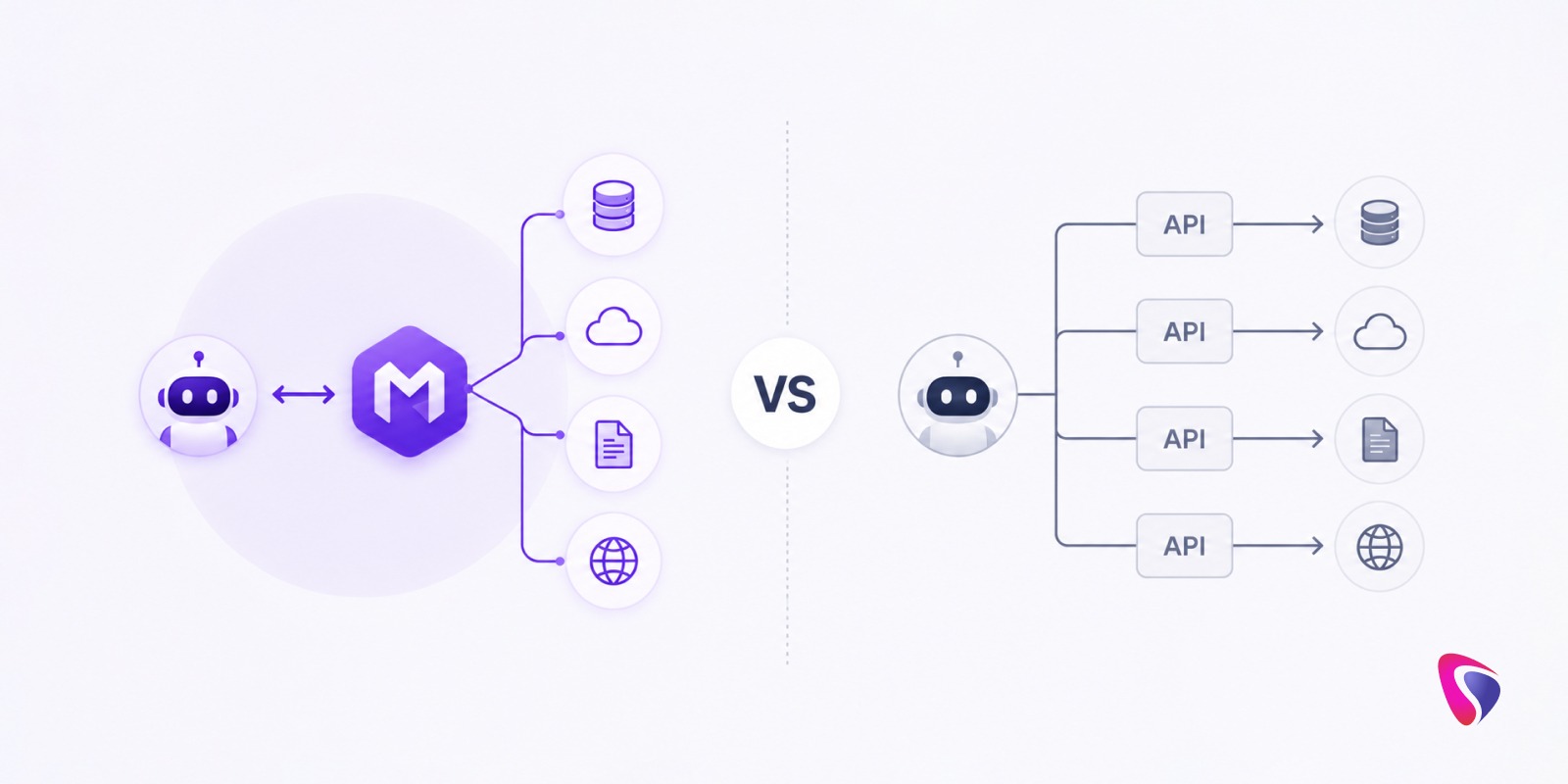
Model Context Protocol is an open standard for connecting AI models and agents to external systems. The key design difference from traditional APIs is that MCP is built around discovery and standardization rather than predetermined, hard-coded connections.
In an MCP architecture, tools, data sources, and capabilities are exposed through MCP-compatible servers. An AI system can query what's available, understand what each capability does, and invoke the ones relevant to the current task - all through a common protocol rather than through a collection of individually built integrations.
The analogy that makes this concrete: traditional APIs are like having a different key for every door in a building, with a human escort required to open each one. MCP is like having a universal access card and a directory that tells you what's behind each door and whether it's relevant to where you're trying to go.
For AI agents specifically, this changes the development economics significantly. Instead of building integrations to every system the agent might need to access, developers build one MCP interface on the AI side and MCP servers on the system side. New capabilities can be added without redesigning the agent. Multiple agents can share the same integration infrastructure. The combinatorial explosion of individual integrations doesn't happen.
MCP vs Traditional APIs: Core Comparison
| Factor | Traditional APIs | MCP |
|---|---|---|
| Designed for AI Applications | No | Yes |
| Dynamic Tool Discovery | No | Yes |
| Enterprise Software Integration | Excellent | Moderate |
| AI Agent Support | Limited | Excellent |
| Integration Maintenance | Higher | Lower |
| Standardization | Varies by vendor | High |
| Ecosystem Maturity | Mature | Emerging |
| Scalability for AI Workflows | Moderate | High |
| Customization Flexibility | Very High | Moderate |
| Enterprise Adoption | Universal | Growing rapidly |
| Security Frameworks | Mature, proven | Still developing |
| Performance Optimization | Excellent | Good |
The table tells an honest story. Neither approach dominates across all dimensions. Traditional APIs are mature, flexible, and universally supported. MCP is purpose-built for AI workflows but is still establishing the ecosystem depth that APIs have built over decades. The architecture decision isn't which one wins - it's which one fits the specific requirement.
How MCP Works in Real-World Enterprise Workflows
The workflow that MCP enables is worth walking through in concrete terms - particularly for teams currently building a copilot for internal enterprise use, where the gap between what stakeholders expect and what traditional integration approaches can deliver tends to surface early and painfully.
A user asks an enterprise AI assistant: "Which customers with open support tickets also have renewals coming up in the next 60 days, and what's been the tone of their recent communications?"
With traditional API integrations, this requires a developer to have pre-built connections to the ticketing system, the CRM renewal data, and the communication records - and to have anticipated exactly this query combination when designing the integration layer.
With MCP, the AI agent receives the query, queries the MCP registry for available tools, identifies that the ticketing system, CRM, and communication platform have exposed MCP-compatible interfaces, pulls the relevant data from all three in whatever order makes sense given what it finds, and synthesizes a response.
The operational difference isn't just developer convenience. It's that the second model can handle query combinations nobody anticipated when the system was built. As business needs evolve and new questions become relevant, the AI's ability to serve those questions doesn't require a new integration sprint.
Where Traditional APIs Continue to Be the Best Choice
Being honest about MCP's current limitations matters for making good architecture decisions.
High-performance transaction processing - payment systems, financial ledgers, real-time inventory management - requires the kind of latency optimization and direct control that traditional API integration provides and MCP's additional abstraction layer introduces friction into. These systems often have compliance requirements around auditability and control that are better served by the mature governance models built around APIs.
Legacy enterprise applications that were built around API-first architectures - and most enterprise software of any age was - aren't going to be re-architected for MCP compatibility quickly. The practical reality is that a large portion of enterprise system landscapes will remain API-based for the foreseeable future, which makes API integration competence non-negotiable regardless of where AI architecture goes.
Custom business logic that involves complex, organization-specific rules and workflows often benefits from the precise control that custom API integration provides. The flexibility to build exactly what the business process requires, without working within the constraints of a general-purpose protocol, has real value for sufficiently complex integration requirements.
Where MCP Delivers the Greatest Business Value
Enterprise copilots - internal AI assistants that need to draw on information from HR systems, project management tools, financial data, knowledge bases, and operational platforms simultaneously - are the use case where MCP's value is most immediately apparent.
Without MCP, building a copilot that can answer "what's the status of the Henderson project, who's working on it, what's the current budget versus actuals, and are there any open blockers?" requires pre-built integrations to project management, HR, finance, and ticketing systems, all coordinated in a custom orchestration layer. With MCP, each of those systems exposes an MCP server, and the AI can compose the answer from them dynamically.
Knowledge management is the other high-value application. Organizations with information distributed across document repositories, wikis, databases, and specialized tools have always struggled to make that information accessible through search. MCP provides a mechanism for AI systems to discover and query across all of those sources through a standardized interface rather than requiring custom connectors for each.
Multi-agent systems - where multiple specialized AI agents need to coordinate and share access to enterprise resources - benefit particularly from MCP because the shared protocol means agents can interoperate without each one maintaining its own integration stack. Organizations building these systems often find the scarcest resource isn't the technology - it's the expertise to implement it correctly. Teams that hire dedicated AI developers with specific experience in MCP architecture move significantly faster than teams learning the stack while simultaneously trying to deliver production systems.
Security Considerations: MCP vs API Governance
Traditional API security is mature for good reasons. OAuth, JWT, role-based access control, rate limiting, audit logging - these frameworks exist because they've been necessary for decades and have been refined through extensive production experience.
MCP security is less settled, which is appropriate honesty given how recently the standard emerged. The core security requirements are the same: authentication controls, access permissions scoped to what each AI system actually needs, audit trails that capture what the AI accessed and what it did, and governance policies that define the boundaries of autonomous AI action.
The specific risks in MCP deployments that traditional API architectures don't face to the same degree include prompt injection - where malicious inputs attempt to manipulate AI agent behavior through the tools it calls - and over-permissioned agents that have access to more than they need. Both are solvable through careful design and explicit governance, but they require deliberate attention rather than inheritance of mature existing frameworks.
For organizations in regulated industries, the security framework maturity gap between APIs and MCP is a practical adoption constraint. Building on top of MCP in a compliance-sensitive environment currently requires more custom governance work than equivalent API-based architectures. That gap will close as the ecosystem matures, but it's real now.
The Reality Check: MCP Does Not Replace APIs
This is the misconception that generates the most confused architecture conversations. MCP doesn't replace APIs. In most practical implementations, MCP sits on top of APIs - the MCP server for a given enterprise system is itself calling that system's APIs to fulfill the AI's requests.
The relationship is complementary rather than competitive. APIs provide direct, reliable access to systems. MCP provides the intelligence layer that lets AI systems use those APIs without requiring a custom integration for every possible combination of systems a workflow might need.
The architecture question isn't which one to choose. It's understanding which layer each technology belongs in. APIs handle system-to-system communication. MCP handles AI-to-system orchestration. Both layers need to be built and maintained well.
The Rise of Hybrid AI Integration Architectures
The organizations making the most progress on enterprise AI integration are building layered architectures where each technology does what it's suited for.
The API layer handles core business application integrations, data exchange between systems, transaction processing, and the direct system-to-system connections that existing enterprise software depends on. This layer looks much like enterprise integration has looked for years - REST and SOAP APIs, integration platforms, managed connectivity.
The MCP layer sits above it, providing the interface through which AI agents access enterprise capabilities. MCP servers expose the relevant capabilities of underlying systems to AI in a form the AI can discover and invoke. New capabilities can be made available to AI systems by adding MCP servers rather than modifying AI applications.
This architecture separates concerns cleanly. Changes to underlying systems are reflected in their MCP servers without necessarily requiring changes to AI applications. New AI applications can access existing capabilities through the MCP layer without requiring new integrations. The governance, security, and access control policies can be applied consistently at the MCP layer.
How to Choose the Right Integration Approach
Traditional APIs
Traditional APIs are the right choice when you're building conventional software integrations where the connections are predetermined, performance optimization is critical, compliance requirements favor established governance frameworks, or you're integrating with legacy systems where API connectivity is already established.
MCP
MCP is the right choice when you're building AI agents that need dynamic access to multiple tools, you're developing enterprise copilots that need to traverse multiple systems at runtime, you're building multi-agent systems where shared integration infrastructure provides operational advantages, or you're prioritizing AI development velocity over maximum integration flexibility.
Combining APIs and MCP
Both are necessary when you're pursuing enterprise-wide AI transformation where AI systems need to interact with a broad range of existing enterprise systems, you want to future-proof the architecture against evolving AI capabilities, and you need the operational reliability of mature API infrastructure alongside the AI-native advantages of MCP.
The Future of AI Integrations Beyond 2026
The enterprise adoption trajectory for MCP is clear enough to project with reasonable confidence. Major enterprise software vendors are adding MCP compatibility to their platforms, which reduces the implementation overhead for organizations building AI on top of those systems. The tooling ecosystem - monitoring, debugging, governance frameworks - is developing rapidly.
Agentic AI ecosystems where networks of specialized agents coordinate across enterprise functions represent the use case where MCP's architectural advantages are most significant. As those deployments become more common, the operational justification for MCP investment becomes more compelling.
The longer-term picture is AI operating systems - centralized platforms that manage AI agent capabilities, integration infrastructure, governance, and monitoring across an organization's AI investments. MCP is well-positioned to be foundational infrastructure in those platforms, providing the standardized connectivity layer that makes cross-system AI orchestration manageable at enterprise scale.
Conclusion
The MCP versus API debate dissolves fairly quickly when you understand what each technology is actually designed to do and where each creates value.
APIs are the proven foundation of enterprise software integration. They're reliable, mature, flexible, and universally supported. Nothing about AI's emergence makes them less relevant for the use cases they're suited for - which include the majority of enterprise system integration requirements.
MCP is a purpose-built solution to a problem that didn't exist at enterprise scale until recently: AI systems that need to dynamically discover and interact with multiple tools and data sources without a developer having pre-built every possible connection. For that specific requirement, MCP is the right architecture.
Organizations building for enterprise AI in 2026 need both layers. The API layer provides the connectivity and reliability that enterprise infrastructure requires. The MCP layer provides the AI-native interface that makes that infrastructure accessible to intelligent, autonomous systems.
The architectural question worth asking isn't which protocol to choose. It's how to build both layers well enough that they can evolve as AI capabilities do - which is moving faster than most enterprise technology architecture cycles were designed to accommodate.
FAQ’s
Q1. What is the main difference between MCP and traditional APIs?
Traditional APIs require predefined integrations, while MCP enables AI systems to dynamically discover and use tools, data sources, and services through a standardized protocol.
Q2. Does MCP replace APIs in AI applications?
No. MCP typically works on top of existing APIs. APIs provide system connectivity, while MCP helps AI agents access and orchestrate those systems more intelligently.
Q3. When should businesses choose MCP over traditional APIs?
MCP is ideal for AI agents, enterprise copilots, and multi-system workflows that require dynamic access to multiple tools and data sources at runtime.
Q4. Are traditional APIs still relevant in 2026?
Yes. Traditional APIs remain the best choice for high-performance transactions, legacy system integrations, compliance-sensitive environments, and custom business workflows.
Q5. What is the best integration strategy for enterprise AI in 2026?
A hybrid approach is often the most effective, using APIs for core system integrations and MCP as the AI orchestration layer for dynamic, cross-platform interactions.