




Enterprise leaders are investing heavily in artificial intelligence, and the numbers reflect the urgency. According to recent market research, global spending on generative AI solutions is projected to surpass $140 billion annually within the next few years, while more than 75% of business executives believe AI will significantly transform their operations. Yet despite this momentum, nearly half of enterprise AI projects struggle to deliver expected results because models lack access to current business knowledge, proprietary data, and domain-specific expertise.
The issue isn't that modern AI models are incapable. Today's foundation models can write content, analyze information, and assist with complex reasoning tasks. Yet despite rapid adoption, studies indicate that nearly half of enterprise AI initiatives fail to achieve their expected business outcomes, while employees still spend up to 20% of their workweek searching for information across disconnected systems. The challenge is that AI models operate primarily on what they learned during training. They don't automatically know your organization's latest policies, customer information, product updates, or industry regulations. As enterprises increasingly depend on AI for customer support, knowledge management, compliance, and decision-making, bridging this knowledge gap has become a strategic priority.
This is where Retrieval-Augmented Generation (RAG) and Fine-Tuning enter the conversation. Both approaches are designed to improve enterprise AI performance, but they achieve this goal through entirely different mechanisms. Choosing the right approach-or combining both effectively-can determine whether an AI initiative becomes a business advantage or remains an underperforming experiment in an era where more than 80% of enterprises are actively investing in AI-driven transformation.
Why Foundation Models Alone Cannot Meet Enterprise AI Requirements
It's worth being direct about the limitation that motivates this whole conversation.
Large language models(LLM) learn from their training data. That training data represents a snapshot of publicly available information up to a cutoff date. It doesn't include your internal documentation, your customer records, your compliance policies, your product specifications, or any of the proprietary information that constitutes your organization's actual knowledge base.
The consequences are predictable. A customer service chatbot built on a general-purpose model can discuss your product category fluently but doesn't know your specific products. An internal knowledge assistant can answer general questions but can't reference the policy your legal team updated last month. A financial advisory tool understands financial concepts but doesn't know the specific regulatory requirements in your jurisdiction or the details of your clients' portfolios.
This is where both RAG and Fine-Tuning enter - as different solutions to the same fundamental problem of bridging the gap between what the model knows from training and what it needs to know to be useful in your specific enterprise context.
Case study : Legal Document Review with Large Language Models
Understanding RAG: How AI Accesses Real-Time Enterprise Knowledge
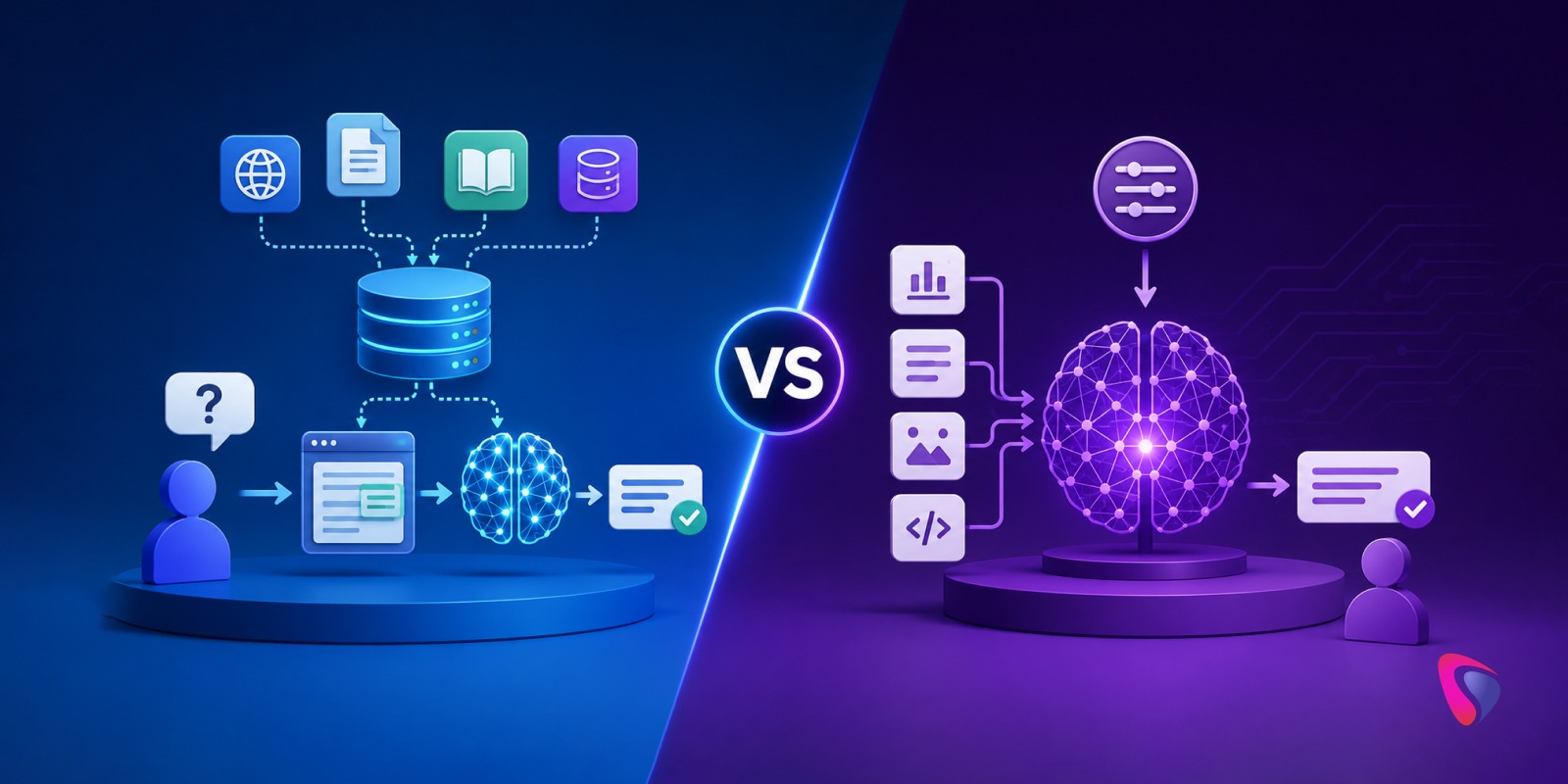
Retrieval-Augmented Generation is an architecture that gives AI models access to external information at the moment they're generating a response. The model doesn't need to have learned something during training to use it - it retrieves relevant content from connected sources and incorporates that content into its reasoning.
The workflow is straightforward in concept, though implementation involves real engineering. A user submits a query. A retrieval system - typically built on vector embeddings and semantic search - identifies the most relevant content from connected knowledge sources. That content is injected into the context the model uses to generate its response. The model produces an answer grounded in retrieved, current, organization-specific information.
The practical effect is significant. An AI system built on RAG can reference documentation that was published yesterday, reflect policy changes that happened last week, and answer questions about information that was never in any public training dataset. The knowledge lives outside the model, which means updating it doesn't require retraining anything.
What RAG doesn't do is change how the model thinks, writes, or interprets domain-specific concepts. The model's underlying behavior - its style, its reasoning patterns, its understanding of terminology - remains whatever it was from pre-training. RAG makes the model more informed; it doesn't make the model more specialized. For organizations exploring this path, RAG Development Services can help architect the retrieval layer correctly from the start, since retrieval quality is ultimately what determines response quality in production.
How Fine-Tuning Transforms AI into a Domain-Specific Expert
Fine-Tuning is the process of continuing to train a pre-existing model on a curated dataset of domain-specific examples. The model's weights are adjusted based on this additional training, embedding domain knowledge, terminology, response patterns, and behavioral characteristics directly into the model itself.
A healthcare organization that fine-tunes a model on clinical documentation and medical literature produces a model that genuinely understands clinical language - not because it retrieves clinical content when needed, but because that understanding is now part of how the model processes and generates language. A legal services firm that fine-tunes on case law and legal reasoning produces a model that approaches questions with legal analytical frameworks baked in.
The distinction from RAG is fundamental: Fine-Tuning changes what the model is. RAG changes what the model knows at a given moment.
This difference has practical implications in both directions. Fine-Tuned models excel at tasks where consistent behavior, specialized terminology comprehension, and domain-appropriate reasoning matter. They don't require retrieval infrastructure or real-time data access for tasks they've been trained on. But updating them when knowledge changes requires retraining, which means time, compute cost, and expertise - and means the model is always working from a snapshot rather than current information.
RAG vs Fine-Tuning: Comparison
| Factor | RAG | Fine-Tuning |
|---|---|---|
| Access to Real-Time Data | Yes - retrieves current content | No - limited to training data snapshot |
| Knowledge Updates | Easy - update the knowledge base | Complex - requires retraining |
| Domain-Specific Behavior | Moderate | Strong |
| Hallucination Reduction | Strong - responses grounded in retrieved content | Moderate |
| Implementation Speed | Faster to initial deployment | Slower - training cycles required |
| Cost of Updates | Lower - update data, not model | Higher - compute-intensive retraining |
| Transparency | High - can cite sources | Lower - knowledge internalized |
| Architectural Complexity | Higher - retrieval infrastructure required | Lower at inference time |
| Enterprise Scalability | Excellent | Moderate |
| Specialized Task Performance | Good | Excellent for specific trained tasks |
| Compliance with Sensitive Data | Cleaner - data stays in retrieval layer | More careful governance required |
The table captures genuine trade-offs. Neither approach dominates across all dimensions, which is why the real answer for most enterprise applications is some combination of both.
Business Scenarios Where RAG Creates the Greatest Enterprise Impact
Dynamic, frequently updated information
is where RAG's architecture is specifically suited and where Fine-Tuning alone is structurally inadequate. If the information your AI needs to be accurate changes frequently - product documentation, compliance regulations, pricing, internal policies, customer records - you need a retrieval architecture. Retraining a model every time relevant information changes is not operationally feasible.
Hallucination reduction in high-stakes applications
is another clear RAG strength. When the model's response is grounded in retrieved content from authoritative sources rather than generated from internalized patterns, factual accuracy improves significantly. Healthcare, legal, and financial services applications - where factual errors have real consequences - benefit substantially from this grounding.
Explainability requirements favor RAG
When a response can be traced back to specific retrieved documents, the basis for that response is auditable. This matters for regulatory compliance, for building user trust, and for debugging when responses are wrong.
Enterprise knowledge management
making distributed organizational information accessible through AI interfaces - is a natural RAG application. The information already exists in documents, wikis, databases, and knowledge bases. RAG provides the interface layer.
The practical challenge with RAG is that retrieval quality determines response quality. A poorly implemented retrieval system that surfaces irrelevant content will produce irrelevant responses regardless of how capable the underlying model is. Vector database design, embedding model selection, chunking strategies, and retrieval ranking all require real engineering attention. Most enterprises find it worth the investment to hire dedicated AI developers with hands-on RAG implementation experience - the architecture is meaningfully more complex than introductory descriptions suggest, and the mistakes made during setup tend to compound.
Where Fine-Tuning Delivers the Most Value
Specialized behavioral characteristics
are Fine-Tuning's home territory. The way a model should reason, the terminology it should use naturally, the format and style of its outputs, the domain frameworks it should apply - these are characteristics that RAG can't install and that prompting can only approximate. A legal AI that thinks like a lawyer, not just one that retrieves legal documents, requires Fine-Tuning.
Consistent output style and tone
is similarly a Fine-Tuning strength. Organizations with strong brand voice requirements, specific communication standards, or industry-specific output formats benefit from a model that has internalized those patterns rather than relying on prompting to achieve them partially and inconsistently.
Classification, extraction, and structured task performance
situations where the model needs to reliably categorize inputs, extract specific information types, or follow precise output schemas - often improve substantially with Fine-Tuning on representative examples. The model learns the specific task rather than approximating it from general capability.
Reduced prompt engineering burden
is a practical benefit that's easy to undervalue. A Fine-Tuned model that produces desired output behavior with minimal prompting is operationally simpler to maintain than a general-purpose model that requires elaborate prompt engineering to stay on task. At scale, that operational simplicity has real value.
The honest challenge with Fine-Tuning is cost and complexity. Dataset preparation requires expertise and curation effort. Training runs require compute resources. Evaluation requires careful design to detect both capability improvements and potential regressions. Organizations without in-house ML engineering capacity often work with a custom AI development company to manage this process - particularly for the dataset curation and evaluation phases, where domain knowledge and technical depth both matter significantly.
Use Case Guidance: Which Approach for Which Application
Customer support systems
typically benefit most from RAG. The information needed - current product documentation, updated policies, specific account context - changes frequently and needs to be accurate. A Fine-Tuned customer service model that doesn't know about last month's product update is actively problematic.
Healthcare AI applications
represent the clearest case for a hybrid approach. Medical terminology, clinical reasoning patterns, and communication style benefit from Fine-Tuning. Current clinical guidelines, patient-specific information, and recently updated regulatory requirements need RAG. A healthcare AI that reasons like a clinician but retrieves current clinical information is more capable than either approach alone.
Case study : Healthcare Automation with AI
Legal research tools
skew toward RAG. Legal information changes, jurisdictions vary, and specific case law matters. The ability to retrieve and cite current, relevant legal content is more valuable than having legal concepts baked into the model - though Fine-Tuning on legal reasoning patterns can complement the retrieval architecture.
Financial services applications
advisory tools, compliance systems, risk assessment - generally benefit from hybrid architectures. Regulatory requirements need to be current (RAG). Financial reasoning patterns and industry-specific communication benefit from domain specialization (Fine-Tuning). Client portfolio information needs to be retrieved, not trained on.
AI writing assistants with specific style requirements
are a Fine-Tuning use case. When the output needs to consistently reflect a particular brand voice, communication standard, or content structure, Fine-Tuning on exemplary content produces more reliable results than prompting a general-purpose model.
Enterprise search and knowledge management
favor RAG architectures. The value is in making existing organizational knowledge accessible, which requires connecting to where that knowledge lives rather than training it into a model.
Understanding the Real Cost of RAG and Fine-Tuning
Cost comparisons between RAG and Fine-Tuning are context-dependent, but some general principles hold.
RAG's costs are primarily infrastructure costs - vector database hosting, embedding generation, retrieval compute, and the ongoing cost of maintaining and updating the knowledge base. These costs are relatively stable and predictable, and they don't spike when knowledge changes.
Fine-Tuning's costs are primarily training costs - compute time for training runs, data preparation and curation labor, evaluation and testing cycles, and the repeated cost of retraining when knowledge needs updating. For models with stable knowledge requirements, these costs are manageable. For domains where relevant information changes frequently, the retraining cycle cost becomes significant.
The crossover point depends heavily on how frequently the knowledge domain changes. For highly dynamic information, RAG is almost always more cost-effective over time. For stable, specialized tasks where behavior matters more than current information, Fine-Tuning often provides better long-term value per query.
Why Hybrid AI Architectures Are Becoming the Enterprise Standard
The most capable enterprise AI applications in 2026 aren't choosing between RAG and Fine-Tuning - they're combining them deliberately, with each approach contributing what it's suited for.
Consider an AI-powered financial advisor deployment. Fine-Tuning on financial advisory conversations, regulatory documentation, and client communication examples produces a model that naturally uses financial terminology, applies appropriate analytical frameworks, and communicates in ways that meet professional standards. RAG connects that model to current market data, specific client portfolios, real-time regulatory updates, and current internal investment products.
The Fine-Tuned model knows how to think and communicate like a financial advisor. The RAG layer ensures it's working with current, accurate, client-specific information. Neither approach alone produces the result - the combination does.
The same pattern applies in healthcare: Fine-Tuning for clinical reasoning and medical terminology, RAG for current clinical guidelines and patient records. In legal services: Fine-Tuning for legal analytical frameworks, RAG for current case law and jurisdiction-specific regulations. In enterprise knowledge management: Fine-Tuning for organizational communication style, RAG for current policy and documentation content. Getting these hybrid architectures right requires experience across both approaches simultaneously - which is why many organizations choose to hire an AI developer who has worked on production deployments of both, rather than specialists in only one method.
A Practical Framework for Selecting the Right AI Strategy
Choose RAG as your primary approach
when the information your AI needs is dynamic, proprietary, or changes frequently; when response accuracy against current facts is critical; when explainability and source attribution matter; or when you need to get something working quickly and maintain it affordably.
Choose Fine-Tuning as your primary approach
when specialized domain behavior, consistent output style, or task-specific performance matters more than access to current external information; when the knowledge domain is stable; or when you're building AI for classification, extraction, or structured output tasks where training on examples produces more reliable results than prompting.
Choose a hybrid approach
when you're building enterprise-grade AI applications where both behavioral specialization and current knowledge access matter; when accuracy, capability, and maintainability all need to be optimized simultaneously; or when the use case involves expert reasoning applied to current information - which describes most of the highest-value enterprise AI applications.
Emerging Trends Shaping Enterprise AI in 2026 and Beyond
Continuous Fine-Tuning techniques that reduce the cost and complexity of keeping Fine-Tuned models current are developing rapidly. As those techniques mature, the maintenance burden that currently favors RAG for dynamic domains will partially diminish - though RAG's real-time access advantage will remain relevant.
Multimodal RAG - retrieval systems that work across text, images, audio, and video - is expanding what RAG can ground AI responses in. Enterprise knowledge exists in many formats, and retrieval systems that can work across them unlock more of it.
Agentic AI systems - where AI agents autonomously execute multi-step workflows - generally depend on RAG architecture because agents need to dynamically access tools and information at runtime. The rise of agentic deployments is driving RAG adoption as much as any other factor.
Agentic AI systems - where AI agents autonomously execute multi-step workflows - generally depend on RAG architecture because agents need to dynamically access tools and information at runtime. The rise of agentic deployments is driving RAG adoption as much as any other factor. Underpinning all of this is the growing demand for LLM Integration Services that connect foundation models to enterprise data sources, internal tools, and existing workflows - making the model useful inside the organization's actual operating environment rather than in isolation.
Conclusion
RAG and Fine-Tuning are complementary tools for the same underlying challenge: making AI systems accurate, capable, and useful in enterprise contexts where general-purpose models fall short.
RAG makes AI more informed - connecting models to current, proprietary, organization-specific information at the moment of use. Fine-Tuning makes AI more specialized - embedding domain expertise, behavioral characteristics, and task-specific capabilities into the model itself. The highest-performing enterprise AI applications increasingly combine both, using each where it contributes most distinctively.
The architectural decision that matters isn't which one to use. It's understanding deeply enough what each approach does - and where each falls short - to combine them effectively for the specific application you're building. Organizations that get this right are building AI systems that are genuinely capable of delivering on enterprise requirements, not just impressive in demos.
That understanding is what separates AI investments that compound in value over time from ones that plateau at proof-of-concept.
FAQ’s
Q1. What is the main difference between RAG and Fine-Tuning?
RAG retrieves external, up-to-date information during response generation, while Fine-Tuning trains a model on domain-specific data to improve its behavior and expertise.
Q2. Which approach is better for handling frequently changing business data?
RAG is better for dynamic information because it can access updated documents, policies, and databases without retraining the model.
Q3. Does Fine-Tuning reduce AI hallucinations?
Fine-Tuning can improve domain understanding, but RAG is generally more effective at reducing hallucinations because responses are grounded in retrieved source content.
Q4. When should enterprises use a hybrid RAG and Fine-Tuning approach?
A hybrid approach is ideal when organizations need both specialized domain expertise and access to real-time, proprietary, or frequently updated information.
Q5. Which is more cost-effective for enterprise AI in 2026?
RAG is typically more cost-effective for evolving knowledge bases, while Fine-Tuning provides better value for stable, specialized tasks requiring consistent behavior and output quality.