



Walk into most enterprise data strategy conversations in 2026 and you'll hear some version of the same tension. The business side wants to know why AI initiatives aren't delivering personalization at the level competitors seem to be achieving. The data side wants to explain that the problem isn't the AI - it's that customer data is scattered across seven systems that don't talk to each other, and no one has agreed on which one to trust.
That tension is the reason both Salesforce Data Cloud and Snowflake are on so many enterprise shortlists right now. They both promise to resolve it. They resolve it in genuinely different ways, and understanding that difference is what actually informs a good platform decision.
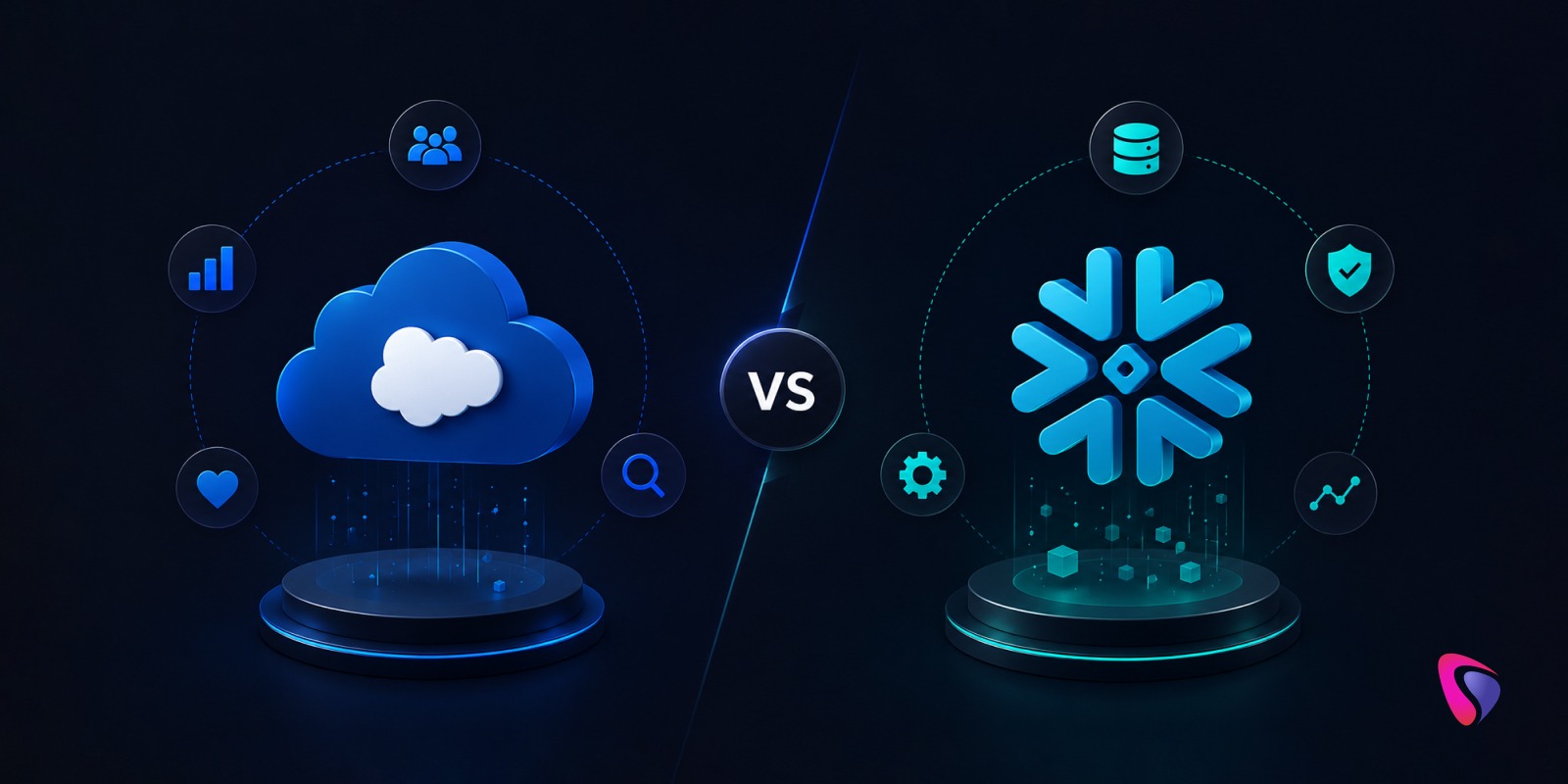
The short version: Salesforce Data Cloud was built to answer the question "how do we know who our customer is across every touchpoint, and how do we act on that in real time?" Snowflake was built to answer a broader question: "how do we store, process, and make accessible every kind of enterprise data at scale?" One is a customer intelligence platform with an activation engine at its core. The other is an enterprise data infrastructure platform that can support customer intelligence as one of many workloads. Neither is universally better. What matters is which question your organization is actually trying to answer.
This guide works through that distinction in enough detail to be useful - covering architecture, AI capabilities, customer data management, integration depth, cost structure, and what the decision actually looks like for different types of organizations.
Why Data Infrastructure Has Become the AI Strategy Conversation
Most AI initiatives don't fail because the models are bad. They fail because the data feeding the models is fragmented, inconsistent, or inaccessible in the moment the AI needs it.
Customer data in particular tends to exist in a state that's charitable to call distributed. CRM systems hold relationship history. Marketing platforms hold behavioral data. eCommerce systems hold transaction records. Support tools hold service history. ERP systems hold financial context. Each of those systems has its own data model, its own definition of a customer record, its own update cadence. When an AI system needs a complete picture of a customer to personalize an experience or make a recommendation, it's working from fragments - and the quality of the output reflects that directly.
This fragmentation problem is what both platforms address, though they approach it from different angles and with different depths of capability in different areas. Understanding where each one excels requires understanding what each was actually designed to do.
What Is Salesforce Data Cloud?
Salesforce Data Cloud is Salesforce's answer to a specific problem: customer data that lives in too many places to be useful for real-time business operations.
The platform ingests customer information from across the Salesforce ecosystem - Sales Cloud, Service Cloud, Marketing Cloud, Commerce Cloud - as well as external systems, and builds unified customer profiles that are accessible across all of those touchpoints simultaneously. It's not just a storage layer. The design intent is activation: taking what's known about a customer and making it available to every business process that touches that customer, in real time.
This architecture is what makes Data Cloud particularly well-suited for AI use cases that are customer-facing. Einstein AI and Agentforce - Salesforce's autonomous AI agent platform - draw on Data Cloud's unified profiles to generate personalized recommendations, route service inquiries intelligently, trigger marketing sequences at the right moment, and support sales teams with contextual intelligence. The AI isn't working from a static snapshot. It's working from a continuously updated profile that reflects the most recent customer interaction regardless of which channel it happened through.
For organizations that have already committed significantly to the Salesforce ecosystem, the value of this integration depth is hard to overstate. Working with an experienced salesforce development company to implement Data Cloud properly means the setup and configuration work required to achieve equivalent results - by pulling data from Salesforce into a separate platform and then pushing insights back - is handled correctly from the start rather than retrofitted later.
Case study : Ticket Resolution with Salesforce Service Cloud
What Is Snowflake?
Snowflake is a different kind of answer to a different version of the data problem.
Where Data Cloud is purpose-built for customer data and customer-facing operations, Snowflake is a general-purpose enterprise data platform. It handles structured and unstructured data at scale, across virtually every organizational function - finance, operations, supply chain, product analytics, research, customer data, and more. Its architectural design separates storage from compute, which allows it to scale each independently and deliver cost efficiency at very high data volumes.
Snowflake's strength is breadth and flexibility. Data scientists working on machine learning models, analysts building cross-functional reports, engineering teams running data pipelines, business intelligence tools consuming aggregated datasets - all of these workloads can run on Snowflake simultaneously without competing for resources in ways that degrade performance.
The Data Marketplace, which lets organizations share and access data sets from external providers, is another capability that distinguishes Snowflake for organizations whose AI and analytics needs go beyond their own first-party data. That kind of external data enrichment is difficult to replicate in a platform optimized for a single ecosystem.
What Snowflake is not is a turnkey customer intelligence platform. Organizations that want unified customer profiles, identity resolution, and real-time activation in Snowflake can build those capabilities - but building them requires meaningful engineering investment that Data Cloud provides out of the box.
Feature Comparison: Where Each Platform Stands
| Feature | Salesforce Data Cloud | Snowflake |
|---|---|---|
| Primary Purpose | Unified customer profiles and activation | Enterprise-scale data storage and analytics |
| Customer Profiles | Native, built-in | Requires custom development |
| CRM Integration | Deep native Salesforce integration | Requires engineering work |
| AI Personalization | Built-in via Einstein and Agentforce | Requires configuration and tooling |
| Data Warehousing | Limited relative to Snowflake | Core capability |
| Real-Time Activation | Strong | Moderate |
| Enterprise Analytics | Moderate | Strong |
| AI Model Support | Salesforce AI ecosystem | Broad, multi-framework AI ecosystem |
| Data Sharing | Limited | Extensive via Data Marketplace |
| Multi-Cloud Support | Moderate | Strong |
| Marketing Activation | Native | Requires additional tools |
| Customer Journey Intelligence | Strong | Custom implementation required |
The table reflects genuine trade-offs rather than a clear winner. Data Cloud wins on customer-specific capabilities and activation speed within the Salesforce ecosystem. Snowflake wins on breadth, analytics depth, and flexibility for organizations with diverse data workloads.
Customer Data Management: Where Data Cloud Has the Advantage
Customer data management is the area where the gap between these platforms is most pronounced - and where the choice between them is most consequential for customer-facing AI initiatives.
Salesforce Data Cloud was designed from the ground up to solve identity resolution at scale. When a customer interacts through email, then visits the website, then contacts support through a mobile app, Data Cloud is built to recognize those as the same person and consolidate the interactions into a single profile - even when the underlying identifiers are different. That unified profile then becomes accessible across every Salesforce application without additional engineering work.
The practical business impact of this: marketing teams can see the service history of the customer they're about to target. Sales teams can see recent support interactions before a renewal conversation. Agentforce deployments can access the complete relationship history when a customer initiates a conversation. The data that exists is actually usable in the moment it's needed.
Snowflake can store all of that same data. What it doesn't provide natively is the identity resolution logic, the real-time profile consolidation, or the activation layer that makes unified customer data available across business processes without additional tooling. Organizations that want to build those capabilities on Snowflake can do it - but they'll typically need to hire dedicated Salesforce developers or data engineers with cross-platform experience to bridge the gap between raw storage and operational activation.
AI Capabilities: A More Nuanced Comparison Than It Appears
Both platforms have made significant AI investments, but they're optimizing for different kinds of AI workloads.
Salesforce Data Cloud's AI story is about activation. The platform provides the data foundation that makes Einstein AI and Agentforce effective in customer-facing contexts. Personalized product recommendations, AI-generated sales email sequences, intelligent service routing, predictive engagement scoring - these capabilities work well partly because the AI has access to comprehensive, current, unified customer data rather than stale exports or partial snapshots. The integration is tight enough that AI capabilities can be deployed without building a data pipeline to feed them.
Snowflake's AI story is about flexibility. Data scientists can train models on Snowflake data using the frameworks they prefer - Python, R, Spark, whatever fits the team's existing skills and workflows. Organizations building proprietary AI models, data products, or analytical applications that go beyond what any packaged AI platform provides have significantly more room to work in Snowflake. The Snowpark platform allows data science and ML workflows to run directly on Snowflake data without exporting it, which simplifies the development cycle considerably.
For generative AI specifically, the choice follows the same pattern. Data Cloud is the right choice when the generative AI application is customer-facing and benefits from deep integration with Salesforce workflows. Snowflake is the right choice when the generative AI workload is part of a broader enterprise AI platform, involves data from multiple departments or external sources, or requires the flexibility to swap AI frameworks as the technology evolves.
Also read : Einstein GPT vs ChatGPT
Integration Depth: Ecosystem Fit Matters More Than Feature Lists
Integration is where theoretical feature comparisons often diverge most significantly from practical implementation experience.
Salesforce Data Cloud's integration story is essentially its native connectivity to the Salesforce ecosystem. If your CRM, marketing automation, customer service platform, and commerce infrastructure are all Salesforce products, Data Cloud connects to all of them without integration engineering work. Changes in one system propagate to the unified customer profile. Insights generated from the profile flow back into the operational systems where teams actually work. The loop closes natively.
The limitation of this is its mirror image: organizations with significant technology investments outside the Salesforce ecosystem get less value from that native connectivity. This is where Salesforce consulting services become particularly valuable - helping organizations map which integrations are worth the engineering effort and which third-party connections genuinely erode the time-to-value advantage Data Cloud is supposed to deliver.
Snowflake's integration story is essentially the opposite. Its partner ecosystem and connector library are extensive enough that it can ingest data from nearly any source and expose processed data to nearly any downstream tool. Business intelligence platforms, ML frameworks, data pipeline tools, cloud providers - Snowflake has connectors or native integrations with most of them. For organizations running heterogeneous technology stacks, this flexibility is a genuine advantage.
Scalability: Different Architectures for Different Growth Patterns
Both platforms scale. The question is what kind of scaling they're optimized for.
Salesforce Data Cloud scales in the customer engagement dimension - handling larger volumes of customer profiles, higher frequency of profile updates, more complex identity resolution across more sources, real-time activation at higher traffic volumes. The architecture is optimized for the latency requirements of customer-facing operations, where a 200-millisecond response time matters in a way it might not for a nightly batch analytics job.
Snowflake scales in the enterprise data dimension - handling larger datasets, more concurrent analytical workloads, more complex queries, more diverse data types. Its separation of storage and compute is specifically designed to let organizations add compute capacity for intensive analytical workloads without paying for that compute when those workloads aren't running. For organizations with variable analytics demand - heavy workloads at end of quarter, lighter loads day-to-day - that architectural choice has meaningful cost implications.
For genuinely large-scale data processing beyond customer engagement data - financial modeling, supply chain analytics, large-scale machine learning training - Snowflake generally has the advantage.
Real-World Use Cases: Where Each Platform Actually Performs
Understanding where each platform creates the most value is more useful than comparing feature lists in the abstract.
Salesforce Data Cloud makes the most sense when:
An enterprise is deeply invested in the Salesforce ecosystem and wants customer intelligence available across all of those touchpoints without significant integration engineering. When the strategic priority is customer experience improvement - more personalized marketing, better service interactions, AI-powered sales support - and the team wants those capabilities operational quickly. When Agentforce adoption is part of the roadmap and the AI agents need access to comprehensive, current customer context to be effective. When marketing personalization requires real-time data activation rather than batch processing.
Snowflake makes the most sense when:
An organization needs a single platform for data from across the entire business - not just customer data. When data science teams require the flexibility to work with diverse datasets, train proprietary models, and build custom analytical applications. When business intelligence and reporting needs span multiple departments with different data sources and different analytical requirements. When external data enrichment through the Data Marketplace is part of the analytics strategy. When the technology stack is heterogeneous and a platform that integrates widely matters more than one that integrates deeply with a single ecosystem.
Cost Structure: What Actually Drives the Bill
Cost comparisons between these platforms are difficult to make in the abstract because both are priced in ways that scale with usage, and the usage patterns vary enormously by organization.
Salesforce Data Cloud pricing is typically tied to the volume of unified customer profiles managed, data activation volumes, and the specific Salesforce licenses already in place. For organizations already paying for Salesforce enterprise products, Data Cloud licensing often sits on top of existing investment rather than replacing it. The ROI calculation for Salesforce-centric organizations tends to focus on revenue impact - improved conversion rates, better retention, reduced service costs - rather than infrastructure cost reduction.
Snowflake's billing is consumption-based - storage costs and compute credits that scale with how much data you're storing and how much processing you're running. The model can be very cost-efficient at moderate scale and very expensive at high volume without careful governance of query efficiency and resource allocation. Organizations that implement Snowflake without paying attention to query optimization and cost controls regularly encounter billing surprises. Those that manage it carefully often find it competitive with or cheaper than traditional data warehouse alternatives.
The Case for Using Both
This is increasingly how sophisticated enterprises are approaching the decision - not as an either/or choice but as a complementary architecture where each platform does what it does best.
The pattern that's emerged: Snowflake as the enterprise data foundation, handling analytics, ML model development, operational reporting, and cross-functional data sharing. Salesforce Data Cloud as the customer activation layer, drawing on data that may originate in Snowflake but taking responsibility for customer identity resolution, profile unification, and real-time activation across Salesforce applications.
The Salesforce and Snowflake partnership has made this architecture easier to implement than it was previously. Data doesn't have to move repeatedly between the two systems - the integration layer allows Data Cloud to work with data that lives in Snowflake without full replication. Organizations get the analytical depth of Snowflake and the customer activation capabilities of Data Cloud without maintaining two completely separate data estates.
Future Trends Shaping the Decision
Agentic AI is the trend that's making unified customer data most urgent in 2026. AI agents that interact with customers - in service contexts, sales contexts, or marketing contexts - are only as good as the customer context they can access. An agent that has to work from incomplete or stale data produces interactions that feel generic at best and wrong at worst. Both platforms are investing in making their data available to AI agents, but Data Cloud's architecture is more directly optimized for the real-time, customer-specific context that effective agents require.
Real-time personalization expectations have shifted the calculus on batch versus streaming data architectures. Customers interacting with brands in 2026 expect experiences that reflect their recent behavior - not their behavior from last week's batch export. This expectation favors platforms with real-time activation capabilities, which is a relative strength of Data Cloud.
Data sovereignty and compliance requirements are influencing platform selection in regulated industries and global organizations. Both platforms have made investments in data residency, privacy controls, and compliance frameworks, but the specific requirements of healthcare, financial services, and government customers vary enough that evaluation against specific regulatory requirements is essential before any decision.
Which Platform Should Your Organization Choose?
Choose Salesforce Data Cloud if
The Salesforce ecosystem is your primary operational environment, customer experience and personalization are strategic priorities, you want AI capabilities operational quickly without significant custom development, and Agentforce is part of your near-term AI roadmap.
Choose Snowflake if
You need a platform that serves the entire enterprise rather than primarily customer-facing functions, your data science team requires flexibility to build and train proprietary models, your technology stack is heterogeneous and broad integration capability matters more than deep ecosystem integration, and enterprise analytics across multiple departments is a primary requirement.
Consider both if
Your Salesforce investment is significant and your analytics and AI needs extend beyond CRM use cases, you want enterprise-grade analytics infrastructure alongside purpose-built customer intelligence capabilities, and your organization is mature enough to manage the integration complexity that comes with a dual-platform architecture.
Conclusion
The Salesforce Data Cloud vs Snowflake decision is genuinely strategic, not just technical. Getting it wrong doesn't just mean choosing a less convenient tool - it means building AI and data capabilities on a foundation that isn't designed for what you're actually trying to accomplish.
Data Cloud is the right foundation for organizations whose primary ambition is activating customer intelligence across every touchpoint and doing it quickly within a Salesforce-centric environment. The platform earns its cost when customer experience improvement is the measurable outcome and the Salesforce ecosystem is where the business operates.
Snowflake is the right foundation for organizations whose ambitions span the full enterprise - where customer data is one important input among many, where data science teams need room to work, and where analytical flexibility matters more than any single ecosystem's depth of integration.
The organizations navigating this decision most effectively in 2026 are the ones that have been honest about both what they're trying to accomplish and where they actually are in their data maturity. A technically sophisticated answer built on the wrong strategic premise delivers the wrong outcome, regardless of how well it's implemented. Start with the business problem. Let the platform decision follow from there.
FAQ’s
Q1. Is Salesforce Data Cloud better than Snowflake for AI?
It depends on the use case. Salesforce Data Cloud is stronger for customer-facing AI, personalization, and Agentforce integrations, while Snowflake offers greater flexibility for enterprise AI, machine learning, and custom model development.
Q2. Can Salesforce Data Cloud and Snowflake work together?
Yes. Many enterprises use Snowflake as their central data platform and Salesforce Data Cloud as the customer activation layer, combining advanced analytics with real-time customer engagement.
Q3. Which platform is better for customer data management?
Salesforce Data Cloud has the advantage because it provides built-in identity resolution, unified customer profiles, and real-time activation capabilities without extensive custom development.
Q4. Is Snowflake a Customer Data Platform (CDP)?
No. Snowflake is primarily a cloud data platform and data warehouse. While it can support CDP-like capabilities, organizations typically need additional tools and engineering effort to create unified customer profiles and activation workflows.
Q5. Which platform is more cost-effective in 2026?
The answer depends on usage patterns. Salesforce Data Cloud often delivers faster ROI for Salesforce-centric organizations, while Snowflake can be cost-efficient for large-scale analytics if compute usage and data workloads are carefully managed.