




Top 8 Software Development Life Cycle Models in 2026
Apr 2026



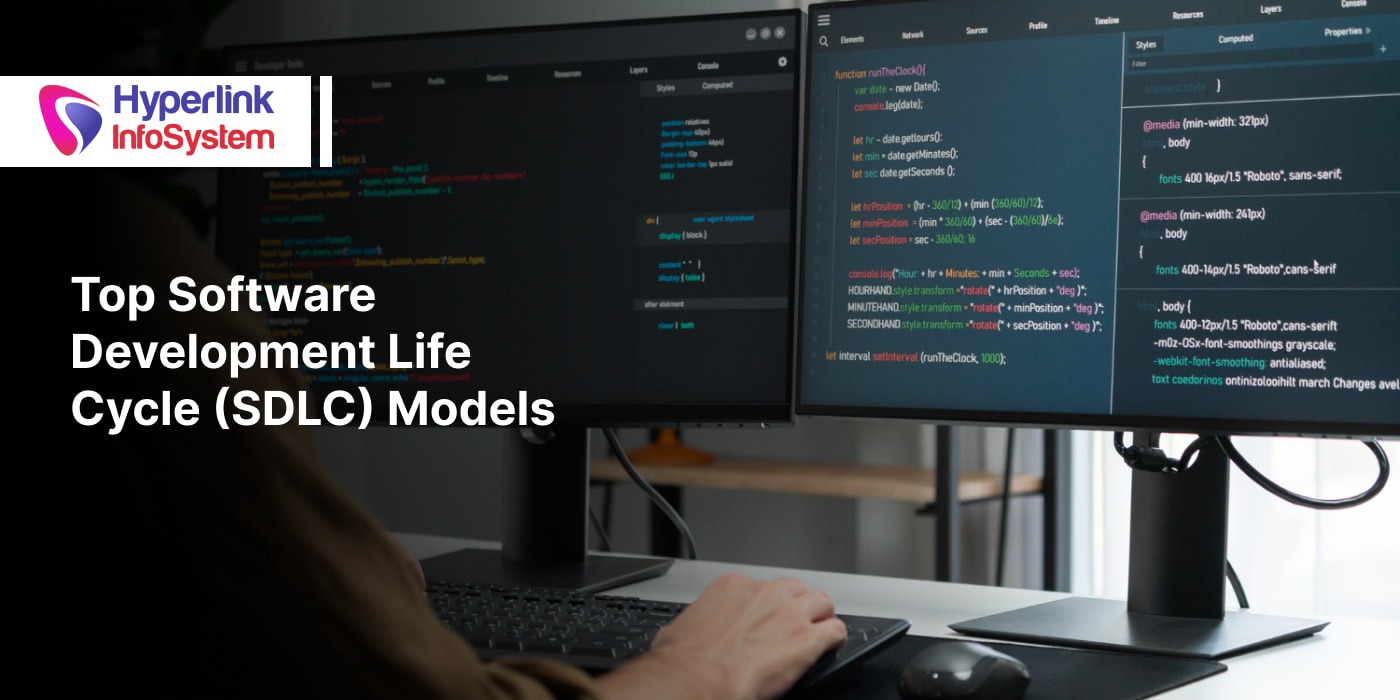

Many people have the misconception that software development involves only coding. If that were true, 90 percent of developers would be rich and famous. Having a smart idea is just one part of the process. It does not guarantee software development success. For achieving success in a software development project, companies should also get the other stages right.
These stages include planning, execution, and a foolproof post-launch strategy. Also, companies are under great pressure to adopt advanced technologies. Customer expectations have also forced companies to change their software development strategies.
Completing the project as per the agreed deadlines also adds pressure. As per a survey, 75% of businesses expect their software projects to fail. Most companies’ software development projects fail due to the following reasons;
- Poor Communication
- Unrealistic Expectations
- Insufficient testing
The above-mentioned challenges are only a few of the challenges that companies may face. Depending on the company’s project, specific goals, and other factors, other challenges may also emerge. Choosing the right software development model helps manage many of these challenges. Also, it ensures that the project stays on track from the first day.
In addition, companies can also customize and tweak their software development strategies if required. Each department and individual involved in the project will remain on the same page.
All of this sounds great, but it brings us to the burning question. What is the best software development lifecycle model in 2026? Things have become complicated in the past few years. This is because project requirements may change quickly. Also, companies must consider the budget, team size, quality, and other factors. In this blog, we will discuss the best software development models in 2026. Let’s get started.
What is a Software Development Cycle?
A software development cycle is the process of developing software from start to finish. This includes ideation, execution to launch, and maintenance. The software development consists of different stages. Each stage requires careful consideration and planning. A mistake in one stage can affect the other stages.
The software provides a clear idea of how to approach software development. It also has a roadmap for all the stages, along with the minor aspects that require attention. At the same time, the software development cycle guides companies on how to adhere to budgets and deadlines. If there are changes, the roadmap has strategies to manage them.
The core stages in a software development cycle are as follows-
- Planning and Requirement Analysis
- System Design
- Development
- Testing and Quality Assurance
- Deployment
- Maintenance and Support
Also Read, Software Development Tech Stacks
8 Top Software Development Models in 2026
When it comes to software development, companies can choose from different models. Every company has different requirements with unique needs, constraints, and budgets. Also, certain software development models suit certain development styles. Below are the 7 most popular software development models in 2026.
The Waterfall Model
The Waterfall development model is a traditional and systematic model that companies use to build software. With this model, companies must follow a detailed approach that involves many steps. Simply put, this model is like water flowing down a waterfall. The water can only flow downward; there is no other direction. Below are the steps that companies must follow when using the Waterfall software development model.
- Company understands the client's needs and gathers the required information.
- Create a system design. This is where the app/software structure is planned.
- Developers write code for the software.
- Testing is conducted to identify flaws and bugs, if any.
- Once the final product is ready, it becomes ready for deployment.
- Software maintenance and refinement are important to ensure its relevance.
Companies must remember that the Waterfall development model does not have any shortcuts. It's a methodical approach. Each stage must be completed before moving to the next one. Changing the sequence of these steps would mean changing everything from the start.
This would consume additional time and resources. Changes would mean delaying the overall development. This is true, especially for government or enterprise software development projects.
Pros of the Waterfall Software Development Model
- Simple and easy to understand
- Clear structure with each phase explained in detail.
- Managing development and tracking progress is easy.
- Ensures strong documentation for each stage.
- Best when requirements are fixed and clear.
Cons of the Waterfall Software Development Model
- Making changes and corrections is hard.
- Not a good fit for projects with ever-changing requirements.
- Testing is conducted at the end. Errors will be identified late.
- The finished product is ready only after completing the last stage.
- Higher chances of failure when requirements are misinterpreted.
Agile Model
The Agile software development model is unique because it offers great flexibility. Also, this approach places greater emphasis on teamwork and collaboration. Processes and tools are the second priority. With the agile software development model, the project is divided into multiple short cycles.
Additionally, the Agile development model promotes close teamwork between professionals involved in a project. This includes developers, testers, designers, and others. The project head conducts such meetings at regular intervals. These meetings are to discuss project progress and find solutions to problems. Improvements can be made to the project if necessary. Meetings are an integral part of the Agile development model.
Unlike other software development models, the agile model does not focus heavily on documentation. It focuses more on software and continuous development. This approach helps companies realize the following benefits:
- Quicker Feature Development
- Reduced Risks
- Improved Product Quality
Most importantly, agile development helps companies adapt to evolving business needs. This ensures its relevance and continuity over time.
Pros of the Agile Software Development Model
- Flexibility and adaptability under different situations.
- Faster delivery and frequent releases.
- Gathers continuous feedback from customers to improve quality.
- Encourages teamwork and transparency.
Cons of the Agile Software Development Model
- Making predictions related to costs and timelines becomes easier.
- Requires constant involvement of clients.
- Detailed documentation is not that important.
- Challenging for large/complex projects.
Hybrid Model
The hybrid software development model is excellent for adapting to project changes. It is a combination of two or more development models. The most common development models used include the following:
- Waterfall
- Agile
- Spiral
- Incremental
Company owners and key decision makers choose the development model based on business needs. The development process changes according to business requirements. Not the other way around. Considering the project guidelines, technical needs, budget, and other constraints, the team picks the best combination.
Below is a simple explanation of how this model works.
- Starts with a plan-driven phase. This is similar to the Waterfall development cycle. It defines the architecture, high-level requirements, timelines, budgets, compliance needs, and more.
- This type of planning is best suited for regulated sectors and enterprise companies. Even contract-based projects can benefit from it.
- After the planning and design phase is over, the team adopts small cycles to build the project. These software cycles are similar to the Agile style.
- Teams build software in short spurts or phases. Continuous testing is done, and stakeholder reviews are considered after every phase.
- Feedback is incorporated from time to time. However, this feedback doesn’t affect the overall project progress or structure.
- For projects involving high-risk or technically uncertain aspects, teams may use spiral model techniques.
- Features that require new technologies, demand extra security, or greater performance are risky. Teams conduct a risk analysis to handle them.
- Building POC (proof of concept) or experimental versions helps test the software before implementation or launch.
- If something fails, the results will be highlighted early. Plus, fixing the mistake won’t cost the company heavily.
- Stable components will follow a linear flow.
- Uses documentation only for key checkpoints. Detailed documentation of everything and at all stages is not necessary.
- Balances predictability and adaptability. This ensures flexible governance.
Pros of the Hybrid Software Development Model
- Hybrid model combines structure and flexibility. It also incorporates the best of planning while ensuring adaptability.
- Ideal for large, complex, or regulated projects.
- Different teams can combine various models to achieve their goals.
- Designs and plans are created early. After each stage, the teams get feedback from users or stakeholders. This helps to correct errors early on.
Cons of the Hybrid Software Development Model
- Hard to manage because it combines many SDLC models.
- Hybrid models require experienced project managers plus clear communication.
- Undefined roles and development phases may confuse employees.
- Includes higher overheads for planning, documentation, and communication.
Spiral Model
The Spiral model is a software development model where development happens in phases. At the same time, team members check for potential issues. Project development happens in different cycles, also known as spirals. Each spiral or phase starts with planning. Team heads decide how the spiral should start and what it must achieve. It also considers the cycle’s specific requirements and alternatives.
In the second stage, teams conduct a detailed risk analysis. This helps them identify problems that may arise during software development. Problems can include technical issues, adherence to schedules, or budget. Then the software development task is performed. Certain features are tested to check how the app works. Before the employees begin working on the next spiral, stakeholders will review everything. After review, the latter will share their feedback.
If any changes are required, the team will work on them. With each stage, the software continues to improve. The main focus of the spiral model is to identify and manage risks proactively.
Pros of the Spiral Software Development Model
- Focuses greatly on identifying risks and minimizing them.
- Allows flexibility as per project requirements.
- Constant feedback from users/stakeholders improves quality.
- Spiral models are best for large and complex projects.
Cons of the Spiral Software Development Model
- Can be complex and hard to manage.
- Requires considerable budget.
- Also requires strong expertise in risk analysis.
- Small, low-risk projects may not benefit from this model.
V-Model
V-Model is a unique software development approach where testing is conducted along with development. When matching and development are planned side by side, it forms a V shape. There are two sides of the V-shaped model.
- Left-Hand Side - Includes requirement analysis, system design, and detailed design.
- Right-Hand Side - Different types of testing. This includes unit, integration, system, and acceptance testing.
The testing is conducted after the completion of each phase. This approach ensures that the output aligns with project goals and expectations. Along with testing, even detailed documentation is prioritized. With a phase-wise testing approach, errors are caught quickly. It is better to fix multiple errors after the product is ready. It also helps track the source of the error. The V-model is ideal when everyone is aware of the project requirements.
Pros of the V-Model Software Development Model
- Focuses on early testing. This ensures quick rectification of errors.
- Provides a clear structure with a complete idea of phases and deliverables.
- Tracking progress and finding errors is simple.
- Focuses mainly on the quality of validating requirements.
Cons of the V-Model Software Development Model
- Has a rigid structure. Difficult to change after development starts.
- Unsuitable for projects with constantly changing requirements.
- Does not provide much flexibility for customer feedback during development.
- Using this model for small projects can be expensive and time-consuming.
DevOps Methodology
The DevOps methodology is a fairly recent software development model. It prioritizes collaboration between development and operations teams. The collaboration should remain continuous throughout the software development project’s duration. The main aim of the DevOps methodology is to speed up the software development process. Simultaneously, it also aims to improve the process’s reliability. Also, this SDLC model eliminates traditional silos.
In traditional development processes, each stage is isolated. After one stage is over, the next one begins. This changes with the DevOps methodology. Whether it's software development, testing, or deployment, everything is shared and continuous. Other key traits of this development model include the following:
- Automation - Crucial in building, testing, and deploying software.
- Continuous Integration - Every change in the SDLC model must be merged and tested.
- Continuous Delivery & Deployment - Releasing updates fast, safe, and simpler.
- Monitoring and Feedback - Enables teams to detect problems proactively in practical usage.
- Code-Managed Infrastructure - Write the infrastructure once. The system builds it the same way each time.
- Security - Security is a part of the process. It is not an afterthought.
Overall, the DevOps software development model focuses mainly on speed, quality, and continuous improvement.
Pros of the DevOps Methodology
- Faster software development and updates
- Better inter-team collaboration
- Early and quick bug detection and fixing.
- Improved system reliability and scalability.
Cons of the DevOps Methodology
- High costs for setup and tooling.
- Requires a drastic change in culture and mindset.
- Managing complex automation is challenging.
- Requires skilled professionals.
- May not be beneficial for small or static projects.
Rapid Acceleration Development (RAD) Model
This model focuses on building software quickly, but with a difference. Users are required to provide regular feedback while developers use ready-made components. Unlike other software development models that plan everything at the start, the RAD model creates several versions of the app. It focuses on speed and involves all the users. From planning and design to final delivery, the teams will be involved and provide proper feedback. This approach will enable companies to make changes easily.
Additionally, the RAD model uses special tools and frameworks to make development quicker. Testing and software development happen simultaneously. When users have a clear idea of what to achieve with software development, the RAD model is great. But these details will change as and when users provide feedback. In short, the main goal of RAD is to develop software quickly and efficiently.
Pros of the RAD Model
- Faster development and faster completion.
- User is involved during each stage. This improves clarity.
- Making changes at later stages is easy.
- Reusable components make development faster and simpler.
- The detection of issues early becomes possible due to early prototypes.
Cons of the RAD Model
- Unsuitable for large or complex development projects.
- Constant user availability and feedback are a must.
- Requires skilled developers and advanced tools.
- Unclear requirements make project management difficult.
- Lack of control can lead to poor documentation.
Feature-Driven Development Model (FDD)
FDD is an agile software development model. In this model, companies focus on designing and developing software by breaking up the system into multiple features. These features are the ones that the client wants in the final product. Below is a short explanation of how the FDD model works.
- Create a simple model of the system. This helps everyone understand how the business works and what the software must achieve.
- Developers must identify the features that the software must have. They must list them clearly and in simple language.
- All these features must be arranged in a way. This will help developers and others work in an easy, step-by-step manner.
- Every feature is designed to enable design, development, and testing to happen quickly. It normally takes a few days.
- Before starting development, FDD focuses on design and detailed documentation.
- Everyone working on the project will have their roles clearly defined. This includes developers and others who work on technical aspects.
- The yardstick for measuring progress is the number of features developed. The number of tasks does not matter.
In this way, the feature-driven development model enables everyone to monitor the progress of the project.
Pros of the FDD Model
- Prioritizes client-focused features. Easy to track progress.
- Encourages excellent design and clear documentation.
- Ideal for large and complex projects.
- Results are regular and visible.
Cons of the FDD Model
- Unsuitable for small projects.
- Not feasible without experienced developers and strong leaders.
- Does not allow much flexibility due to sudden changes in project needs.
- Initial modeling may require additional time.
Wrap Up
Choosing the right software development cycle for a project can be confusing. With the right guidance and a thorough understanding of project requirements, companies can make it simple. Understand that we have covered 8 software development cycles in this blog. That said, there are many other models that companies use to optimize their software development projects. The choice of software development cycle depends on the company’s unique goals, budget, and other factors. Technical knowledge of the team and long-term vision must also be taken into consideration.
Despite so much information available online and a team of experienced employees, it may be hard to choose the right software development cycle. Hyperlink InfoSystem can help your company streamline this process. With 12+ years of industry experience, we are not your regular app development company. From game development, AI and ML projects, e-commerce development, to web and CMS development, our services cover a wide spectrum of offerings.
Connect with our experts to see what we can do for you.

Frequently Asked Questions
The best software development lifecycle models for enterprise-grade projects include Agile, Waterfall, Spiral, and Hybrid. However, business needs can differ from company to company. It is best to partner with a software development and consulting firm.
Choosing the best software development lifecycle model can be confusing for many companies. We will not go into the technicalities of the process. However, we will list the basic steps to choosing the best software development lifecycle model for a project.
- Understand Project Requirements
- Consider Project Size and Complexity
- Evaluate Risk and Criticality
- Analyze Customer Involvement
- Assess Team Skills and Experience
- Check Product Time to Market Needs
- Must Align with Company Culture
- Ensure Adequate Compliance
The cost of hiring software developers can vary based on the geographical location. Below are the average hourly rates for hiring software developers in the U.S. and elsewhere.
- India - $18 - $40/hour
- North America - $75 - $150/hour
- South America - $30 - $65/hour
- Asia - $20 - $50/hour
- Europe - $35 - $120/hour
Yes, testing is crucial in every software development cycle (SDLC) model. But the timing may vary for each model. In the Waterfall model, testing happens after the software development process is complete. But for the V-model, testing happens at the same time as each development phase. Testing requirements differ for other models as well.
Documentation helps companies track project requirements and design decisions. They can use documentation to check what has been done and where mistakes have happened. This documentation also helps with future maintenance.
Harnil Oza is the CEO & Founder of Hyperlink InfoSystem. With a passion for technology and an immaculate drive for entrepreneurship, Harnil has propelled Hyperlink InfoSystem to become a global pioneer in the world of innovative IT solutions. His exceptional leadership has inspired a multiverse of tech enthusiasts and also enabled thriving business expansion. His vision has helped the company achieve widespread respect for its remarkable track record of delivering beautifully constructed mobile apps, websites, and other products using every emerging technology. Outside his duties at Hyperlink InfoSystem, Harnil has earned a reputation for his conceptual leadership and initiatives in the tech industry. He is driven to impart expertise and insights to the forthcoming cohort of tech innovators. Harnil continues to champion growth, quality, and client satisfaction by fostering innovation and collaboration.
Latest Blogs



Is BlockChain Technology Worth The H ...
Unfolds The Revolutionary & Versatility Of Blockchain Technology ...


IoT Technology - A Future In Making ...
Everything You Need To Know About IoT Technology ...
Feel Free to Contact Us!
We would be happy to hear from you, please fill in the form below or mail us your requirements on info@hyperlinkinfosystem.com
Hyperlink InfoSystem Bring Transformation For Global Businesses
Starting from listening to your business problems to delivering accurate solutions; we make sure to follow industry-specific standards and combine them with our technical knowledge, development expertise, and extensive research.

4500+
Apps Developed

1200+
Developers

2200+
Websites Designed

140+
Games Developed

120+
AI & IoT Solutions

2700+
Happy Clients

120+
Salesforce Solutions

40+
Data Science

