




Ask any developer who's been in the industry for more than five years what the biggest shift in their day-to-day work has been lately, and odds are the answer involves AI. Not in a vague, theoretical sense - in a very practical "I described what I needed and got working code back in thirty seconds" sense.
That's vibe coding. And it's a bigger deal than either the enthusiasts or the skeptics are making it.
The enthusiasts will tell you it's democratizing software development, making engineers ten times more productive, and basically eliminating the boring parts of the job. The skeptics will tell you it's a toy that produces unmaintainable garbage that'll cost you twice as long to fix as it would've taken to write properly.
Both are describing real things they've actually seen. Neither is giving you the full picture.
What's genuinely happening is that AI development tools have crossed a threshold. They're not just autocomplete anymore - they can generate entire working applications from a description. That matters enormously for prototyping speed, for reducing repetitive work, for letting small teams punch above their weight. It also creates a specific category of problems that don't show up until you're deep into a project or, worse, already in production.
This isn't an article about which approach wins. It's about understanding what each one is actually good at, where the real risks live, and how teams that are doing this well have figured out the right combination.
Key Takeaways
- Vibe coding's speed advantage is real - not marketing. It genuinely changes prototyping economics.
- Traditional coding still owns the reliability and maintainability category, especially at scale.
- Security gaps in AI-generated code are often invisible until someone specifically looks for them.
- No prompt, however well-crafted, replaces architectural judgment at enterprise scale.
- The teams getting the best results aren't picking one approach - they're combining both deliberately.
- How fast you wrote the code has nothing to do with whether it's ready for production.
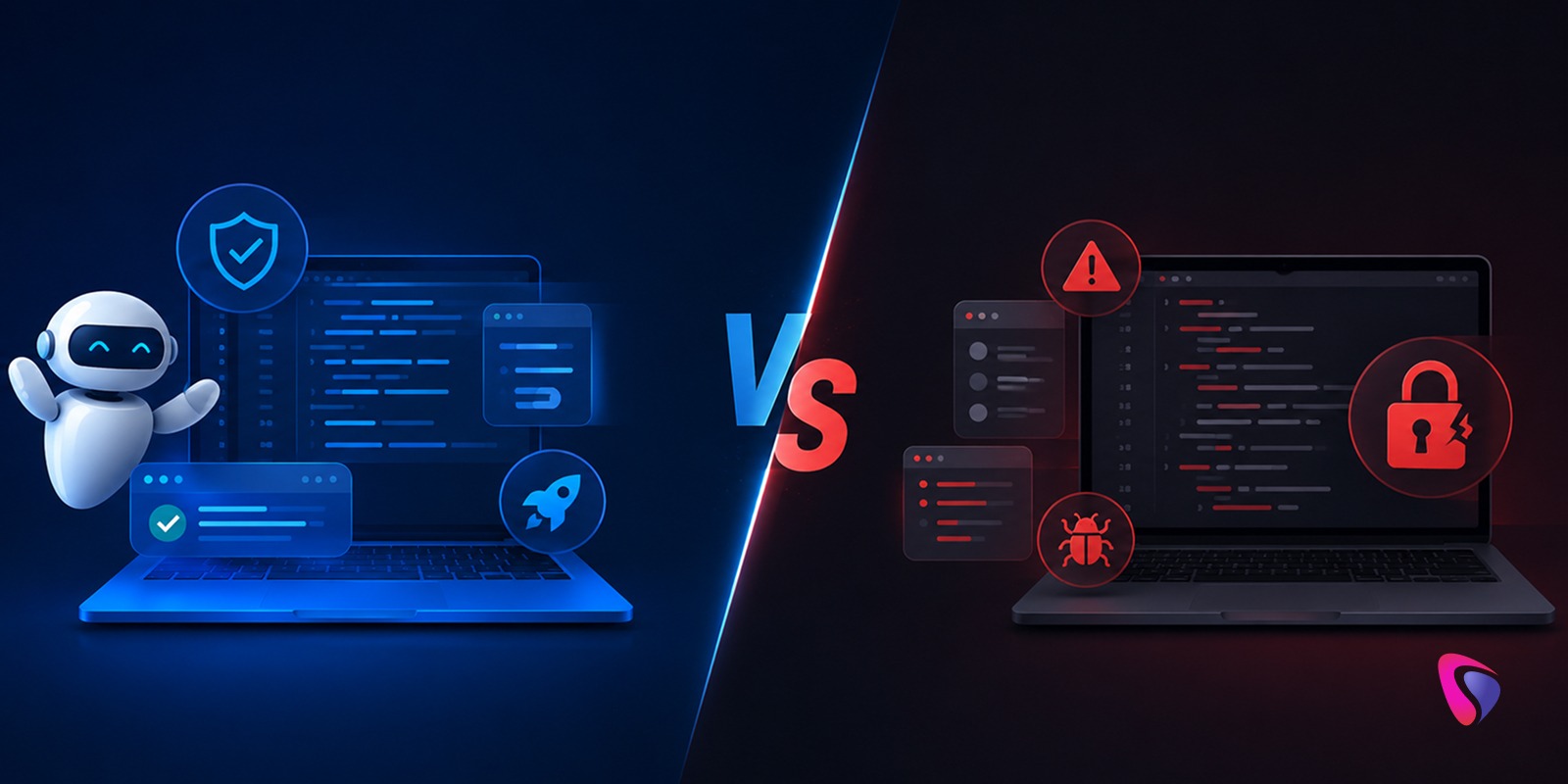
Vibe Coding vs Traditional Coding: Core Differences
| Factor | Vibe Coding | Traditional Coding |
|---|---|---|
| Development Approach | AI-generated from prompts | Human-written code |
| Speed | Extremely fast | Moderate |
| Learning Curve | Lower | Higher |
| Code Control | Limited | Complete |
| Customization | Moderate | Extensive |
| Security Visibility | Often unclear | Fully visible |
| Scalability | Depends on generated architecture | Designed intentionally |
| Maintainability | Can become difficult | Easier with standards |
| Debugging | Often complex | More predictable |
| Production Readiness | Requires validation | Typically designed for deployment |
Strip away the AI angle and what you're really comparing is two different relationships between a developer and the code they're responsible for.
Vibe coding puts you in the position of a director. You describe what you want, the AI builds it, and you review what came back. That role shift is genuinely powerful - it's faster, it handles the tedious parts, and it lets you focus on outcomes rather than implementation. The catch is that when something breaks, you're debugging code that someone else (something else) wrote, based on patterns you may not fully recognize.
Traditional coding keeps you as the author. You made every decision, you know why each line exists, and when something fails at 2am you have a mental map of where to look. That knowledge comes at a cost - it's slower, more demanding, and the gap between having an idea and having working software is wider.
Neither of those is inherently better. They're different tools for different contexts. The mistake is treating one as a universal answer.
Vibe Coding vs Traditional Coding Across the Development Lifecycle
| Development Stage | Vibe Coding | Traditional Coding |
|---|---|---|
| Requirements Gathering | Prompt-driven | Detailed planning |
| Architecture Design | AI suggested | Human engineered |
| Development | Rapid generation | Manual implementation |
| Testing | Often reactive | Planned and systematic |
| Security Reviews | Post-generation | Integrated throughout |
| Deployment | Requires validation | Deployment-ready workflows |
| Maintenance | Can become challenging | Structured maintenance |
The speed gap in early development is not subtle. Getting from idea to working prototype in hours rather than days changes what's feasible for a small team. That's a real competitive advantage, especially when you're still figuring out whether an idea is worth pursuing.
The problem shows up later. "Working" and "production-ready" are not the same thing, and the distance between them tends to be longer with AI-generated code than it appears. The code was never designed with your infrastructure, your compliance requirements, or your operational constraints in mind - it was designed to satisfy the prompt. Closing that gap takes engineering work, and the teams that don't budget for it are the ones that end up with expensive surprises.
The teams that handle this well have one thing in common: they treat AI output as a draft, not a deliverable.
Challenges and Risks of Vibe Coding
Hidden Security Vulnerabilities
Here's what makes this one particularly frustrating: the code looks fine. It runs. Your tests pass. Nothing is obviously wrong. And somewhere in the dependency chain or the auth flow, there's a pattern that was perfectly acceptable four years ago and is now a documented vulnerability that attackers actively look for.
This happens because AI models learn from code that already exists on the internet - which means they've absorbed both the good practices and the bad ones, and they can't reliably tell the difference. They generate what looks like it should work, not what has been validated as secure.
The specific risks that come up most often:
- Injection vulnerabilities - SQL, command, and others
- Authentication implementations that are functional but weak
- API configurations that expose more than intended
- Data that ends up logged or stored somewhere it shouldn't be
- Access controls with gaps that aren't obvious from the happy path
A functional code review won't catch most of these. You need someone specifically looking for security issues - and increasingly, that means incorporating AI powered threat detection into the audit process itself, using the same category of tooling to find vulnerabilities that was used to generate the code in the first place. That's exactly the step that gets skipped when the pressure is to ship.
Lack of Architectural Consistency
Every prompt is, in a sense, a fresh start. The AI doesn't carry forward a memory of the decision you made two weeks ago about how this service should handle state, or why you chose a particular pattern for error handling. It answers the current question as best it can.
What this produces over time - across a project built prompt by prompt - is a codebase with an identity crisis. Different sections solving similar problems in entirely different ways. Naming conventions that evolved as the project did. Error handling that's robust in some places and nonexistent in others.
Nothing is broken, exactly. But six months later, when someone needs to add a feature or track down a bug, they're navigating a codebase that doesn't have a consistent internal logic. That's expensive - in time, in frustration, and in the mistakes that happen when engineers misread code they don't fully understand.
Compliance and Regulatory Risks
Compliance frameworks have a way of being unforgiving about how something was built. The fact that AI generated the code is not a mitigating factor in an audit.
In banking, healthcare, insurance, and anything else that touches personal data at scale, there are specific requirements around data privacy, audit trails, encryption, and user consent. These requirements exist as constraints that have to be designed into the system - they can't reliably be added after the fact.
AI-generated code can create gaps in any of these areas without any obvious signal that something is missing. The code works. It just doesn't satisfy a requirement that wasn't in the prompt because nobody thought to include it.
Human review of AI-generated code in regulated industries isn't optional. It's the minimum acceptable governance.
Scalability Analysis: What Happens at Enterprise Scale?
There's a version of almost any application that works fine for a few hundred users. Building something that holds up for a hundred thousand, or a million, is a fundamentally different engineering challenge - and it's one that AI generation tools are not well-suited to solve on their own.
Performance Bottlenecks
AI-generated code optimizes for producing something that works. Runtime efficiency is a secondary concern at best. The issues that result tend to be invisible at low scale and increasingly painful as usage grows:
- Database queries that nobody optimized because the tables were small enough that it didn't matter during development
- API calls happening redundantly because the generated code didn't account for caching
- Memory usage patterns that only become a problem under sustained load
These aren't rare edge cases. Engineers who inherit AI-generated codebases encounter them regularly. The fixes aren't usually complicated - but finding them requires understanding the code well enough to know where to look.
Infrastructure Challenges
Production enterprise systems don't just need to work - they need to keep working when things go wrong. Load balancing, distributed architecture, disaster recovery, fault tolerance, monitoring - these aren't features you add later. They're design decisions that shape the architecture from the start.
Traditional engineering teams plan for failure as part of the design process. It's not pessimism - it's how you build something that actually stays up. Vibe coding tools almost never address these concerns comprehensively, which means someone has to come back and address them, usually under more pressure than they would have been if it had been designed in from the beginning.
Reliability Under Load
Production is messier than development. Traffic doesn't arrive at a steady rate. Services that depend on each other fail at inconvenient times. Networks are unreliable. Hardware eventually fails.
Systems that weren't explicitly designed to handle these conditions don't handle them well. That's true of any development approach that doesn't make resilience a first-class concern - vibe coding just makes it easier to skip that step.
Technical Debt and Long-Term Maintenance
Technical debt is something every codebase accumulates. What makes AI-generated technical debt particularly tricky is that it's less visible than the kind that comes from traditional development shortcuts. You can see when someone left a TODO comment. You can't always see that the dependency tree has ballooned to twice the size it needs to be.
Inconsistent Codebases
A project built through iterative prompts tends to read like a collaboration between several developers who never talked to each other. Each section is internally coherent; the whole is harder to follow than it should be.
The day-to-day impact: new engineers take longer to get productive. Debugging takes longer because you have to understand a section's particular logic before you can trace through it. Simple changes carry more risk because the ripple effects are harder to predict.
Dependency Sprawl
AI tools default to using existing libraries rather than implementing solutions directly. Usually that's fine. Across a full codebase, it produces more dependencies than you actually need - and every dependency is a surface area. More things to patch, more potential version conflicts, more places for vulnerabilities to hide.
This is fixable, but it requires someone to actually look at the dependency tree with a critical eye, which is another step that tends to get skipped when the focus is on shipping.
Debugging Complexity
The honest version of this: debugging code you didn't write is harder than debugging code you did. When you wrote it, you remember what you were thinking. When the AI wrote it, you have to reconstruct that understanding from the code itself.
Sometimes that's quick. Sometimes it takes longer than it would have taken to write the thing from scratch. Neither outcome is guaranteed - but the risk of the second outcome is higher with AI-generated code, and it's worth accounting for in how you plan.
Use Cases: Where Each Approach Excels
Best Use Cases for Vibe Coding
MVP Development - The economics of validation change completely when you can get to a working prototype in hours instead of weeks.
Internal Tools - Dashboards, automation scripts, internal utilities - lower stakes, faster is better, and the security surface is limited.
Proofs of Concept - Show that something is technically possible before anyone commits to building it properly.
Startup Experimentation - Get something in front of real users fast enough to learn from it before you've over-invested in the wrong direction.
Developer Productivity - The boilerplate, the repetitive scaffolding, the stuff that's necessary but not interesting - AI handles it well.
Best Use Cases for Traditional Coding
Enterprise Applications - Multi-team, multi-year systems where maintainability isn't a nice-to-have.
Financial Platforms - The compliance and security requirements don't bend for development methodology.
Healthcare Systems - When code has to be auditable and explainable, you need to have written it with that in mind from the start.
Large SaaS Products - Architecture that needs to evolve over years requires intentional design.
Mission-Critical Systems - When the cost of failure is high, the visibility of traditional engineering is worth the slower pace.
Hybrid Approach: The Future of Software Development
The most capable development teams right now aren't debating which approach to use. They've already figured out that the question is wrong. The question is how to combine them so you get AI's speed without the hidden costs.
A hybrid workflow that holds up in practice:
- AI generates the initial implementation from well-structured prompts
- Engineers review the architecture - not just for bugs, but for consistency and long-term sense
- Security teams audit the generated code before it gets anywhere near production
- QA validates against actual requirements, not just "does it run"
- DevOps prepares the infrastructure the code will actually live in
- Someone with accountability makes the deployment call
What you end up with is development that moves faster than traditional engineering alone - without the technical debt, security gaps, and architectural inconsistencies that pure vibe coding tends to produce.
That's not a compromise. That's just what responsible AI-assisted development looks like when you're building something real.
Decision Framework: Choosing the Right Approach
Choose Vibe Coding If:
- You need to move fast and the cost of failure is manageable
- It's a prototype, MVP, or internal tool
- Security requirements are light
- You're still figuring out if the idea is worth pursuing
- Iteration speed matters more than long-term maintainability
Choose Traditional Coding If:
- Security isn't negotiable
- Compliance requirements apply
- The system needs to scale and stay maintainable over years
- Reliability under failure conditions is a hard requirement
- The people who build it won't always be the people who maintain it
Choose a Hybrid Approach If:
- You want speed without giving up production quality
- You're building something real users will depend on
- Security review is required before deployment
- Multiple teams will touch the codebase over time
- You want to ship fast now without closing off your options later
How a Development Partner Can Help You Get Both
The speed-versus-quality framing is a false choice - but getting both requires more than just having access to AI tools. It requires knowing when to use them, how to validate what they produce, and how to integrate AI generation into an engineering process that's actually built for production.
We work with organizations to do exactly that. As an AI development company that works across both ends of this spectrum, we combine AI-assisted development with architectural rigor, security-first design, DevOps automation, and QA frameworks that treat "deployable" as the actual standard - not "compiles and runs."
Whether you're turning an MVP into a scalable product, building an enterprise application with compliance requirements baked in from day one, or working on something where failure genuinely isn't an option - the decision to hire dedicated AI developers rather than stretch an existing engineering team often determines whether that standard actually gets met. The goal stays the same: software that holds up, can be explained, and can be extended without heroics.
AI changes the pace of development. Engineering judgment is still what determines whether the result is worth deploying.
Conclusion
Vibe coding isn't hype. The productivity gains are real, the speed advantage is real, and the ability to get from concept to working prototype without writing every line manually is genuinely valuable. Anyone dismissing it hasn't used it seriously.
But fast and ready are different things, and conflating them is where teams get into trouble.
The security issues aren't hypothetical - they're the kind that pass code review because they look correct, and they get found in audits or, worse, by attackers. The architectural inconsistencies are real - they start as minor annoyances and compound into serious maintenance problems. The scalability gaps are real - they're invisible until they're not, and by then you're fixing them under pressure.
None of this means don't use AI tools. It means use them with the same discipline you'd apply to any other part of the development process. Review what gets generated. Audit for security. Design for scale intentionally. Keep engineers accountable for the code, regardless of who wrote the first draft.
Traditional coding isn't going anywhere. For systems where the stakes are high, it provides something AI generation doesn't: a complete audit trail of human decisions, made by people who understood the constraints and had skin in the game.
The future isn't one or the other. It's both, used deliberately, with experienced engineers making the calls that actually matter.
Build fast. Ship responsibly. Those aren't opposites - they're just both required.
FAQ’s
Q1: Is vibe coding safe to use for production applications?
Not on its own. The code can run perfectly and pass tests while still containing security gaps, scalability issues, or compliance blind spots. It needs human review, security audits, and architectural validation before it's production-ready.
Q2: Does vibe coding actually save time, or does it create more work later?
Both can be true. Early development is genuinely faster - hours instead of days. But closing the gap between "working" and "production-ready" takes real engineering effort, and skipping that step creates expensive problems down the line.
Q3: What's the biggest security risk with AI-generated code?
Hidden vulnerabilities that look completely normal. AI models learn from code that includes both good and bad practices, and generate things that appear functional without being validated as secure - injection flaws, weak auth, exposed configs.
Q4: Should startups use vibe coding or traditional coding?
For MVPs, prototypes, and early validation - vibe coding makes sense. For anything handling sensitive data, scaling to many users, or requiring compliance - traditional coding or a hybrid approach is necessary.
Q5: What does a hybrid development approach actually look like?
AI generates the initial code, engineers review architecture and consistency, security teams audit before deployment, QA validates against real requirements, and a human makes the final deployment call. Speed from AI, accountability from humans.