


Building a Contact Tracing App in 2026: A Practical Guide to Features, Cost, and Tech Stack
Oct 2026



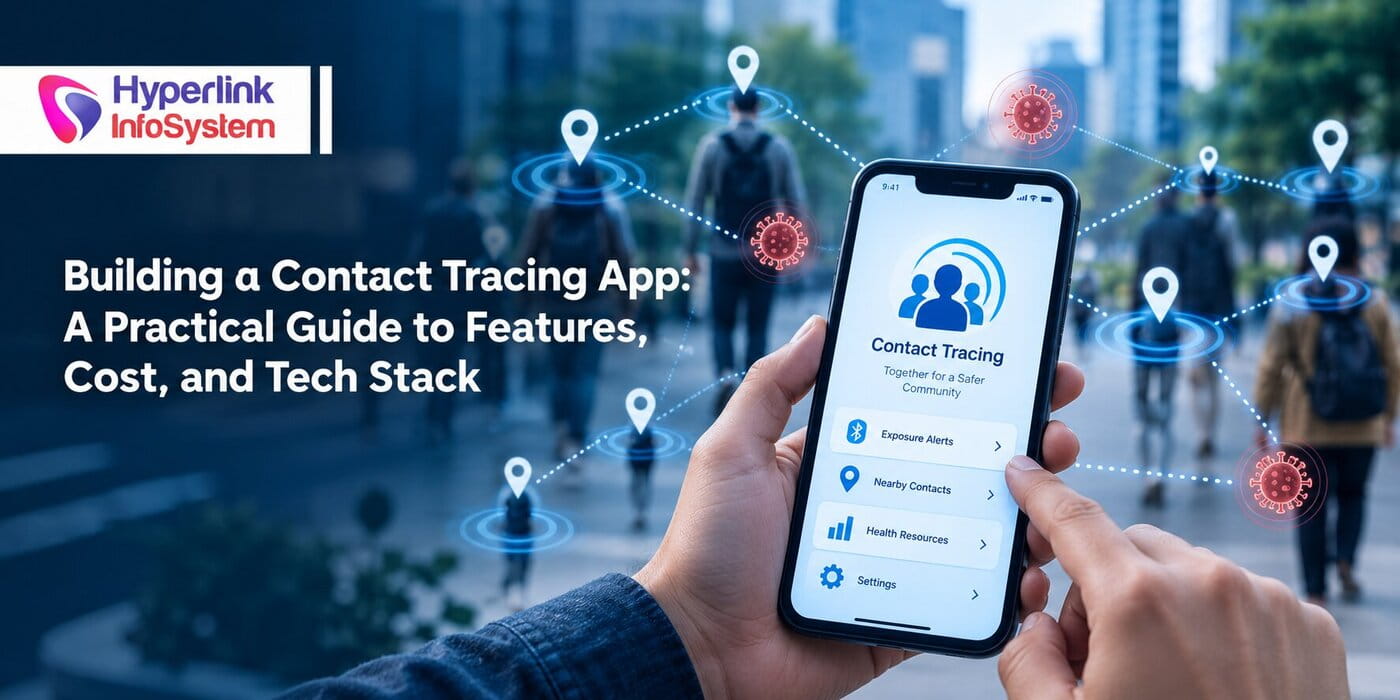

The findings regarding the evaluation of the use of a mobile application by community health workers for tuberculosis contact tracing were shared in August 2026. These findings were drawn from 2,452 households with 10,649 individuals within the households to illustrate how technology is being applied to public health practice on a wide scale. The critical question raised through this case study is how the application would convert the field data into something meaningful.
The issue is not just about logging interactions or exposure alerts. What is required is an application that will function in the real world, handle data safely, and provide a good user experience in the particular platform it has been built for. Data logging is only part of the challenge. Getting that data to take action is the other part.
This makes contact tracing applications a specific discipline within mobile application development. AI developments in healthcare can be used to analyze patterns and make public health decisions, yet their applicability depends on the problem at hand and the accuracy of the data.
The application development process starts off with gaining a comprehensive understanding of the desired application, its usage, users, and environment in which it is supposed to work. All future actions are determined by such decisions.
What is a Contact Tracing App and How does It Function?
A contact tracing application is software used to identify and monitor any potential infection with a contagious disease. This application helps health officials organize information regarding a specific case, identify any potential infections, and give instructions. Depending on its use, the software can be utilized by health professionals, public health staff, public health officials, or an individual.
The contact tracing application differs from a regular health app. It links exposure information to the right follow-up actions. It is built based on the disease being traced, the environment where contact tracing is conducted, and the information needed for decision-making.
How does a Contact Tracing App Work?
1. Relevant data collection
This involves the gathering of information about confirmed cases, reported symptoms, or possible contacts according to the workflow of the application and permission from the user.
2. Contact identification
Bluetooth systems have the ability to detect other devices around them and determine how close they are, whereas location-based systems can use their location data to identify possible connections.
3. Evaluating potential exposures
This tool uses specific public health criteria to determine which potential exposures require further investigation. Proximity is not enough to prove transmission.
4. Transmission of alerts and instructions
Eligible users could receive either exposure alerts or instructions relating to testing, symptom tracking, or advice for reaching out to healthcare professionals.
5. Tracking Follow-ups
Approved staff members may use dashboards and case management systems for following up on actions and maintaining records.
What are the Essential Features of a Contact Tracing Application?
Contact tracing applications are developed with characteristics whose efficiency is subject to variables that might not be easily identifiable during planning stages. What might seem like an effective characteristic during planning phases might be proved to be ineffective upon implementation or might cause some complications for the end user. Selection of a characteristic to be incorporated requires further investigation of the underlying problem.
1. Exposure Detection and Event Recording
Exposure detection determines potential interactions that could satisfy the pre-set criteria for contact. Bluetooth Low Energy (BLE) technology can access the distance between two interacting devices without relying on GPS all the time. The location-based technique might be suitable for particular public health studies. Whereas the hardware beacon is good for controlled settings.
These criteria have to be based on changes in signal, device compatibility, and the environment. The strength of the Bluetooth signal is not a reliable way to determine the distance between the devices.
During contact tracing app development, the technique that will be used should take into account the purpose for which the application will be developed. In addition, recording only the minimum activities will avoid any further data collection.
2. Exposure Notifications
This is where the exposure notification process will notify the user about the risk of coming into contact with an infectious person through information that has been authenticated. The message must explain what the exposure means and what the user should do after exposure.
The push notification service will ensure that users receive current information, while in-app messaging will give meaning to the current situation. It is necessary to pay attention to the problems concerning permissions, failed notifications, and availability of the Internet connection.
Well-worded notifications and good timing allow users to react without unnecessarily alarming themselves. Notifications must also ensure the anonymity of the person being notified and must not show a calculated exposure as a definite infection.
3. Case Reporting and Verification
Information about cases must be correct for reliable tracing. This information needs to be collected in an organized manner through the application by approved users, healthcare workers, or reporting entities. The information collected can be validated using a verification process before initiating any action.
Based on the use of the tool, there could be the provision of structured forms, timestamps, document submissions, and the status of reports pending analysis. The symptom questionnaires and self-reports could also be included based on their relevance to the tracing process.
Health check-ups, health clearance criteria, and quarantine monitoring are some of the more specific tasks. They might be appropriate for particular implementations of clinical and work environments, but they should only be incorporated if there is a need for that information.
4. User Consent and Privacy Controls
Due to the nature of contact tracing apps handling private information, privacy mechanisms need to be incorporated into the design process. This implies that when using such an app, users should be aware of the kind of data being collected and the reason for collecting it.
These include encryption of information when it is transmitted and stored, proper storage, access rights, minimizing the amount of information collected, and rules for retention and deletion. The users must clearly understand the rules for permissions regarding Bluetooth and location.
Use of pseudonym can aid in reducing exposure of information directly, but it cannot guarantee that privacy will be maintained under all situations. The legal issues like GDPR and HIPAA need to be taken into consideration depending on the jurisdiction and the companies managing the app.
5. Public Health or Administrator Dashboard
A secure dashboard will provide the right personnel with a view of the tracing process. This could include a view of caseloads, pending reports for review, follow-up activities, response times, and exposure trends.
Access control should limit each individual to the data that is necessary for them to perform their duties. Public health professionals might be required to have the ability to manage cases, while the workplace administrators would need only limited operational data.
Analytics may enable the authorized team to measure the reporting, delay, and effectiveness of workflows. AI in healthcare can also contribute to pattern recognition and decision support, if warranted by the use case and data quality. Such functions should be assessed on their reliability, biases, and appropriateness.
6. Integration and Multilingual Support
The contact tracing app could be required to communicate with the laboratory report system, EHR system, case management software, or an authorized workplace system. This could avoid redundant data entry and facilitate information sharing between services that are authorized to access the data.
Integration criteria should be set from the start. Old systems could have varied data structures, authentication mechanisms, and security policies, which means that compatibility testing will be necessary to ensure correct data flow and permissions.
Multilingual interfaces, accessible texts, and easy navigation may assist users in using the application efficiently. These aspects become especially relevant when community members or field workers have to input data promptly and in different locations.
A mobile app development company that possesses experience in providing healthcare app development services should consider all of these points at the stage of planning the project rather than making them an addition to the process of development.
How Much Does Contact Tracing App Development Cost in 2026?
Development of a contact tracing application in 2026 involves an integration of software development skills with stringent medical confidentiality laws. Due to the complex nature of developing applications that deal with public health data, development costs are dictated by the level of sophistication of the architectural design of the platform.
The table below illustrates the budget allocation for development projects of various scopes:
|
Development Tier |
Estimated Cost (USD) |
Project Timeline |
Core Deliverables & Capabilities |
|
Minimum Viable Product (MVP) |
$50,000 – $90,000 |
3 – 4 months |
Single platform deployment (iOS or Android), basic BLE proximity logging, basic user account creation, manual self-reporting of symptoms, and an easy-to-use admin dashboard. |
|
Production-Ready Platform |
$100,000 – $250,000 |
5 – 8 months |
Cross-platform compatibility (Flutter/React Native), offline-first syncing of field workers' data, automatic exposure notifications, advanced geospatial clustering, and HIPPA/GDPR security compliance. |
|
Enterprise / Government Grade |
$250,000 – $450,000 |
9+ months |
National health registry and laboratory API integrations, artificial intelligence predictive models for outbreak prediction, IoT wearables/beacons for workplace use, and secure hardware enclaves. |
What Influences Contact Tracing Development Costs?
1. Feature Complexity
Basic reporting and notifications are cheaper to develop than proximity detection, case verification, and dashboard features. Incorporating AI in healthcare for pattern recognition will lead to higher development and maintenance costs.
2. Platform Selection
Creating two apps for iOS and Android platforms demands extra development and testing efforts. Cross-platform mobile application development could help to save efforts, but the compatibility and features of specific platforms could increase expenses.
3. Security and Compliance
Security measures such as encryption, access control, audit logs, and testing increase development costs. Total investment will be based on the total sensitivity of the data being collected, the environment of deployment, and the regulations.
4. Third-party Integrations
Any connection with laboratory systems, electronic health record systems, or public health registries will require extra programming. The use of legacy platforms and data transfer complications may result in increased costs associated with integration.
5. UI/UX Design and Testing
Designing for accessibility, multilingual interfaces, ease of workflow, and testing of device compatibility require a lot of work. Some applications that serve various communities or field staff members may need more usability testing.
Additional Cost to Include in the Budget
While the setup costs have been paid for, budget for cloud hosting, maintenance, security updates, technical support, and other third-party services. There will be additional expenses to be incurred if hardware is chosen.
Kogniz contact tracing, for instance, is an example of a company that utilizes wearables and gateways to carry out contact tracing within workplaces. The cost of deploying such equipment includes the cost of procuring the hardware, installing it, and maintaining it.
Core Technologies Behind a Contact Tracing App
|
Technology |
Role in the Application |
When It Is Appropriate |
|
Bluetooth Low Energy (BLE) |
Detects encounters based on proximity by exchanging anonymous tokens in the background, depending on device and operating system restrictions. |
Decentralized, privacy-focused applications with exposure tracking but no tracking of physical location history. |
|
GPA & Location Services |
Maps out coordinates and monitors geographical movement for location-based processes. |
Closed site tracking and high-risk tracking where use cases for public health necessitate location history. |
|
Native or Cross-Platform Mobile Frameworks |
Forms the basic structure used to create the frontend user experience on both iOS and Android operating systems. |
Cross-platform (Flutter, etc.) development for efficiency; native code for OS optimization or hardware enclave security. |
|
Backend APIs & Cloud Infrastructure |
Manages the verification of authorized reports, exposure notifications, system configuration, and lab integrations. |
All implementations are safe for data synchronization between local clients and the administrative server. |
|
Encryption & Identity/Access Controls |
Secures health data during transmission and storage through implementation of role-based access restrictions. |
All systems must be compliant with the minimum standards of regulation within the global healthcare regulatory system (HIPAA, GDPR). |
|
Analytics & AI Tools |
Handles authorized reporting validation, exposure notifications, system configurations, and lab integration. |
More advanced public health systems that require predictive modeling, built from quality foundational data. |
It is important to pick the appropriate technology stack depending on the scalability of the application, compatibility with devices, integration needs, and maintenance needs. During contact tracing app development, it is advisable to validate these factors in the real-world operating environment before committing to the architecture. A mobile app development company can assist in assessing the trade-offs in technicalities earlier on.
Privacy, Security, and Compliance Considerations
Information regarding the health status of people, their proximity history, and identification information may be collected by the contact tracing applications, and therefore adequate security arrangements must be made, as failure to do so may result in the leakage of sensitive information.
Things to consider while developing contact tracing apps:
Data Minimization
Collect only those pieces of data that you need for your tracking process. If the mobile platform needs only anonymous Bluetooth tokens to identify any exposure event, do not collect or store any physical location data at all.
Consent and Transparency
The users should always be aware of what happens to their information. You need to provide proper documentation of the information that you collect, the people who have access to that information, and the exact time of its destruction.
Encryption & Access Control
The health information must always be kept highly encrypted. The roles of users should be strictly controlled, and encryption technology should be used for transmitting and storing the information.
Retention & Deletion
Proximity logs and symptoms information should be set to a permanent expiry date. Automated database clean-up should ensure the removal of all records of users once the clinical medical incubation period comes to an end.
Navigating Regulatory Requirements
There is a big variation in healthcare laws and privacy laws depending purely on your target jurisdiction. For example, there are completely different criteria for compliance when working in GDPR-compliant Europe as compared to HIPAA-compliant U.S.
Continuous Security Testing
The software and cloud backend integration will be constantly developing. Thus, the development team needs to do regular vulnerability testing, pen-tests of the backend access control, and code reviews.
Why Partner With Hyperlink InfoSystem for Contact Tracing App Development?
Contact tracing app development needs a development partner that can transform health or corporate demands into a working solution. Hyperlink InfoSystem will assist in the determination of the project scope and application architecture according to the application requirements.
Our mobile application development services include UI/UX development, front-end and back-end engineering, integration, testing, and deployment. We also offer maintenance services to help deal with any technical problems and facilitate future updates. When any project involves health-related information, our team of developers makes sure to take into account all the requirements in the process of development.
As one of the top mobile app developers, Hyperlink InfoSystem helps organizations throughout the whole process of developing the app. The emphasis is on the creation of an application that will suit all the necessary workflow and technological requirements. Need assistance? Contact our team today!

Frequently Asked Questions
The typical Minimum Viable Product can be developed in a period of 3 to 4 months. The development process of a production-level platform that has cross-platform compatibility takes 5 to 8 months, whereas developing an enterprise solution requires 9 months or more.
No. Contemporary apps make use of BLE technology that can determine proximity to other devices through token exchange. It is worth noting that such an approach allows for mapping of proximity interactions without any tracking of the geographic position of a user.
Personal data is safeguarded because of the decentralized processing of data through local token matching on the device, end-to-end encryption of data both in transit and at rest, role-based access control, and automatic data deletion after 14 days.
Personal data is safeguarded because of the decentralized processing of data through local token matching on the device, end-to-end encryption of data both in transit and at rest, role-based access control, and automatic data deletion after 14 days.
It is necessary to allocate between 15% and 25% of the total development cost annually for maintenance. This money would be allocated to cloud hosting infrastructure that is scalable, OS compatibility for iOS and Android, and annual security checkups.
Harnil Oza is the CEO & Founder of Hyperlink InfoSystem. With a passion for technology and an immaculate drive for entrepreneurship, Harnil has propelled Hyperlink InfoSystem to become a global pioneer in the world of innovative IT solutions. His exceptional leadership has inspired a multiverse of tech enthusiasts and also enabled thriving business expansion. His vision has helped the company achieve widespread respect for its remarkable track record of delivering beautifully constructed mobile apps, websites, and other products using every emerging technology. Outside his duties at Hyperlink InfoSystem, Harnil has earned a reputation for his conceptual leadership and initiatives in the tech industry. He is driven to impart expertise and insights to the forthcoming cohort of tech innovators. Harnil continues to champion growth, quality, and client satisfaction by fostering innovation and collaboration.
Latest Blogs


Is BlockChain Technology Worth The H ...
Unfolds The Revolutionary & Versatility Of Blockchain Technology ...

IoT Technology - A Future In Making ...
Everything You Need To Know About IoT Technology ...
Feel Free to Contact Us!
We would be happy to hear from you, please fill in the form below or mail us your requirements on info@hyperlinkinfosystem.com
Hyperlink InfoSystem Bring Transformation For Global Businesses
Starting from listening to your business problems to delivering accurate solutions; we make sure to follow industry-specific standards and combine them with our technical knowledge, development expertise, and extensive research.

4500+
Apps Developed

1200+
Developers

2200+
Websites Designed

140+
Games Developed

120+
AI & IoT Solutions

2700+
Happy Clients

120+
Salesforce Solutions

40+
Data Science

