


Electronic Health Records in 2026: Top Trends & Innovations
Oct 2026



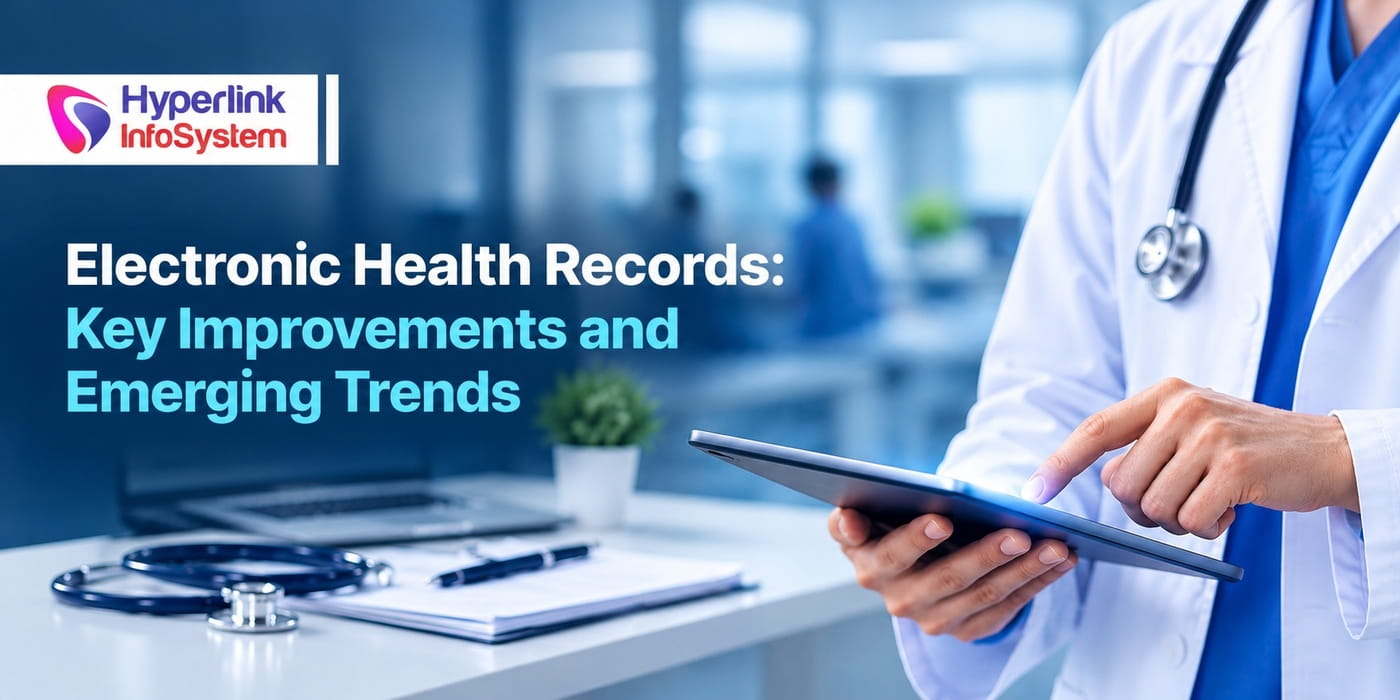

With the increasing expectations of what the system is supposed to achieve, more healthcare practitioners have been focusing on investing in the development of electronic health record systems. Each function requires different capabilities from the same software system, making EHR software development an important aspect to consider in healthcare organizations.
According to Grand View Research, the market value of electronic health records is forecasted to be at USD 35.9 billion by 2025, whereas it is estimated to further grow to USD 37.5 billion by 2026. The market will continue registering a CAGR of 5.1% between 2026 and 2033.
Still, the development of the market is not the only factor that determines the benefits of using the EHR system for the provider of medical services. Indeed, the software behind the system needs to meet clinical needs, to be compatible with the current infrastructure of the institution, and to adjust to the changes in healthcare practices.
So, what makes EHRs more valuable in 2026, and which advancements should be monitored most attentively?
Electronic Health Records Are Evolving Beyond Digital Recordkeeping
Disorganized user interfaces in EHR systems can bring friction to normal workflow processes, while structured workflows may hinder staff from documenting information in an easy way as per their specialty needs. Such challenges in usability of the system are important since clinicians are required to navigate through the records among other duties.
In addressing these practical challenges, effective EHR software development is achieved through better navigation features, customizable templates for clinicians, and workflow designs that reflect how health practitioners function. Accessibility and usability changes can also aid patients’ engagement with their health data.
The importance of digital transformation in healthcare is dependent to a great extent on whether the software can integrate effectively with its users. There should be no added complexity in clinical procedures.
Key Technologies Improving Electronic Health Records in 2026
The development of EHR is determined by how well the capabilities being introduced can meet the needs of contemporary healthcare provision. Choice of technology should strike a balance between clinical needs, available infrastructure, and adaptability. Every investment made should be for solving a specific problem and developing a sustainable system.
1) AI-Powered Documentation and Clinical Workflow Automation
Ambient listening, speech recognition, and natural language processing technologies are providing some assistance with respect to clinical documentation in the healthcare industry. It may record the interaction between a healthcare professional and the patient, extract medical data, and create clinical notes and summary notes. Clinical documentation and healthcare workflow automation powered by artificial intelligence could potentially help reduce the time wasted on data reentry.
Clinicians are needed to review the notes created using AI to ensure their accuracy. The process of developing EHRs needs to have correction procedures, approval processes, consent from the patients, and protections for recordings that are sensitive in nature.
2) Health Data Exchange Based on Interoperability and Standards
The interoperability of the EHR systems makes them capable of exchanging data with laboratories, radiology, pharmacies, and other companies. HL7 is used in health care message exchange, while the application programming interfaces are built on FHIR and enable structured data exchange. Proper integration of the EHR system can provide physicians with access to necessary information without using non-integrated systems.
Nevertheless, transfer of the data does not imply that it will be used by other systems. Terminology standardization and patient identification are crucial in spotting trends, finding out about allergies, and forming medical history. Therefore, it is necessary to make sure that when implementing the FHIR API, the effective use of data is ensured.
3) Predictive Analytics and Clinical Decision Support
Predictive analytics is the analysis of patients’ historical information, vital statistics, and laboratory information to identify risks, probability of readmission, and deterioration. The use of clinical decision support systems will assist clinicians by providing alerts when clinical guidelines have not been adhered to.
Such technologies help in clinical decision-making but do not replace it. Healthcare providers have to validate the models on the population of patients along with evaluating the accuracy of the model and the presence of any potential bias. Appropriate warnings will minimize the occurrence of false alarms.
4) Cloud-Based EHRs and Mobile Patient Access
EHR systems that work through the cloud enable authorized access in all healthcare organizations and can expand according to storage and computing needs. Mobile EHRs will enable clinicians to view patient records and enter documentation while taking care of the patient on the spot, while the development of patient portals will enable patients to have access to their results, medications, and appointments.
The features would demand proper authentication, permissions based on roles, reliable connectivity, and a mobile device-friendly interface. Caregiver access should be made according to applicable rules of consent and authorization. Healthcare organizations also need to take into account provisions for system outages, backups, and data security while choosing cloud architecture.
5) Security, Data Governance, and Emerging Technologies
Encryption, access control based on roles, two-factor authentication, auditing, use of secure application programming interfaces, and suspicious activity monitoring are the tools needed for healthcare information security. The privacy-by-design approach also includes data minimization, setting data retention policies, and making sure that the access level corresponds to user roles.
Although blockchain in the healthcare industry could provide a tamper-resistant audit trail, consent management, and data provenance, they are not an alternative to secure databases and access control. In the same way, 5G can be helpful for specific applications from a cost perspective.
Challenges That Can Limit EHR Improvements
The advancement of electronic health records can face limitations due to technical barriers, privacy concerns, cost considerations, and opposition to change. Early resolution of these issues facilitates the process of planning upgrades for health care organizations that will facilitate digitalization within the health care industry.
1) Legacy System Integration and Fragmented Data
Numerous healthcare organizations use outdated databases and software systems that are hard to interface with new technologies. The integration of AI technologies and cloud platforms may reveal data format mismatches, data gaps, and performance problems. It is important for EHR systems to be integrated and for the legacy EHR system to be upgraded.
The Solution: Adopt a phase-based approach to minimize disruption. Middleware and data mapping could aid in extracting and normalizing data from legacy systems. The use of the FHIR API is possible when conditions permit.
2) Privacy, Cybersecurity, and Evolving Regulations
The EHR system contains patient data that can be subject to different types of threats, including ransomware attacks, unauthorized access to the information, and data breaches. At the same time, healthcare professionals are required to follow certain privacy and security regulations, which include HIPAA regulations in the US and GDPR if applicable.
The Solution: Embed security and privacy controls within the system design. Encryption, role-based permissions, audit logs, and periodic security testing will aid in securing patient information. Blockchain in the healthcare industry might provide particular data provenance and audit controls, but they have to be considered in the context of actual security and privacy needs.
3) AI Reliability, Bias, and Clinician Trust
AI in healthcare could assist with documentation and decision-making, but the results produced by AI could be potentially unreliable due to either inadequate data used to train the models or low-quality performance for different population segments. At the same time, predictive analytics could produce wrong risk predictions, and vague alerts could diminish clinicians’ trust.
The Solution: Validate the AI models on patient data and check their performance once deployed. The clinical decision support system must provide an explanation for the recommendation made whenever possible to allow for review by healthcare professionals.
4) Staff Training, Workflow Disruption, and Adoption Resistance
An improved EHR system will add extra work for physicians where it requires too many clicks, data re-entry, or switching among several screens. Usability concerns will negatively impact workflow and the willingness to adopt the new EHR system if there is not enough training. It should be considered during EHR software development, not afterward.
The Solution: Engage doctors, nurses, and administrators during design. The usability test must be in line with the real work process, whereas role-specific training and feedback could assist in adaptation.
5) Budget Constraints, Long-Term Maintenance, and Unclear ROI
The EHR software development cost is more than the cost of development itself or licensing fees. System integration, cloud hosting, system maintenance, security upgrades, staff training, and system upgrade costs may affect the cost of the overall project.
The Solution: Measure the success of implementation using key performance indicators. The metrics to consider include time taken for documentation, duplicate testing, downtime, and user acceptance. This will enable the healthcare managers to determine the benefits of the modernization efforts made.
Ways Healthcare Practitioners Can Modernize Their EHR System
The implementation of an EHR system in phases can be used by healthcare providers in order to improve the EHR system in question without the need to replace the whole system. In a stepwise process of designing EHR software, one is able to identify process gaps, prioritize clinical needs, test integration, and evaluate performance before implementing any new functionality. Here are some examples of digital transformation in the healthcare industry.
1) Connecting Laboratory and Imaging Results to a Shared Record
Integration of lab systems and imaging systems with EHR facilitates the process for healthcare providers, as they do not need to toggle among different unconnected applications in order to get the required diagnostic information. The integration of the EHR system with compatible FHIR APIs can facilitate structured data exchange, on condition that patient matching, terminology, and data quality are checked. After being standardized, the system is able to identify result trends based on clinical rules.
2) Introducing AI-Assisted Documentation in a Controlled Pilot
The introduction of AI in healthcare by conducting a pilot in the clinical setting will allow healthcare providers to assess the efficacy of the documentation that AI provides before implementing it on a wider scale. Healthcare providers will be able to gauge how accurate the notes produced are, how much time it takes to document using the tool, and the patient’s consent process. AI notes need to be screened prior to being placed into the official patient record.
3) Integrating Remote Patient Monitoring (RPM) Vitals Safely
The remote monitoring devices will be capable of sending data such as blood pressure and heart rates to the connected health care system. But the direct entry of all measurements into the clinical process will lead to many alerts. With the configuration of an integration layer, the aggregation of data, checking for data quality, and the sending of clinically useful alerts to EHR or monitoring dashboard is possible. Proper validation of predictive analytics models will enable identifying risk patterns.
4) Improving Bedside Care Through Mobile EHR Applications
It may be difficult to use desktop EHR applications while making rounds with patients. Healthcare professionals should consider using mobile EHR applications, which will allow authorized users to have access to medication orders, medical records, and vital signs at the point of care. Role-based interface designs may help healthcare professionals to perform their duties easier and avoid redundant data entry. Proper authentication, device management, and integration with the existing EHR are critical for record accuracy and system maintenance.
5) Using a Microservices Layer to Extend Legacy EHR Systems
Changing a hospital’s key database may lead to an increase in project complexity and EHR software development costs. The use of microservices architecture will let certain modern applications and clinical tools work together with the old systems through well-defined APIs, while the current infrastructure allows doing that. This will help achieve gradual modernization without a need for an urgent replacement.
Develop Practical EHR Solutions with Hyperlink InfoSystem
Planning an EHR project becomes much simpler if the developer is well-informed about what decisions are made by the clinicians, what kind of information they require at each step, and the systems they use. This information affects all aspects of the project, including its user interface, data flow, and integrations that ensure continuity of the patient record throughout different departments.
Hyperlink InfoSystem makes sure that those needs are met through EHR software development and other forms of healthcare application development. As a custom software development company, we define the basic functionality, integration of the EHR system, and software development based on our users’ needs. The initial step in this process is the identification of the current setting, the problems that need addressing, and the desired results.
If you are planning to introduce a new EHR system or upgrade an old one, consider checking out our healthcare app development services to see how your requirements can fit into a practical solution. You can even check out our custom software development services to learn about the technical side of your project.

Frequently Asked Questions
A pre-existing EHR system could be enhanced in stages by considering its main drawbacks and upgrading certain elements of the system at once. Healthcare facilities can consider introducing new integrations, enhancing the user interface, moving some functions into the cloud, or installing AI capabilities on the old system but leaving the basic system components untouched. APIs and middleware would assist in integrating older systems with new applications. The team needs to evaluate the quality of the data, dependencies of the system, security concerns, and downtime needs prior to implementing changes.
The costs associated with the development of EHR software applications are subject to considerable variations based on the nature and scope of a project, integration complexity, and regulatory requirements. Specialized localization and customization of a clinic module or extension will cost somewhere between $40,000 and $100,000. On the other hand, development of an enterprise-level EHR system for use in a multi-hospital network will often cost hundreds of thousands and even up to millions of dollars.
The safe implementation of AI will require a robust governance framework in which this technology remains in a supporting role. The healthcare organization must use AI in healthcare as a decision support tool for clinical diagnosis only, without ever replacing the role of the licensed clinician in checking and verifying the recommendations. Secondly, the IT department needs to make sure that the predictive models have clearly cited the precise data points on the basis of which the risk score was generated and also needs to isolate patient data so that it does not end up in public training loops.
Key standards include HL7 FHIR, which enables the sharing of health care information via new APIs, and HL7 v2, which is used for the transmission of clinical messages like lab requests and results. DICOM provides for the transfer of medical images, whereas terminologies like SNOMED CT, LOINC, and ICD ensure that the clinical concepts, lab findings, and diagnoses are represented accurately within the systems. The selection of the right combination will depend on the systems being interfaced and the needs of the country’s health care system.
In ensuring safety for patients' data within cloud environments, there is a need to shift from the old concept of perimeter defense to the use of the zero-trust security approach. The assumption here is that threat can come from any part of the network and therefore there is a need for high levels of end-to-end data encryption whether the data is in storage mode or when it is in transit from one network to another. There should be the use of MFA, strict role-based access, and automated audit trails.
Harnil Oza is the CEO & Founder of Hyperlink InfoSystem. With a passion for technology and an immaculate drive for entrepreneurship, Harnil has propelled Hyperlink InfoSystem to become a global pioneer in the world of innovative IT solutions. His exceptional leadership has inspired a multiverse of tech enthusiasts and also enabled thriving business expansion. His vision has helped the company achieve widespread respect for its remarkable track record of delivering beautifully constructed mobile apps, websites, and other products using every emerging technology. Outside his duties at Hyperlink InfoSystem, Harnil has earned a reputation for his conceptual leadership and initiatives in the tech industry. He is driven to impart expertise and insights to the forthcoming cohort of tech innovators. Harnil continues to champion growth, quality, and client satisfaction by fostering innovation and collaboration.
Latest Blogs

Is BlockChain Technology Worth The H ...
Unfolds The Revolutionary & Versatility Of Blockchain Technology ...


IoT Technology - A Future In Making ...
Everything You Need To Know About IoT Technology ...
Feel Free to Contact Us!
We would be happy to hear from you, please fill in the form below or mail us your requirements on info@hyperlinkinfosystem.com
Hyperlink InfoSystem Bring Transformation For Global Businesses
Starting from listening to your business problems to delivering accurate solutions; we make sure to follow industry-specific standards and combine them with our technical knowledge, development expertise, and extensive research.

4500+
Apps Developed

1200+
Developers

2200+
Websites Designed

140+
Games Developed

120+
AI & IoT Solutions

2700+
Happy Clients

120+
Salesforce Solutions

40+
Data Science

