




Food Delivery App Development in 2026: A Complete Guide to Building Your Platform
Oct 2026





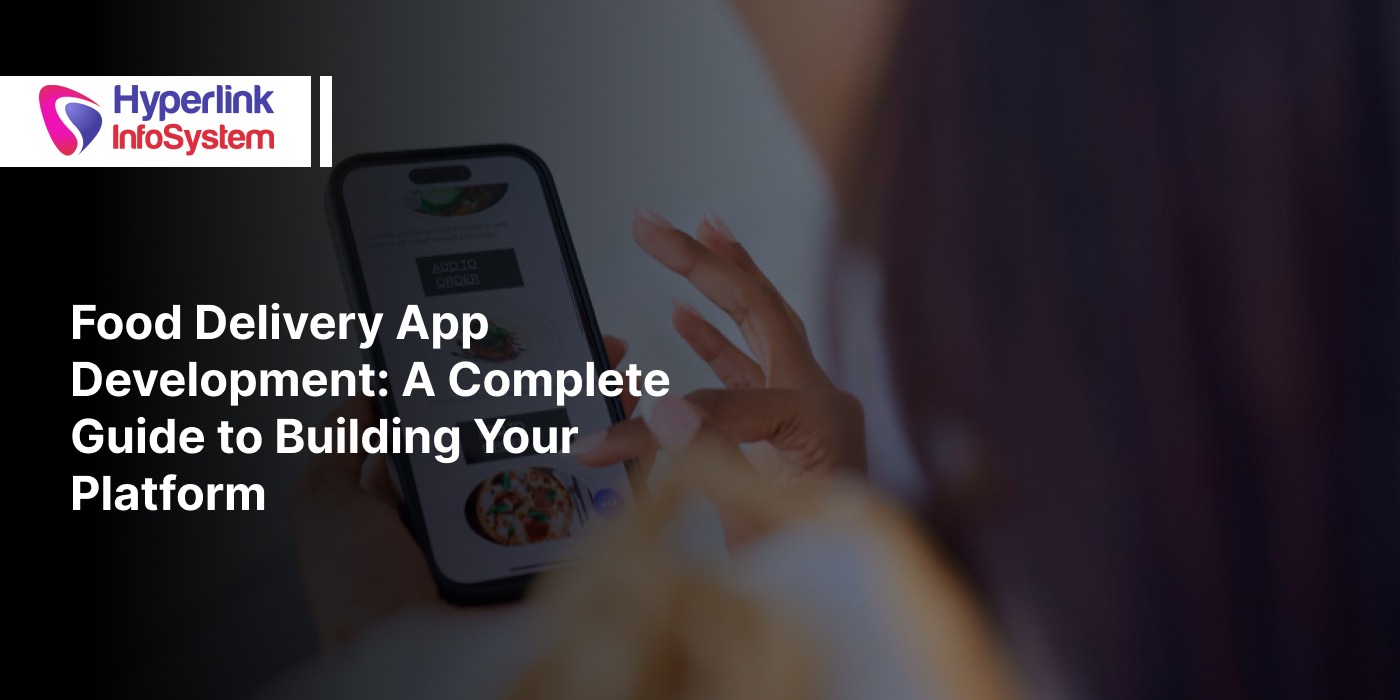

The customer approaches the restaurant, selects a few items, makes the payment, and awaits the order. The process may take up a couple of minutes. However, there is a connected system behind it that needs to make sure that menus, orders, payments, restaurants, delivery partners, locations, and updates are moving in the right order.
That is why food delivery mobile app development becomes much more than a mere product issue. It includes the ability to synchronize multiple users at the same time while maintaining the simplicity of the user experience necessary to place an order easily.
The market potential is indicative of the extent to which the model has become a part of the digital business. As per Grand View Research, the global market for online food delivery services has been valued at $355.6 billion in 2026 and is expected to grow to $505.5 billion by 2030 with a CAGR of 9.4% from 2025 to 2030. The platform-to-consumer service made up more than 71% of market revenues in 2024.
The technology ecosystem that makes such experiences possible is also growing in parallel to the demand, with the global market for mobile applications increasing at a 14.3% CAGR from 2024 to 2030. Among the drivers of this trend are widespread usage of smartphones, internet availability, and development of AI and machine learning in mobile apps.
Building a successful delivery platform is dependent on making certain decisions even before development has started.
- What type of operating model works best for this product?
- What should be included in the first release?
- How do customers, restaurants, delivery partners, and administrators interact with the delivery platform?
- What technical choices will scale well with increasing order volume?
These issues set the course for the whole development process. This guide provides detailed information on how to build a food delivery app, including the business model, functionalities, development process, tech stack, costs, and other challenges that emerge as the platform grows.
Start With the Food Delivery Model You Want to Build
The food delivery model determines the boundaries for the product even before the first screen is designed. This model helps in navigating:
- Who places the order?
- Who fulfills the order?
- Who owns the customer relationship?
- How does money move through the platform?
These decisions eventually influence the features, integrations, delivery infrastructure, and backend architecture required to create a food delivery app.
Restaurant-Owned Delivery App
Restaurant-proprietary apps keep ordering and consumer engagement within one food brand. The customer can look at the menu, place the order, make payments, monitor their delivery, and use any offers related to promotions or loyalty within the restaurant’s own app.
The development scope usually revolves around order placement, menu management, customer accounts, payments, order tracking, and integration with POS and/or Kitchen systems. The revenue model usually comprises food items, while other sources may include delivery fees, subscription models, and loyalty programs.
The restaurant is also under more accountability in terms of fulfillment and customer service. Therefore, delivery management, availability of inventory, order coordination, and operational analysis become key factors to consider in planning food delivery mobile app development.
Multi-Restaurant Aggregator
An aggregator serves as the bridge connecting several restaurants within a single marketplace. Customers get greater choice, while restaurant owners have another way through which orders can be made.
The platform must coordinate different aspects such as restaurant accounts, menus, pricing, availability, offers, payment options, reviews, and order management. Search and filters become increasingly important when the number of restaurants increases. The process of onboarding and administration becomes an additional layer of the system.
Revenue is generated from commissions by restaurants, delivery charges, sponsored listings, and subscription packages. The technological reach broadens with the need for the platform to ensure consistency of data and order states between various restaurant partners.
Integrated Order-and-Delivery Marketplace
An integrated marketplace combines restaurant discovery and ordering with a platform-managed delivery network. The platform takes responsibility for connecting an accepted order with an available delivery partner and keeping all participants updated until completion.
An integrated marketplace combines restaurant discovery and food ordering with delivery management by the platform. The platform is responsible for matching an accepted order to a delivery partner and ensuring that everybody remains up-to-date until the task is done.
Revenue could be generated through restaurant commission, delivery fee, service charge, subscription, and ordering programs by corporations. As the number of orders increases, there is a need for a better dispatch algorithm and location infrastructure that would improve the functionality of the food delivery application. This is also important in the decision-making process of the food delivery app development company.
Cloud Kitchen and D2C Platform
Cloud kitchens do not have a physical dine-in area and depend heavily on online ordering and delivery. One platform can either serve one virtual restaurant or many virtual restaurants running under one operational structure.
The product can connect customers to the kitchen process and enable menu management, geographical presence, promotion, order routing, customer retention, and analytics. Direct sales will be the main source of income, with delivery charges, subscriptions, and promotional activities offering alternative ways of generating revenue.
However, the model can affect the architecture of technology too. Several virtual brands will necessitate central administration with their own menus, pricing, branding, and performance statistics, whereas common kitchens and deliveries will demand synchronized order management.
Ultimately, the correct model depends on how much control the platform wants over the entire process of ordering and delivery. Knowing the scope upfront will help you understand what needs to be included in terms of features, integration, delivery mechanisms, and costs involved in developing a food delivery app.
Built Around the People Who Use the Platform
A food delivery system has multiple people who are involved with the same order. However, they interact with the order in different ways. The customer is looking for fast and easy ordering, the restaurant requires management of orders that come in, and the delivery person needs clear instructions.
This is why the user structure plays an integral role in food delivery mobile app development. Every interface should serve a specific function and should still relate to the same order, payment, location, and status information.
Customer App
The customer-facing app combines the process of discovery, ordering, payments, and delivery tracking into one seamless experience. The most common features include account creation, restaurant discovery, menu viewing, filters, cart management, checkout, payment, order tracking, rating, and customer service.
Suggestions for customization, address saving, favorited places, repeat ordering, promotions, and push notifications could further enhance repeat usage. The design must be able to streamline the process from discovering the restaurant to completing an order, especially on a mobile device where any additional steps could create frustration.
Restaurant Panel
The panel provided to restaurants gives them control over the data and orders generated on the platform. The restaurant management will have to manage the menu, pricing, availability, preparation time, orders received, promotions, and the operating hours without depending on the platform administrator.
Also, the dashboard can offer order and sales analysis for restaurants to be able to analyze their performance and demand. The integration of POS and Kitchen Management comes into play as order volume rises.
Delivery Partner App
The delivery partner application links accepted orders to the individuals accountable for the last leg of delivery. It is necessary that the application offers order assignments, pickup information, navigation, customer information, status of delivery, and earnings.
Location services are especially significant in this context. It is essential that the platform has the ability to accept and process location data and provide directions to the delivery partners as well as status information to the consumers. Availability control can also assist in locating suitable partners for new orders.
Admin Dashboard
The admin dashboard provides an operational overview of customers, restaurants, delivery partners, orders, payments, promotional deals, and support tickets. The administrators can utilize it for approving partners, managing their accounts, tracking active orders, dealing with refund cases, setting up commissions, and looking at platform-level analytics.
As the platform grows, role-based access control, reporting capabilities, fraud detection, and alerts would become even more important. Well-designed dashboards will also give the internal team the visibility needed to detect problems before they affect many orders.
This is how all four of these experiences together make up the working structure of the app. The interfaces for each may continue to be purpose-specific, but the architecture of the app itself should have the ability to synchronize data at every point in the ordering process. This inter-connectivity is an important factor to consider when building a food delivery app.
How to Build a Food Delivery App: A Step-by-Step Development Guide
Just identifying what kind of platform you wish to launch is just the beginning. What comes next is the conversion of that platform into a product capable of handling orders, payments, restaurant management, delivery coordination, and communication within one single connected system.
A systematic approach to development will ensure that the scope of your product remains manageable yet gives scope for future developments. Here are seven key steps to develop a food delivery app.
Step 1: Validate the Market and Define Product Requirements
Begin by clarifying who the platform will cater to, where the customers will be located, and how the product can address their problems. The market research will involve investigating customer expectations, the needs of restaurants, delivery considerations, alternative solutions available in the chosen market segment, and possible gaps in the market.
The model of operations discussed above should help inform these decisions. There will be different considerations to be taken into account when developing an app owned by the restaurant compared to a multi-restaurant marketplace.
Step 2: Define and Prioritize the MVP
The first release should include sufficient functionalities to enable an entire ordering process without attempting to provide all features right from the start. Focus on functionalities that will help with discovering, ordering, paying, fulfilling, and communicating.
For an average platform, the initial scope could consist of customer registration, restaurant and menu management, shopping cart and checkout, payment gateway, order management, delivery assignment, notifications, and general administration functions. An effectively defined MVP would also provide an easily measurable scope for the food delivery app development company to estimate resources and time needed.
Step 3: Design the Connected User Experiences
A food delivery app consists of multiple interfaces. Therefore, UX design will have to consider information flow between all these interfaces. Determine all the user flows for customers, restaurants, delivery agents, and admins before diving into UI design.
Customer journey may go through discovering restaurants, menu choices, check out process, payment, order confirmation, order tracking, and order delivery. Each of the restaurant and delivery workflows will have its own transitions of statuses, but for the admin interface, visibility will be required for all processes. Unnecessary steps can be detected early at the wireframes, prototype, and usability testing stages.
Step 4: Develop the Platform and Integrate Core Services
After the flow of the product and technical specifications have been figured out, work can be done on the mobile apps, backend, database, and admin. In terms of the backend, it has to handle users, restaurants, menus, orders, payments, deliveries, notifications, and permissions, all while maintaining data consistency throughout the platform.
These third-party components are no less important. The map and locations API, payment gateway, push notifications, SMS or email services, analytics tools, and point-of-sale systems may be included in the final offering.
That is where having an experienced mobile app development company will play an important role by integrating the application layer into the backend architecture and other integration requirements rather than handling them separately.
Step 5: Test Real-World Order Scenarios
Testing should not be restricted to the assessment of individual screens and functionality. A food delivery application requires testing from start to finish throughout the entire order process.
A realistic test scenario would be placing an order by a user, acceptance of the order by the restaurant, assignment of the order to the delivery partner, tracking of the order by the user, and completion of the transaction. The team should also test the cancellation process, failed payment attempts, unavailability of food choices, delayed preparation, wrong delivery location, refund process, and network failures.
Load and performance testing are also vital before the launch of the app, especially if the platform is supposed to deal with peak loads during meal times.
Step 6: Launch with a Controlled Rollout
Controlled launches will highlight problems in operation prior to scaling the business into other markets. Begin with a limited number of restaurants, delivery vendors, customers, or geographic regions and track the entire ordering process.
Other considerations during the first launch include app store compliance, payment verification, analytics, customer service procedures, restaurant onboarding, delivery partner preparation, and production management. This is aimed at setting up an efficient operational benchmark and not just launching the app.
Step 7: Track Performance and Continuously Improve
Product optimization begins with the launch, not its completion. Look out for metrics such as order fulfillment, order cancellations, delivery time, payment problems, reorders, restaurant acceptance rate, and customer retention to determine areas that require improvement.
The above inputs can help with future iterations of the app. Personalization features, intelligent recommendations using AI, smart dispatching, loyalty programs, or further integrations can be added as the platform grows. This iterative approach allows teams to build a food delivery app based on actual behavior rather than having to anticipate all needs beforehand.
Choose the Right Technology Stack for Your Food Delivery App
The technology stack must have responsive design, real-time communication, secure payment integration, location-based services, and robust performance at peak loads. It must also be consistent with the business model of the platform, workflow processes, and scalability requirements.
1) Mobile App Development
The mobile layer dictates the experience for customers, restaurants, and delivery partners. Apps can be native and developed using Swift for iOS and Kotlin for Android, or cross-platform using frameworks like Flutter and React Native.
Native app development provides more control and optimization at the platform and device level, whereas cross-platform development enables teams to keep a common codebase for both iOS and Android apps. Both have their advantages depending on performance, features, and budget needs.
2) Backend and Database
The backend handles the users, restaurants, menu, orders, payment, delivery assignment, notifications, and all other business logic. Node.js, Python, and Java can be used for building the backend, and PostgreSQL, MySQL, and MongoDB can be considered for database use.
Real-time features play a vital role in designing a mobile application for food delivery services. The architecture must be designed to deal with frequent changes in order statuses, delivery locations, notifications, and other types of information without affecting other parts of the platform. Caching techniques like Redis can assist with that.
3) APIs and Third-Party Integrations
Third-party APIs offer key functionalities without the need to build all the services in-house.
- Maps and Location: Allow address searching, routing, geolocation, tracking, and estimation of time of arrival.
- Payments and Notifications: Facilitate payment processing, refunds, payment statuses, SMS, emails, and push notifications.
- POS Integration: The restaurant can connect its POS with the current kitchen and order management systems.
The chosen integration needs to fit the target market, payment options, geographic region, and workflow of the restaurant.
4) Cloud, Security, and Scalability
Platforms like AWS, Microsoft Azure, and Google Cloud offer the computing and storage infrastructure.
Security should address the issues of authentication, access control based on roles, encryption, secure APIs, and security of payment information. This architectural design must also incorporate auto-scaling features, ensuring that as demand for deliveries increases at certain times of the year, the resources will scale to accommodate that without impacting any ongoing orders. A properly structured stack enables developers to construct an application for delivering meals that is capable of scaling in terms of both new users and other functionalities.
How Much Does It Cost to Build a Food Delivery App?
To provide a realistic outlook, market averages generally fall across three distinct project tiers:
|
Development Tier |
Estimated Cost Range (USD) |
Estimates Timeline |
Scope and Architectural Characteristics |
|
Lean MVP Tier |
$30,000 – $60,000 |
3 – 5 Months |
Based on one cross-platform app development framework (such as Flutter or React Native) that includes map routing, one payment gateway, and necessary admin panel functionalities for one target audience. |
|
Growth Stage Tier |
$60,000 – $150,000 |
5 – 8 Months |
Includes customized UI/UX designs/layouts, native platforms (iOS and Android), automated multi-driver dispatching systems, and a multi-region deployment system. |
|
Enterprise Platform |
$150,000 – $300,000 |
8 – 12+ Months |
Developed on top of an available microservices-based architecture, predictive AI matching systems, automated regional payments system, and enterprise-level restaurant POS hardware integration. |
Challenges That Can Affect Food Delivery App Development and How to Overcome Them
Many interrelated operations have to be managed simultaneously in the case of a food delivery platform. This is a list of major problems that can impact food delivery app development and the solutions used to tackle them.
Real-Time Order and Delivery Coordination
- Challenge: Order status, kitchen preparations, assignment to deliveries, and customer information should be kept consistent at all times. Any delay or inconsistency in status information could result in wrong estimations for pickup and poor customer experience.
- Solution: Utilize an event-driven architecture in the backend and real-time communication for consistency of updates about orders and deliveries.
Peak-Time Scalability and Performance
- Challenge: Orders can skyrocket during lunchtime, dinner time, weekends, or promotional events for the application and cause strain on the API, database, and payment gateway services.
- Solution: The system should be built on scalable cloud-based infrastructure with load balancers, caching, database optimizations, and auto-scaling to enable the increase in resources without impacting any live order.
Location Accuracy and Delivery ETA
- Challenge: Drifting GPS, inaccurate addresses, traffic situations, and route modifications may result in inaccurate delivery addresses or ETAs.
- Solution: Incorporate efficient mapping and geolocation APIs along with constant tracking of location, verification of addresses, recalculation of routes, and calculation of ETAs.
Payment Failures, Fraud, and Refunds
- Challenge: Incomplete transactions, double charges, fraudulent transactions, and difficult refund processes may cause issues with orders and financial disputes.
- Solution: Integration of payment gateways along with transaction validation, anti-fraud protection, idempotent payment processing, and an automatic refund process is required. Payment state should be synchronized with the order system.
Data Security and Third-Party Dependencies
- Challenge: The food delivery platform processes customer data, payment data, location data, and integrates with third-party systems. The vulnerability of APIs and the unavailability of third-party systems could impact several processes in the platform.
- Solution: Deploy encryption techniques, authentication, role-based authorization, API protection, and continuous monitoring. Ensure that integration with the third party includes fail-safes that guarantee core processes keep running even if the third-party system is down.
Why Make Hyperlink InfoSystem Your Partner for Food Delivery App Development?
A successful food delivery app requires that all elements of the ordering process be in sync with each other. Hyperlink InfoSystem integrates everything from product strategy to UI/UX design and testing into a single development process.
Our food delivery app development services can cater to diverse business models such as apps that belong to restaurants, multi-restaurant marketplaces, cloud kitchen apps, and delivery apps. Our entire focus remains on creating a platform that is in line with your business model and which adapts according to growing demands. Contact our team for more insights into the development process, technologies, and costs involved.

Frequently Asked Questions
There are many forms of revenue streams, such as commissions from restaurants, service fees, subscription packages, paid listings, advertising, premium accounts, and corporate catering. The right choice depends on the business model of the platform and its user base.
Yes, a multi-tenant backend is common when developing a food delivery application. The database will employ isolated account permissions to enable one administrator to manage separate menus, different local price structures, independent courier dispatch zones, and financial analyses for multiple physical and cloud-based kitchens.
This system includes the following four connected surfaces with only the necessary components:
- Customer App: Registration, menu navigation, secure payment and a single payment gateway, order tracking.
- Restaurant Panel: Order confirmation, status updates, basic toggle for item availability.
- Driver App: Task notifications, basic routing on map, status updates, and toggle.
- Administrator Dashboard: Basic user management, transaction monitoring, dispute management.
To expand beyond borders, you need to base your strategy on localized architecture. This means utilizing a database architecture design that splits up the configurations at the global level and the localized factors such as taxes, address format, currency, language, etc. When it comes to transactional activities, use a payment orchestration engine, for instance, Stripe or Adyen. These tools will automatically show you native payment options depending on the user's IP address and GPS coordinates.
Data protection can only be ensured through a multi-layered security infrastructure integrated into the very fabric of your core codebase. Ensure that PCI-compliant tokenization is achieved through third-party gateways such as Stripe so that card information never comes into contact with your internal servers. Encrypt data in transit using TLS 1.3 and data at rest with AES-256 encryption. OAuth 2.0 and/or JWT should be used to protect API communication channels, and access should be restricted through role-based access control, along with phone number masking.
Harnil Oza is the CEO & Founder of Hyperlink InfoSystem. With a passion for technology and an immaculate drive for entrepreneurship, Harnil has propelled Hyperlink InfoSystem to become a global pioneer in the world of innovative IT solutions. His exceptional leadership has inspired a multiverse of tech enthusiasts and also enabled thriving business expansion. His vision has helped the company achieve widespread respect for its remarkable track record of delivering beautifully constructed mobile apps, websites, and other products using every emerging technology. Outside his duties at Hyperlink InfoSystem, Harnil has earned a reputation for his conceptual leadership and initiatives in the tech industry. He is driven to impart expertise and insights to the forthcoming cohort of tech innovators. Harnil continues to champion growth, quality, and client satisfaction by fostering innovation and collaboration.
Latest Blogs


Is BlockChain Technology Worth The H ...
Unfolds The Revolutionary & Versatility Of Blockchain Technology ...


IoT Technology - A Future In Making ...
Everything You Need To Know About IoT Technology ...
Feel Free to Contact Us!
We would be happy to hear from you, please fill in the form below or mail us your requirements on info@hyperlinkinfosystem.com
Hyperlink InfoSystem Bring Transformation For Global Businesses
Starting from listening to your business problems to delivering accurate solutions; we make sure to follow industry-specific standards and combine them with our technical knowledge, development expertise, and extensive research.

4500+
Apps Developed

1200+
Developers

2200+
Websites Designed

140+
Games Developed

120+
AI & IoT Solutions

2700+
Happy Clients

120+
Salesforce Solutions

40+
Data Science

